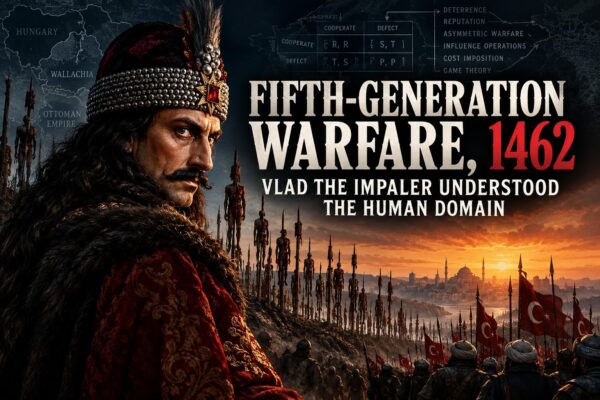
Editor’s Note: This article is written in parallel to retired Army Lieutenant Colonel Dave Cloft’s detailed series on 5th Generation Warfare as applied to today’s hyper-rapid-communications environment. It really does demonstrate the old adage that there is nothing new under the sun.
Ed.
History remembers Vlad III of Wallachia as Vlad the Impaler, which is admittedly a terrible name if you are trying to get invited to neighborhood barbecues.
He was also Dracula.
Not the cape-wearing Transylvanian fellow with the questionable dental plan. The real Dracula. Vlad III, son of Vlad II Dracul, a 15th-century Wallachian prince who fought the Ottoman Empire and developed a reputation for putting his enemies on very large sticks.
For centuries, we have largely filed Vlad under “medieval psychopath.”
But what if we assume something different?
What if Vlad was a rational actor?
Put down the psychology textbook and pick up the game theory book. Suddenly Vlad starts looking less like a lunatic and more like an extraordinarily ruthless practitioner of asymmetric warfare.
Welcome to fifth-generation warfare, circa 1462AD.
Vlad had a math problem.
Wallachia—roughly part of modern Romania—wasn’t exactly a superpower. Immediately south sat the Ottoman Empire under Sultan Mehmed II, who had conquered Constantinople and the Byzantines in 1453.
The Byzantines were the surviving eastern half of the Roman Empire—Romans (Christians) in their own eyes—so when Constantinople fell to the Ottomans in 1453, it ended an imperial tradition stretching back more than a thousand years to ancient Rome.
That should get your attention.
If the guy next door just captured Constantinople, you probably don’t defeat him by announcing a five-year modernization plan for the Wallachian Army.
Vlad couldn’t outspend Mehmed.
He couldn’t out-recruit him.
He couldn’t field a comparable army.
And he couldn’t count completely on his own political class because Wallachian nobles—the boyars—had the charming medieval habit of changing allegiance whenever doing so appeared beneficial.
Vlad therefore faced the same basic problem weak powers have faced throughout history:
How does the little guy make the big guy afraid of him?
The answer was information.
Specifically, horrifying information.
Today we’d call much of this psychological operations, information warfare, deterrence, influence operations and perhaps components of what people now describe as fifth-generation warfare.
Vlad called it Tuesday.
His signature method was impalement. And while some contemporary accounts undoubtedly exaggerated the numbers—particularly hostile German stories—the underlying practice wasn’t propaganda. Vlad really did impale people.
A lot of them.
The important question isn’t whether this was barbaric. Of course it was.
The interesting question is:
Why?
Consider the payoff matrix.
Suppose you’re an Ottoman (muslim) soldier invading Wallachia.
Normal medieval warfare isn’t exactly Club Med. You might be killed, wounded, captured or ransomed.
But now intelligence arrives concerning this particular Romanian prince.
Capture apparently involves a wooden pole inserted somewhere remarkably unpleasant.
Your expected cost of invading Wallachia just changed.
That’s game theory.
Vlad couldn’t necessarily increase the probability of defeating every Ottoman soldier.
But he could dramatically increase the perceived cost of losing to him.
That distinction matters.
In 1462 Mehmed invaded Wallachia. Vlad responded with tactics we would immediately recognize today: scorched earth, denial of supplies, harassment, ambushes, psychological operations and a spectacular nighttime attack against the Ottoman camp.
Vlad reportedly intended to kill Mehmed himself.
Again, assume rationality.
Why fight thousands of Ottoman soldiers when killing one particular Ottoman might disrupt the entire campaign?
That’s asymmetric warfare.
But Vlad’s masterpiece of psychological warfare was waiting near Târgoviște.
Ottoman troops encountered what became known as the Forest of the Impaled—a horrifying display of corpses placed where the invading army would see them.
Imagine marching hundreds of miles through hostile territory and discovering that.
No PowerPoint presentation required.
The message was perfectly clear:
Welcome to Wallachia. Your risk assessment may require updating.
That’s where the fifth-generation warfare analogy gets interesting.
Modern warfare increasingly recognizes that the decisive battlefield isn’t necessarily terrain.
It’s the human mind.
You don’t always have to destroy an enemy army.
Sometimes you need to convince the enemy soldier that fighting isn’t worth it.
Convince his commander that continuing the campaign costs too much.
Convince political leaders that victory will be ugly.
Convince allies that supporting the campaign carries unacceptable consequences.
Change perceptions and you can sometimes change behavior without destroying the opponent.
Vlad understood that 500 years before anybody invented the phrase “information operations.”
And his audience wasn’t merely Ottoman.
Vlad had another problem:
His own nobles.
Wallachian politics was essentially Game of Thrones without dragons and with considerably worse workplace safety regulations.
Princes were replaced. Rivals appeared. Nobles defected. Assassinations happened.
Vlad needed loyalty.
So consider another payoff matrix.
Remain loyal to Vlad: You probably keep your land, wealth and pulse.
Betray Vlad:Yo u may become municipal landscaping.
Suddenly cooperation looks very attractive.
And here’s where repeated-game theory becomes important.
A threat only works if people believe you’ll carry it out.
If Dad says, “Turn that Nintendo off or you’re grounded,” and Junior knows Dad has made that threat 37 times without actually grounding anyone, the threat has zero strategic value.
Vlad did not suffer from this credibility problem.
Once Vlad established that betrayal could produce spectacular consequences, his reputation began doing work for him.
That’s deterrence.
Nuclear weapons operate on a vastly different moral and technological scale, but the strategic concept is recognizable: the purpose of a credible threat is often not actually carrying it out.
It’s changing somebody else’s decision before they act.
This doesn’t make Vlad a good man.
Game theory doesn’t tell us what’s moral.
It tells us how actors behave when choices, incentives, information and consequences interact.
And that distinction matters.
Vlad’s strategy was monstrously cruel. Innocent people undoubtedly suffered. Terror can create resistance as easily as obedience, and brutality can generate enemies faster than it eliminates them.
But dismissing Vlad as simply insane prevents us from learning anything from him.
Assume rationality instead.
Now we see a ruler trapped between larger powers, surrounded by questionable allies, commanding limited resources and facing an empire he couldn’t possibly defeat conventionally.
So Vlad found another battlefield.
Human perception.
He weaponized reputation.
He manipulated incentives.
He imposed disproportionate costs.
He made threats credible.
He targeted leadership.
He turned stories about himself into strategic weapons.
And he attempted to make cooperation cheaper than defection.
That’s game theory.
That’s asymmetric warfare.
And viewed through our modern vocabulary, there’s a strong family resemblance to fifth-generation warfare.
The weapons have changed.
The mathematics hasn’t.
Five hundred years later, governments still spend billions trying to accomplish essentially what Vlad accomplished with some timber, carefully cultivated rumors and absolutely horrifying public relations.
Because sometimes the most powerful weapon isn’t the army you actually possess.
It’s the army your enemy believes he’s about to face.
Vlad understood that.
And unfortunately for several thousand people in 15th-century Wallachia, he was exceptionally committed to maintaining the brand.
If you enjoyed this article, then please REPOST or SHARE with others; encourage them to follow AFNN. If you’d like to become a citizen contributor for AFNN, contact us at managingeditor@afnn.us Help keep us ad-free by donating here.
Substack: American Free News Network Substack
Truth Social: @AFNN_USA
Facebook: https://m.facebook.com/afnnusa
Telegram: https://t.me/joinchat/2_-GAzcXmIRjODNh
Twitter: https://twitter.com/AfnnUsa
GETTR: https://gettr.com/user/AFNN_USA
CloutHub: @AFNN_USA