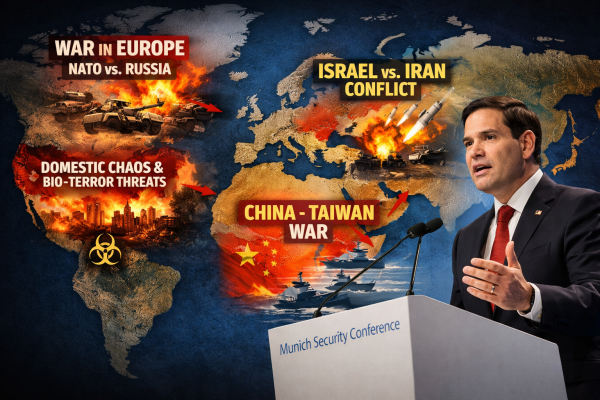
At the Munich Security Conference, Secretary of State Marco Rubio did something unusual in modern diplomacy: he told the truth politely.
He reaffirmed America’s commitment to Europe, praised NATO, spoke warmly about shared history and civilization—and then, in effect, slid a note across the table that read: You’re going to have to handle more of your own business.
This wasn’t abandonment. It was triage.
Because the United States is staring down a reality no speechwriter can spin away: a world where four fires can ignite at once, and the American fire department only has so many trucks.
The math is unforgiving. NATO versus Russia in Europe. Israel versus Iran in the Middle East. China versus Taiwan in the Indo-Pacific. And at the same time, civil unrest, infrastructure sabotage, and bio-agricultural or terror shocks at home. That’s not “overseas commitments.” That’s system overload.
For decades, U.S. strategy quietly assumed a ceiling. Two major regional wars at once—max. Even then, that assumption relied on friendly timing, full magazines, functioning alliances, and a domestic population that wasn’t simultaneously tearing itself apart on social media. Today, that ceiling hasn’t gone up. If anything, it’s lower.
Which brings us back to Rubio’s speech.
When Rubio tells European allies that the transatlantic relationship is permanent but Europe must become stronger, he’s not delivering a think-tank cliché. He’s acknowledging that the United States cannot fight Russia, deter China, contain Iran, and stabilize its own homeland at the same time without someone else carrying real weight.
NATO has to stop being the world’s most expensive insurance policy that only one customer pays into.
The uncomfortable truth is this: if NATO cannot hold Russia largely on its own—with U.S. support, intelligence, and strategic backing, but not U.S. primacy—then the entire alliance model collapses under four-front pressure. Europe doesn’t need America less; it needs America not everywhere at once.
Because the four-war problem isn’t about losing battles. It’s about dilution.
A Patriot missile can’t defend Warsaw, Tel Aviv, Taipei, and Kansas City simultaneously. A carrier strike group can’t be in the Baltic, the Red Sea, and the South China Sea on the same day. A National Guard unit can’t restore order at home and secure ports overseas at the same time. Every additional crisis forces Washington to downgrade something from “win” to “manage” to “hope it doesn’t get worse.”
That’s exactly how great powers lose influence without ever being defeated outright.
China understands this perfectly. It doesn’t need the U.S. to lose NATO. It just needs NATO to require constant American babysitting. It doesn’t need America to abandon Taiwan. It just needs America to hesitate because Europe is screaming, the Middle East is on fire, and the homeland is unstable.
This is why Rubio’s message matters. By telling Europe—politely, diplomatically, and with historical reverence—that it must be more capable and self-sufficient, U.S. policy is quietly preparing for the possibility that all four fires ignite at once.
Europe as a net security consumer is a luxury America can no longer afford.
That doesn’t mean Europe fights alone. It means Europe fights first, hardest, and longest on its own continent. It means European industry ramps production. European air defenses expand. European logistics and manpower fill the gap so U.S. forces aren’t immediately drained by a continental war that should, frankly, be existential for Europe itself.
Because if Europe can anchor the Russia problem, the United States can do what only it can do elsewhere.
The Indo-Pacific is a naval and air war at scale. Taiwan is not just a democracy; it’s the center of global advanced manufacturing. Lose that, and every Western economy feels it. The Middle East remains a volatility generator that can spike energy markets and missile inventories overnight. And the homeland—ignored for too long as a “rear area”—is now a battlespace where social cohesion, food security, and infrastructure matter as much as brigades.
Rubio didn’t say all this outright. Diplomats rarely do. But the subtext was unmistakable: We are aligning for a world where America cannot be the default solution to every problem simultaneously.
NATO self-sufficiency isn’t a betrayal of the alliance. It’s the only way the alliance survives a four-front shock.
Because the alternative is grim. An America pulled in every direction, allies hedging, adversaries probing, stockpiles shrinking, decisions slowing. A superpower still strong—but exhausted. Still armed—but reactive. Still influential—but no longer decisive.
Four fires don’t have to burn America down. But only if the people closest to one of them pick up a hose.
And that, politely but firmly, is what Rubio was really saying in Munich.
If you enjoyed this article, then please REPOST or SHARE with others; encourage them to follow AFNN. If you’d like to become a citizen contributor for AFNN, contact us at managingeditor@afnn.us Help keep us ad-free by donating here.
Substack: American Free News Network Substack
Truth Social: @AFNN_USA
Facebook: https://m.facebook.com/afnnusa
Telegram: https://t.me/joinchat/2_-GAzcXmIRjODNh
Twitter: https://twitter.com/AfnnUsa
GETTR: https://gettr.com/user/AFNN_USA
CloutHub: @AFNN_USA
Worth noting that as NATO’s first commander, Ike himself said that if American boots were still on the ground in Europe ten years later that meant NATO had failed.