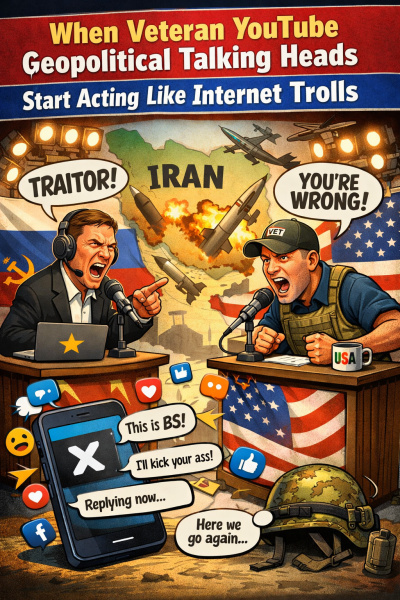
The modern battlefield isn’t always a desert or a mountain range. Sometimes it’s a comment thread.
Recently a rather entertaining clash broke out on X involving Chuck Holton and Scott Ritter. The topic was Iran, American policy in the Middle East, and the usual assortment of geopolitical hot takes that now fill podcasts and social media feeds.
I didn’t watch the whole exchange unfold live. What caught my attention was Holton’s response after Ritter fired off the sort of comment you’d expect from a keyboard warrior: “You better hope I never meet you in public.”
That’s not exactly the tone most Americans expect from someone presenting themselves as a serious strategic thinker.
Now let’s be clear about something. Veterans arguing about foreign policy is not the problem. In fact, it’s healthy. People who have worn the uniform should absolutely debate how American power is used. The military has always produced strong opinions—usually accompanied by horrible coffee and worse briefing slides.
But what used to separate professional disagreement from internet drama was something the officer corps once valued deeply: discipline.
When someone accepts a commission in the United States military, they swear an oath to the United States Constitution. Not to a party. Not to a president. Not to whatever narrative is trending that week. The oath protects the right to criticize American policy, even harshly.
What it used to discourage was turning geopolitical debate into a public ego contest.
Ritter has built a large online following by explaining why Western governments are incompetent, Western media is lying, and Russia is strategically outplaying NATO at every turn. Those arguments often appear on platforms happy to amplify them—including Russian state media outlets.
Now, appearing on foreign media is not automatically treason. Let’s keep the temperature reasonable.
But it’s also not surprising that some veterans raise an eyebrow when an American commentator frequently appears on adversarial media platforms explaining how misguided American policy supposedly is.
That’s where Holton’s frustration seems to come from.
Holton’s background is straightforward: former Army Ranger, now a war correspondent who has spent plenty of time around conflict zones. He’s blunt, sometimes abrasive, and not particularly interested in academic geopolitical theory. His worldview is shaped by the very old-fashioned idea that when hostile regimes threaten American interests, the United States should probably push back.
Ritter, on the other hand, delivers his commentary with the confidence of a man who believes he alone understands the entire geopolitical chessboard while the rest of the West stumbles around in ignorance.
Humility is not exactly the brand.
Anyone who has listened to his commentary knows the tone: rarely calm, totally authoritative, and absolutely certain. Everyone else—from NATO generals to intelligence agencies—is apparently too uninformed to grasp the strategic reality that Ritter sees so clearly.
Confidence can be useful. But when the argument ends with playground threats on social media, the performance starts to look less like strategic insight and more like a podcast personality protecting his brand.
The larger issue here isn’t really about Ritter or Holton individually. It’s about the strange media ecosystem that now surrounds geopolitical commentary. Social media rewards certainty. Podcasts reward outrage. The louder and more dramatic the claim, the bigger the audience. And suddenly debates about war and strategy look like cable news shouting matches.
Watching veterans argue online isn’t new. Watching them threaten each other like teenagers on a gaming forum, however, is something the profession of arms used to avoid. Because once the discussion reaches that point, the real casualty isn’t anyone’s argument. It’s the professionalism that used to define the people having it. Do better Gentlemen.
If you enjoyed this article, then please REPOST or SHARE with others; encourage them to follow AFNN. If you’d like to become a citizen contributor for AFNN, contact us at managingeditor@afnn.us Help keep us ad-free by donating here.
Substack: American Free News Network Substack
Truth Social: @AFNN_USA
Facebook: https://m.facebook.com/afnnusa
Telegram: https://t.me/joinchat/2_-GAzcXmIRjODNh
Twitter: https://twitter.com/AfnnUsa
GETTR: https://gettr.com/user/AFNN_USA
CloutHub: @AFNN_USA