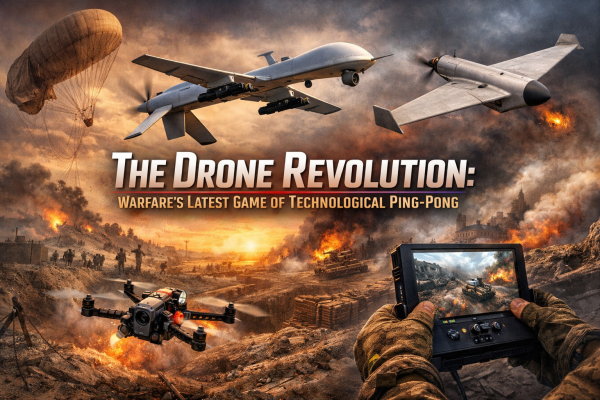
Drone warfare didn’t suddenly appear in Ukraine. Like most military revolutions, it crept in quietly, evolved through trial and error, and then suddenly exploded onto the battlefield when the technology, the cost curve, and the tactical need all aligned.
The basic idea of unmanned warfare actually dates back more than a century. During World War I, armies experimented with remotely controlled aircraft and explosive “aerial torpedoes.” They were crude and unreliable, but the concept was already there: send a machine instead of a pilot into harm’s way. Through the Cold War the idea matured into reconnaissance drones used primarily for surveillance. The United States began using early UAVs over Vietnam and later refined the concept in the 1990s and early 2000s.
The real turning point came with the rise of armed drones like the MQ-1 Predator and MQ-9 Reaper. For the first time, a pilot sitting in Nevada could watch insurgents halfway around the world and launch a missile without ever leaving a chair. The United States dominated this era of drone warfare. Precision strikes against terrorist leaders became almost routine during the wars in Iraq and Afghanistan. Drones were expensive, technologically sophisticated aircraft controlled by satellite links and packed with sensors.
Then the technology began spreading.
In 2011 Iran famously captured a RQ-170 Sentinel stealth reconnaissance drone that had strayed over its territory. Whether it was hacked, spoofed, or simply malfunctioned is still debated. What is not debated is what happened afterward. Iran displayed the aircraft publicly and soon unveiled its own versions based on the captured design. This is the first example of the modern “drone ping-pong” cycle. One country develops something advanced. Another captures it, copies it, modifies it, and sends it back into the field.
But the real revolution didn’t come from copying expensive American drones. It came from realizing you didn’t need them.
Iran and other countries began building extremely simple “loitering munitions,” essentially disposable drones designed to crash into their targets. The most famous example is the Shahed-136. It’s not stealthy. It doesn’t carry fancy sensors. In fact, it’s basically a small engine, a GPS system, a warhead, and a propeller bolted onto a triangular wing. The reason it matters is cost. A Shahed drone might cost tens of thousands of dollars. The missiles used to shoot it down often cost hundreds of thousands or even millions.
This cost imbalance has become one of the defining features of modern warfare.
Ukraine turned this idea into a laboratory. What started as reconnaissance drones quickly evolved into something entirely new. Soldiers on both sides now fly small first-person-view (FPV) drones straight into tanks, artillery positions, and trenches. Many of these drones are built from commercial racing-drone parts that cost a few hundred dollars. A weapon that once required a missile system costing hundreds of thousands can now be delivered by a soldier holding what looks like a video-game controller.
The battlefield has changed accordingly. Tanks that once dominated maneuver warfare now hide under improvised cages or layers of mesh designed to stop incoming drones. Infantry units move under camouflage nets to avoid aerial detection. Electronic warfare units jam control signals while drone operators hunt for targets from a few kilometers away. In some sectors of Ukraine the sky is so saturated with drones that soldiers describe it as a permanent swarm.
The same technology is now shaping conflicts across the Middle East. Iran and its allied groups have used drones extensively against shipping, military bases, and infrastructure. Cheap drones allow smaller powers to threaten much larger militaries. A nation that cannot afford fleets of advanced aircraft can still build hundreds or thousands of expendable unmanned weapons.
What makes this a true revolution in military affairs is the economics. Traditional military technology usually follows an expensive path. Tanks cost millions. Fighter jets cost tens of millions. Advanced missiles cost even more. Drones flip that equation upside down. A $500 drone can destroy a $5 million vehicle. A swarm of cheap drones can overwhelm air defenses designed to stop a handful of high-end missiles.
And this is where the technological ping-pong begins again.
Once drones became common, armies immediately began developing counters. Electronic jammers disrupt control signals. Shotguns and machine guns are being reintroduced as anti-drone weapons. Laser systems and microwave weapons are under development to shoot down large numbers of drones cheaply. In response, drone developers are experimenting with autonomous navigation that doesn’t rely on GPS or radio signals. Artificial intelligence is beginning to allow drones to recognize and track targets on their own.
Action. Reaction. Counteraction.
This cycle is as old as warfare itself. Armor leads to armor-piercing weapons. Radar leads to stealth. Submarines lead to sonar and depth charges. Every new weapon creates the next countermeasure. Drone warfare is simply the latest turn of that wheel.
What makes it feel revolutionary today is how quickly the cycle is happening. In Ukraine a new tactic might appear on the battlefield and be countered within months. A drone modification built in a garage workshop can spread across entire units within weeks. The speed of innovation has accelerated dramatically because the technology itself is relatively simple and widely available.
In the end, drones are not replacing traditional weapons entirely. Artillery, missiles, and aircraft still matter enormously. But drones have added a new layer to warfare that sits somewhere between infantry and airpower. They provide cheap surveillance, precision strikes, and constant pressure on enemy forces.
For a few hundred dollars and a backpack full of batteries, a soldier can now wield a capability that once required an entire air force. And once that reality appeared on the battlefield, there was no going back.
If you enjoyed this article, then please REPOST or SHARE with others; encourage them to follow AFNN. If you’d like to become a citizen contributor for AFNN, contact us at managingeditor@afnn.us Help keep us ad-free by donating here.
Substack: American Free News Network Substack
Truth Social: @AFNN_USA
Facebook: https://m.facebook.com/afnnusa
Telegram: https://t.me/joinchat/2_-GAzcXmIRjODNh
Twitter: https://twitter.com/AfnnUsa
GETTR: https://gettr.com/user/AFNN_USA
CloutHub: @AFNN_USA