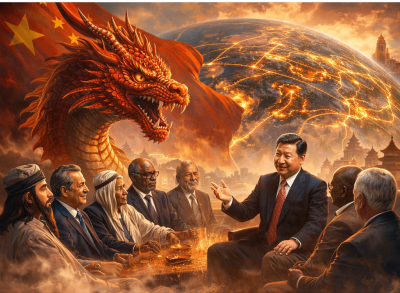
There’s a lazy Western talking point that goes something like this: “China thinks it’s genetically superior.”
That’s not quite right—and misunderstanding it is how you lose.
China’s elite worldview isn’t built on crude racial hierarchy like 20th-century Europe. It’s older, subtler, and in many ways more dangerous. It doesn’t scream superiority. It assumes it.
At the root of it all is a simple idea: China is not just a country. It’s the center of civilization.
The Chinese word for China—Zhongguo—literally means Middle Kingdom. Not metaphorically. Not aspirationally. Matter-of-factly. The center. The reference point. The standard by which order is measured.
This isn’t modern propaganda. This goes back to the Han Dynasty, when China wasn’t just consolidating territory—it was defining identity. The Han period gave birth to what is now the dominant ethnic identity: the Han people. But more importantly, it fused culture, governance, and legitimacy into a single idea: to be Chinese is to be civilized.
Everyone else? Not so much.
Ancient Chinese texts didn’t talk about “equal civilizations.” They talked about order versus chaos. Inside the system: refinement, hierarchy, literacy, philosophy. Outside the system: barbarians. Not necessarily inferior by blood—but inferior by culture, behavior, and alignment with what they believed was the natural order of the world.
And here’s the key: in that system, superiority wasn’t claimed—it was demonstrated through structure. Through bureaucracy. Through stability. Through continuity.
That mindset didn’t disappear. It evolved.
Fast forward to today, and the Chinese Communist Party has taken that ancient civilizational confidence and welded it to modern nationalism and state power. They don’t talk about “genetic superiority.” That would be sloppy. Amateur hour.
Instead, they talk about rejuvenation.
The phrase you’ll hear over and over again is the “great rejuvenation of the Chinese nation.” That’s not just a slogan. It’s a mission statement. It implies something very specific: China was always meant to lead—it just had a temporary setback.
In their narrative, the last 150 years—the Opium Wars, Western colonial pressure, internal collapse—weren’t the natural course of history. They were an anomaly. A disruption. A humiliation.
And now?
History is correcting itself.
This is where Western analysts get it wrong. They keep trying to interpret China through a Western lens—assuming China wants to “win” in the same way the U.S. or Europe defines winning. Faster growth. Bigger military. More alliances.
That’s not the game.
China doesn’t need to win the argument. It just needs to outlast it.
Because if you believe your civilization is 5,000 years old, you don’t panic over a bad decade. You don’t chase quarterly returns. You don’t need immediate dominance. You play the long game—generational, not electoral.
That’s why Beijing can say one thing publicly—“peace, stability, cooperation”—while quietly positioning itself to control supply chains, dominate infrastructure, and shape regional order.
It’s not hypocrisy. It’s strategy rooted in worldview.
And that worldview carries a quiet assumption: our system works better over time.
Not because of DNA. Because of discipline. Continuity. Central control. Cultural cohesion.
Now layer in the Han majority identity, and things get sharper.
China officially recognizes dozens of ethnic groups, but make no mistake—the gravitational center is Han. And the state’s long-term project is not diversity for diversity’s sake. It’s integration under a unified civilizational identity.
They call it “Sinicization.” Which sounds academic until you realize what it means: align with the core—or be reshaped until you do.
Again, not racial supremacy in the explicit sense. But absolutely a belief that there is a correct cultural template—and it happens to look a lot like the historical Chinese core.
Now bring this into geopolitics.
Taiwan? Not just territory. It’s unfinished history. A loose end in the story of national restoration.
The South China Sea? Not just shipping lanes. It’s a reassertion of regional centrality.
The Belt and Road Initiative? Not charity. Not development. It’s infrastructure that quietly redraws the map of influence—roads, ports, rails that all point back to Beijing.
And the West?
From Beijing’s vantage point, the West looks… tired.
Divided politics. Cultural fragmentation. Short-term thinking. Internal arguments about identity, history, and legitimacy.
If you’re sitting in Beijing with a 50-year timeline, you don’t need to defeat that. You just need to let it run.
Because here’s the uncomfortable truth:
Every great power believes, at some level, that it is exceptional.
America says it’s the defender of freedom.
Europe says it’s the guardian of enlightenment.
China says it is the continuation of civilization itself.
Different language. Same instinct.
But China’s version comes with two advantages: it’s older—and it’s more patient.
So no, the Chinese elite aren’t standing around talking about genetic superiority in some cartoonish way.
They don’t need to.
They’ve built a system—and a worldview—where superiority is assumed, history is on their side, and time is their greatest weapon.
And if you’re playing against that mindset with a four-year election cycle and a Twitter attention span, you’re not in the same game.
You’re just on the same board.
If you enjoyed this article, then please REPOST or SHARE with others; encourage them to follow AFNN. If you’d like to become a citizen contributor for AFNN, contact us at managingeditor@afnn.us Help keep us ad-free by donating here.
Substack: American Free News Network Substack
Truth Social: @AFNN_USA
Facebook: https://m.facebook.com/afnnusa
Telegram: https://t.me/joinchat/2_-GAzcXmIRjODNh
Twitter: https://twitter.com/AfnnUsa
GETTR: https://gettr.com/user/AFNN_USA
CloutHub: @AFNN_USA