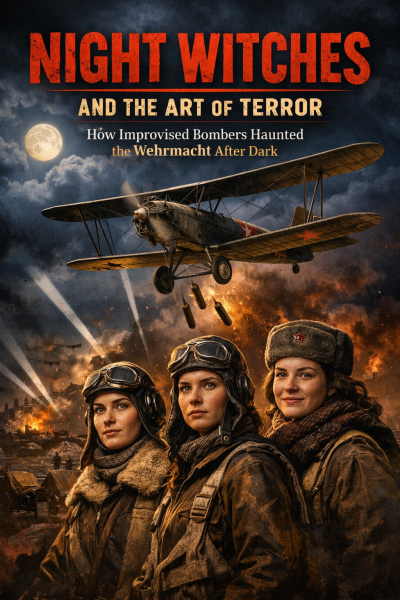
War has a way of stripping theory down to bare necessity. When nations are comfortable, they debate doctrine, write white papers, and argue about what “should” work. When nations are desperate, they use whatever they have, however it works, right now. That is how the 588th Night Bomber Regiment came into existence—not as a social experiment, not as a symbolic gesture, but as an act of national survival.
In 1941, the Soviet Union was being dismantled at industrial speed. Entire armies vanished. Cities fell. Aircraft factories were evacuated east while German armor drove forward. There was no time for elegance. The Red Army needed pilots, aircraft, and pressure on the enemy—immediately. So they did something profoundly unromantic and brutally practical: they took civilians who could fly and turned them into combat airmen.
Many of the women who became the Night Witches had been flying before the war. Civilian aero clubs were common in the Soviet Union, and flight was encouraged as a national skill. These weren’t cosplayers handed wings for morale photos. They were trained aviators, suddenly handed bombs instead of mailbags. Under the leadership of Marina Raskova, they were organized, uniformed, and sent to the front.
Their aircraft was the Polikarpov Po-2, which deserves special mention because it may be the least intimidating combat aircraft ever to terrify a modern army. Built of wood and fabric, slow enough to be outrun by some farm equipment, and equipped with little more than a compass and stubbornness, the Po-2 was not supposed to survive combat. That turned out to be its greatest strength.
The mission assigned to the regiment was night harassment bombing. This was not about destruction; it was about erosion. The goal was to deny German forces something every soldier needs more than ammunition: sleep. Night after night, the Po-2s would appear over German positions, often flying just above treetop level. At the last moment, the pilots would cut their engines and glide silently, releasing small bombs before disappearing back into the darkness.
That silence mattered.
German soldiers described the sound as a faint whoosh, like air moving over a broomstick. It was never loud enough to pinpoint. Never predictable enough to ignore. The bombs were small, but the anticipation was enormous. No rest. No certainty. No off-duty hours. Searchlights snapped on and off all night. Anti-aircraft guns fired at shadows. Entire units stayed awake waiting for the next whisper.
Psychologically, this was devastating. Armies can endure danger. They struggle against uncertainty. The Night Witches turned the night itself into an enemy. They forced the Germans to spend time, fuel, ammunition, and attention on an aircraft that cost almost nothing to operate. A single crew might fly multiple sorties in a single night, returning to refuel and rearm in primitive fields, then heading back out again.
The numbers tell the story. By the end of the war, the regiment had flown roughly 23,000 sorties. That is not a stunt. That is persistence weaponized. Each individual mission might have been minor, but together they created a constant, grinding pressure on German rear areas. Officers complained. Troops cursed. Morale eroded. The nickname “Night Witches” was not admiration—it was fear mixed with exhaustion.
This is the part modern audiences often miss. The Night Witches were not trying to win battles in the cinematic sense. They were trying to make the enemy miserable, distracted, and tired at scale. It was warfare by irritation, perfected through repetition. And it worked precisely because it was unconventional.
Desperate times reward asymmetric thinking. The Soviets didn’t wait to build perfect aircraft or ideal forces. They repurposed what existed. Civilian pilots became military crews. Trainers became bombers. Night became a weapon. The Night Witches are a textbook example of how nations under existential threat blur the line between civilian and soldier—not out of ideology, but necessity.
That is why the regiment still matters historically. Not as a debate point, but as a reminder. When survival is on the line, war stops caring about prestige and starts caring about results. The Night Witches delivered results not by overpowering the enemy, but by haunting him—one sleepless night at a time.
In the end, their legacy is not about who flew the planes. It’s about how desperation breeds innovation, how unconventional tactics can punch far above their weight, and how fear—quiet, persistent fear—can be just as effective as firepower.
If you enjoyed this article, then please REPOST or SHARE with others; encourage them to follow AFNN. If you’d like to become a citizen contributor for AFNN, contact us at managingeditor@afnn.us Help keep us ad-free by donating here.
Substack: American Free News Network Substack
Truth Social: @AFNN_USA
Facebook: https://m.facebook.com/afnnusa
Telegram: https://t.me/joinchat/2_-GAzcXmIRjODNh
Twitter: https://twitter.com/AfnnUsa
GETTR: https://gettr.com/user/AFNN_USA
CloutHub: @AFNN_USA