There’s a lie we like to tell ourselves somewhere between a full fridge and a stable Wi-Fi signal: once things get good enough, we’ll finally calm down. No more chaos. No more fighting. No more drama. Just peace, progress, and maybe a backyard smoker that never runs out of propane.
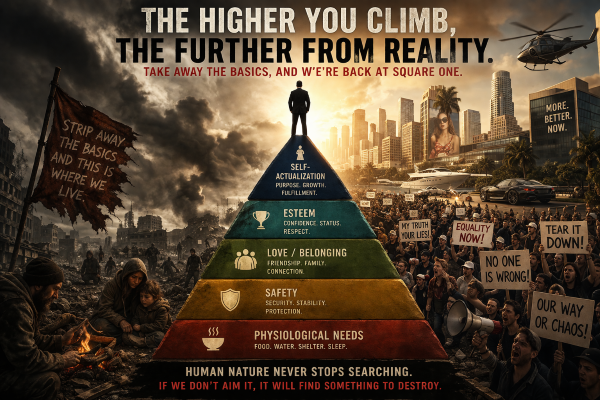
That fantasy dies the second you look at Maslow’s hierarchy of needs with even a hint of honesty.
Maslow didn’t build a staircase to enlightenment. He built a diagnostic chart for human restlessness.
At the bottom, it’s simple: food, water, shelter. Miss any of those and all the higher-level conversations—purpose, identity, self-expression—get bulldozed instantly. You’re not debating philosophy when your stomach’s empty. You’re hunting calories. Civilization collapses real quick when the grocery store shelves go bare. We’ve seen enough “unexpected supply chain disruptions” to know how thin the veneer really is.
But here’s where it gets interesting—and dangerous.
Once those base needs are met, humans don’t relax. They redirect. The hunger doesn’t disappear; it mutates. Survival turns into security. Security turns into status. Status turns into meaning. And meaning? That’s where things go sideways.
Because meaning is subjective. And subjective things are where humans love to fight.
You don’t see riots over oxygen. You see them over identity, fairness, ideology—things that only matter once oxygen is already handled. In other words, the more comfortable we get, the more abstract—and volatile—our conflicts become.
That’s not a glitch. That’s the operating system.
Humans are wired to detect problems and fix them. It’s why we survived long enough to build cities instead of becoming fossils. The problem is, once the real threats are handled, the brain doesn’t shut off. It starts scanning for the next thing to fix, improve, or control. And if it can’t find a real problem? It manufactures one.
That’s how you go from “don’t get eaten” to “I must reshape society in my image.”
Cue the ancient warning label humanity keeps ignoring, dating all the way back to Book of Genesis: the moment we think we can define reality on our own terms, things tend to unravel. Not immediately—never immediately—but predictably.
Comfort breeds the illusion of control. And control, unchecked, breeds arrogance.
We start to believe we’re not just participants in reality—we’re the authors. Little architects of a better world. Tiny gods with big plans. And to be fair, sometimes that impulse builds incredible things: medicine, infrastructure, technology, systems that extend and improve life.
But that same impulse, left unanchored, also tears things apart.
Because what one person calls “improvement,” another calls destruction. What one group sees as justice, another sees as chaos. And suddenly, the battlefield isn’t about survival—it’s about competing visions of what the world should be.
And those fights don’t end cleanly.
Here’s the hard truth: humans are not designed for static satisfaction. We’re built for pursuit. If you remove all struggle, we don’t become peaceful—we become restless. And restless humans are creative in all the wrong ways.
Take away the bottom layers—food, safety, stability—and we revert instantly. Strip the system down and watch how fast priorities reset. The guy arguing about abstract morality yesterday is now figuring out how to keep his family warm. No debate. No ideology. Just survival.
But leave those needs comfortably met for too long without discipline, purpose, or grounding? That’s when we drift into self-created chaos. Not because we’re evil, but because we’re unfinished.
So no, the problem isn’t that humans “look for problems” out of boredom. The problem is that we can’t stop searching. It’s baked in. It’s the same instinct that builds rifles tighter, engines faster, systems more efficient. It’s also the instinct that turns neighbors into enemies over ideas neither can fully prove.
Same engine. Different targets.
The difference between progress and chaos isn’t the drive—it’s the direction.
And here’s the part nobody likes: take away the comforts long enough, and all the high-level nonsense evaporates. Instantly. We don’t evolve past our base nature—we just layer over it. Civilization isn’t a transformation. It’s a buffer.
Remove the buffer, and you’re back at square one, faster than anyone wants to admit.
So the next time someone claims we’ve outgrown our primitive tendencies, remind them: we didn’t outgrow anything. We just got comfortable enough to pretend we did.
And comfort has a funny way of expiring right when you start believing it’s permanent.
If you enjoyed this article, then please REPOST or SHARE with others; encourage them to follow AFNN. If you’d like to become a citizen contributor for AFNN, contact us at managingeditor@afnn.us Help keep us ad-free by donating here.
Substack: American Free News Network Substack
Truth Social: @AFNN_USA
Facebook: https://m.facebook.com/afnnusa
Telegram: https://t.me/joinchat/2_-GAzcXmIRjODNh
Twitter: https://twitter.com/AfnnUsa
GETTR: https://gettr.com/user/AFNN_USA
CloutHub: @AFNN_USA