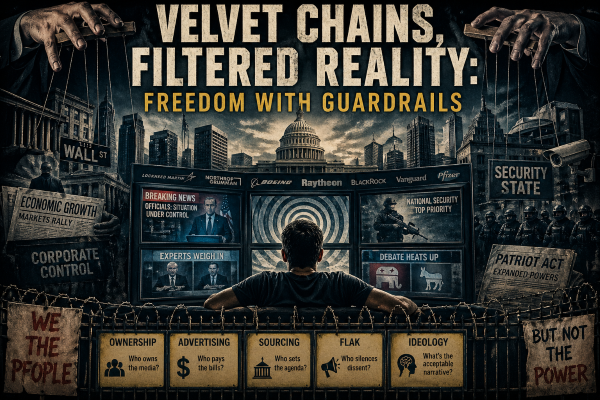
Welcome to the velvet cage—clean lines, good lighting, constitutional rights framed like family photos. You can speak, vote, organize, and post hot takes until your thumbs cramp. Just don’t expect to move the big levers. That’s the modern deal: maximum formal freedom, minimum substantive control. You’re free—right up to the point where it would matter.
Start with the polite fiction. Elections still happen. Parties still act like it’s a steel-cage match. But on the fundamentals—the wiring of the economy, the growth of the administrative state, the handshake between government and corporate power—the menu is pre-selected. You’re not choosing dinner; you’re choosing the garnish. The work of Martin Gilens and Benjamin Page (2014) didn’t need conspiracy theories to make the point: policy outcomes tend to track the preferences of economic elites (rich dudes) far more than average voters. Translation: your vote counts; your leverage doesn’t.
This isn’t a secret cabal so much as a system that matured into itself. C. Wright Mills sketched the blueprint in The Power Elite (1956). Today it’s less an old white man’s club and more a networked web—political professionals, regulators, corporate stakeholders, and a revolving door that spins like a Vegas wheel. Nobody needs a smoke-filled room when incentives already align. The boundaries of the possible are set long before ballots are printed.
Political parties? Think rival marketing teams selling slightly different packaging. Coke vs. Pepsi… Yes, the differences are real—and loud. We love the non-stop election cycle with competing red and blue television networks. But zoom out and the bandwidth is narrow. Same basic product. Peter Mair called it in Ruling the Void (2013): parties hollow out, becoming less representative and more managerial, competing over tone and coalition while steering inside fixed lanes. Voters feel the whiplash—courted like royalty in October, treated like background noise in February.
Now here’s where the system gets clever: it doesn’t need to silence you. It filters reality before you ever see it. Noam Chomsky and Edward S. Herman laid this out in Manufacturing Consent (1988) with what they called “structural filters.” Ownership, advertising, sourcing, flak, and ideology—five ways the news gets shaped without anyone issuing marching orders.
Quick example. One Eisenhower tried to warn us about when he left office. A major defense contract hits the headlines. Coverage rolls out with Pentagon briefings, contractor statements, and think tank analysis. The debate focuses on cost, capability, and timing. What you don’t see leading the story is a sustained challenge to the entire premise—whether the strategy itself is flawed or whether the incentives driving it are warped. Why? Because reporters rely on those same officials for access (sourcing), media companies are tied into the same economic ecosystem (ownership/advertising), and telling the truth invites institutional backlash (flak). The argument happens—but inside a pre-approved box.
Enter the modern twist: Fifth-generation warfare. In 5GW, the battlefield isn’t land—it’s perception. You don’t defeat an enemy by destroying forces; you shape what populations believe, feel, and decide. And here’s the uncomfortable overlap: Chomsky’s filters are basically the delivery system.
You don’t need to control the media if the system already prefers certain narratives. External actors—state or non-state—just nudge what’s already there. Amplify a frame. Inject a selective leak. Feed the outrage machine. The ecosystem does the rest. Narrative shaping becomes less about brute-force propaganda and more about riding the current.
Layer on crises—the accelerant that never quite burns off. After the September 11 attacks, we expanded surveillance and executive authority in the name of safety. Financial shocks and pandemics added more “temporary” tools. Temporary, of course, has a funny habit of aging into permanent. Giorgio Agamben warned in State of Exception (2005) that emergency powers don’t just fade—they settle in. Your rights remain on paper; the environment around them gets much thicker.
Meanwhile, the algorithmic circus ensures you’ll never be bored. Outrage sells. Nuance doesn’t. Tribes harden, and the middle ground gets paved over. You’re free to say anything, which is perfect, because the system will make sure you mostly hear what keeps the fight going. Divide, scroll, repeat.
None of this means your freedoms are fake. Courts still block excesses. Elections still remove people. Civil society still wins battles. But those wins tend to happen at the margins, inside a field already fenced. You can swap drivers; redesigning the engine is another matter.
Here’s the punchline: the same traits that make modern democracies stable—professionalization, legalism, competent bureaucracy—also make them resistant to course correction. Add concentrated economic influence, structural information filters, and crisis-driven expansions of power, and you get a system that’s legitimate enough to endure and insulated enough to ignore you when it counts.
So no, you’re not just a modern day tax-slave in chains; their velvet-lined. You’re in a well-managed free-range complex with excellent amenities and carefully drawn lines. You can roam, travel, debate, own a gun, and vote within them. But if you should ever try to redraw those lines, you’ll discover the difference between formal freedom and actual power—and why the former has never been easier to advertise than the latter is to exercise.
If you enjoyed this article, then please REPOST or SHARE with others; encourage them to follow AFNN. If you’d like to become a citizen contributor for AFNN, contact us at managingeditor@afnn.us Help keep us ad-free by donating here.
Substack: AmericanFreeNewsNetworkSubstack
TruthSocial:@AFNN_USA
Facebook: https://m.facebook.com/afnnusa
Telegram: https://t.me/joinchat/2_-GAzcXmIRjODNh
Twitter: https://twitter.com/AfnnUsa
GETTR: https://gettr.com/user/AFNN_USA
CloutHub: @AFNN_USA
Selected Bibliography
Giorgio Agamben
Agamben, Giorgio. State of Exception. Chicago: University of Chicago Press, 2005.
Noam Chomsky; Edward S. Herman
Chomsky, Noam, and Edward S. Herman. Manufacturing Consent: The Political Economy of the Mass Media. New York: Pantheon Books, 1988.
Martin Gilens; Benjamin Page
Gilens, Martin, and Benjamin I. Page. “Testing Theories of American Politics: Elites, Interest Groups, and Average Citizens.” Perspectives on Politics 12, no. 3 (2014): 564–581.
C. Wright Mills
Mills, C. Wright. The Power Elite. New York: Oxford University Press, 1956.
Peter Mair
Mair, Peter. Ruling the Void: The Hollowing of Western Democracy. London: Verso, 2013.
Dwight D. Eisenhower
Eisenhower, Dwight D. “Farewell Address.” January 17, 1961.
Sheldon Wolin
Wolin, Sheldon S. Democracy Incorporated: Managed Democracy and the Specter of Inverted Totalitarianism. Princeton: Princeton University Press, 2008.
Robert Nozick
Nozick, Robert. Anarchy, State, and Utopia. New York: Basic Books, 1974.
John Rawls
Rawls, John. A Theory of Justice. Cambridge, MA: Harvard University Press, 1971.
Fifth-generation warfare
Hoffman, Frank G. “Hybrid Warfare and Challenges.” Joint Force Quarterly 52 (2009): 34–39.
Kilcullen, David. The Dragons and the Snakes: How the Rest Learned to Fight the West. Oxford University Press, 2020.