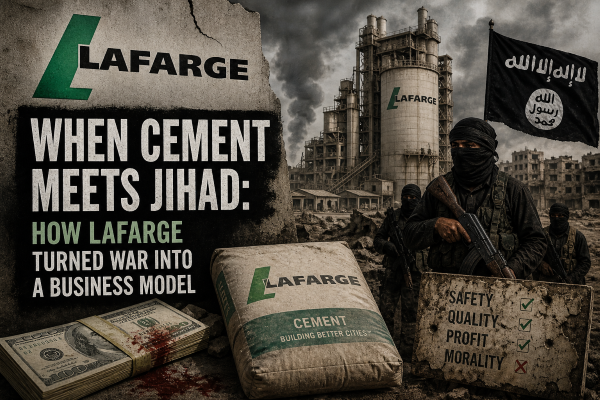
There’s corporate greed, and then there’s whatever the hell Lafarge thought it was doing in Syria. Because “cutting corners” usually means skipping safety briefings or fudging a spreadsheet—not wiring money to jihadists so your cement plant can keep humming while the country around it collapses into a medieval bloodbath.
But that’s exactly what happened.
From roughly 2012 to 2014, as Syrian Civil War turned northern Syria into a live-fire apocalypse, Lafarge made a calculated decision: stay open, stay profitable, and if that meant paying off armed groups—including ISIS and al-Nusra Front—then so be it. Business is business. Even if your business partners occasionally crucify people for sport.
The company didn’t just stumble into this. Courts later described it as an organized system. Money moved. Deals were made. Raw materials, checkpoints, safe passage—all greased with cash. The same way you’d negotiate trucking contracts in Ohio, just with more AK-47s and fewer HR policies.
And for a while, it worked.
The Jalabiya cement plant stayed operational longer than it had any right to. Profits were protected. Executives kept their bonuses. Somewhere in a boardroom, someone probably called it “risk mitigation.”
Fast forward to reality.
In 2022, the United States Department of Justice did something rare: it didn’t slap wrists—it broke fingers. Lafarge pleaded guilty to providing material support to terrorist organizations and paid roughly $778 million in fines. That’s not a parking ticket. That’s a statement.
But the real slow-burn reckoning came out of France, where the legal system took its sweet, espresso-sipping time grinding through years of investigations. Then in April, 2026, the hammer finally dropped. French courts convicted Lafarge of financing terrorism and violating sanctions. Senior executives were sentenced to prison. The company was fined again. The verdict spelled it out clearly: this wasn’t confusion in a war zone—it was a business model.
Let that sink in. A multinational corporation essentially created a shadow supply chain where extremist groups functioned as subcontractors.
And yet, the most disturbing part isn’t even the money.
It’s the people.
Syrian employees were reportedly forced to keep working as the security situation collapsed around them—kidnappings, sniper fire, the kind of daily risk that doesn’t show up in quarterly earnings reports. These weren’t executives dialing in from Paris. These were locals stuck in a kill zone, trying to survive while their employer treated the war like an inconvenient weather pattern.
When the verdict finally came down, those workers got…nothing. No compensation. No meaningful justice. Just a legal acknowledgment that, yes, things were terrible—followed by a collective shrug.
Meanwhile, Lafarge as a corporate entity? Still standing. Still part of Holcim. Still doing business. Because in the global economy, if you’re big enough, even a scandal involving terrorist financing becomes a line item—painful, expensive, but survivable.
And that’s the real story here.
This wasn’t a rogue employee or a misunderstanding. It was a calculated risk decision made by educated professionals in suits who understood exactly who they were dealing with. The assumption wasn’t that it was legal. The assumption was that they could get away with it.
For years, they did.
Until investigators started following the money, and suddenly the same paper trail that kept the plant running became Exhibit A in a courtroom.
Now it’s being framed as a landmark case in corporate accountability. And sure, technically, it is. A major corporation was prosecuted. Executives went to prison. Governments flexed a little muscle.
But don’t confuse that with a systemic fix.
Because the uncomfortable truth is this: the global business environment still rewards operating in unstable regions. The incentives haven’t changed. Access to resources, strategic positioning, cheap labor—all still there. The only variable is how much legal risk you’re willing to absorb.
Lafarge just miscalculated the threshold.
They assumed the chaos of Syria would bury their actions. Instead, it preserved them—like a fossil record of corporate decision-making at its most cynical.
So what’s the takeaway?
Not that corporations will avoid war zones. They won’t.
Not that governments will suddenly regulate morality. They rarely do.
The takeaway is simpler, and darker: if the profit margin is high enough, someone, somewhere, will always be willing to do business with the devil.
Lafarge didn’t invent that reality.
They just got caught writing the checks with blood on their hands.
If you enjoyed this article, then please REPOST or SHARE with others; encourage them to follow AFNN. If you’d like to become a citizen contributor for AFNN, contact us at managingeditor@afnn.us Help keep us ad-free by donating here.
Substack: American Free News Network Substack
Truth Social: @AFNN_USA
Facebook: https://m.facebook.com/afnnusa
Telegram: https://t.me/joinchat/2_-GAzcXmIRjODNh
Twitter: https://twitter.com/AfnnUsa
GETTR: https://gettr.com/user/AFNN_USA
CloutHub: @AFNN_USA