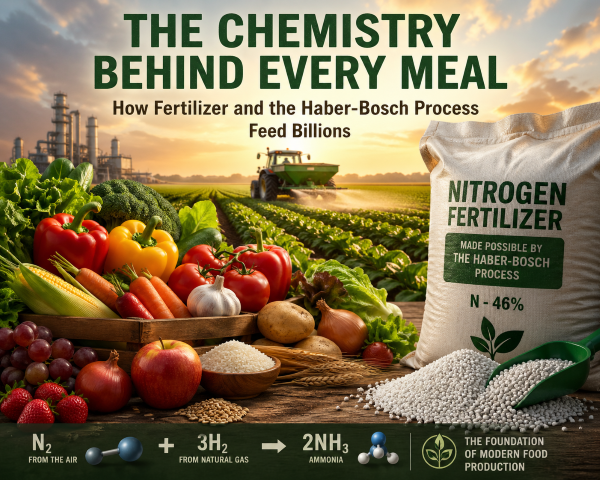
We like to pretend food comes from virtue. Hard work, sunshine, maybe a red barn and a guy in overalls. Reality check: your dinner exists because of industrial chemistry, fossil fuels, and a process that forces atmospheric nitrogen to behave like it’s being interrogated in a back room.
At the center of this quiet miracle—and quiet dependency—is the Haber-Bosch process. It doesn’t get headlines. It doesn’t trend. But it’s arguably one of the most important inventions in human history, because it broke the natural limits on how much food we can produce. Without it, the global population wouldn’t look anything like it does today.
Here’s the problem it solves. Plants need nitrogen to grow. Not optional—essential. Nitrogen is a core component of amino acids, proteins, DNA. No nitrogen, no crops. Simple. The catch? The air is full of nitrogen (about 78%), but it’s locked up as N₂, a molecule with a triple bond so strong it might as well be welded shut. Plants can’t use it. Nature fixes nitrogen slowly through lightning and specialized bacteria. That pace worked fine when the world had a fraction of today’s population. It doesn’t scale to billions.
So humans cheated.
The Haber-Bosch process takes nitrogen from the air and hydrogen—usually stripped from natural gas—and forces them together under conditions that would make a submarine blush: roughly 150–300 atmospheres of pressure and temperatures around 400–500°C, all over an iron-based catalyst. Under those conditions, nitrogen’s stubborn triple bond finally breaks, and it combines with hydrogen to form ammonia: NH₃.
The reaction looks clean on paper:
N₂ + 3H₂ → 2NH₃
In reality, it’s an industrial grind. Massive reactors, constant heat, continuous flow. Ammonia comes out, gets cooled, separated, and then turned into fertilizers like urea, ammonium nitrate, or ammonium sulfate. That’s what gets spread across fields from Iowa to India.
And here’s the uncomfortable truth: a massive portion of global food production depends on that ammonia. Take it away, and yields drop—hard. Not a polite dip. More like a structural collapse in output, especially for staple crops like wheat, rice, and corn. Those crops don’t run on vibes and organic hashtags. They run on nitrogen.
This is where the “billions would starve” argument comes from. Not because the Earth suddenly shrinks or soil disappears, but because modern agriculture has been engineered around artificially abundant nitrogen. Pull that input, and you revert to slower, lower-yield systems—manure, crop rotation, limited natural fixation. Those methods still work, but they support fewer people per acre and demand more land and labor.
Now let’s talk about the real dependency chain, because this is where things get interesting—and a little fragile.
Ammonia production depends on natural gas, both as a hydrogen source and as an energy input. No gas, no hydrogen. No hydrogen, no ammonia. Then layer on top the infrastructure: pipelines, fertilizer plants, railroads, ports, trucks. Then the financial system that lets farmers buy inputs months in advance. Then the political system that hopefully doesn’t decide to disrupt any of the above in a fit of ideological enthusiasm.
What you end up with is a food system that’s incredibly productive—and tightly coupled to energy, industry, and logistics. It works brilliantly when everything is humming. But it’s not a self-sustaining pastoral fantasy. It’s an industrial network that requires constant inputs and stability.
And this is where the public conversation goes off the rails. You’ll hear claims that “the planet can only support a couple billion people,” as if that’s some fixed biological ceiling. It’s not. Carrying capacity is not just about land and sunlight—it’s about technology. Haber-Bosch raised that ceiling by unlocking nitrogen at scale. If you deliberately remove that capability, then yes, the ceiling drops. Not because nature changed, but because we turned off the machine that was doing the heavy lifting.
That doesn’t mean we’re one policy memo away from famine. It means decisions about energy, agriculture, and industry aren’t abstract. They’re directly tied to how much food gets produced and at what cost. You can’t wish away the chemistry.
So the next time someone talks about food production like it’s a moral philosophy debate, remember this: billions of people are eating because we figured out how to take inert gas from the sky, break it apart under extreme conditions, and turn it into plant fuel. That’s not ideology. That’s physics, chemistry, and a whole lot of pressure—literally.
Mess with that system carelessly, and the consequences won’t be theoretical. They’ll show up right where it hurts most: on the dinner table.
If you enjoyed this article, then please REPOST or SHARE with others; encourage them to follow AFNN. If you’d like to become a citizen contributor for AFNN, contact us at managingeditor@afnn.us Help keep us ad-free by donating here.
Substack: American Free News Network Substack
Truth Social: @AFNN_USA
Facebook: https://m.facebook.com/afnnusa
Telegram: https://t.me/joinchat/2_-GAzcXmIRjODNh
Twitter: https://twitter.com/AfnnUsa
GETTR: https://gettr.com/user/AFNN_USA
CloutHub: @AFNN_USA