Stand on the bank of the Au Sable River at sunrise and it’s all mist, pine trees, and trout quietly minding their business. Feels like the kind of place that’s always been this way—stable, predictable, friendly.
It hasn’t.
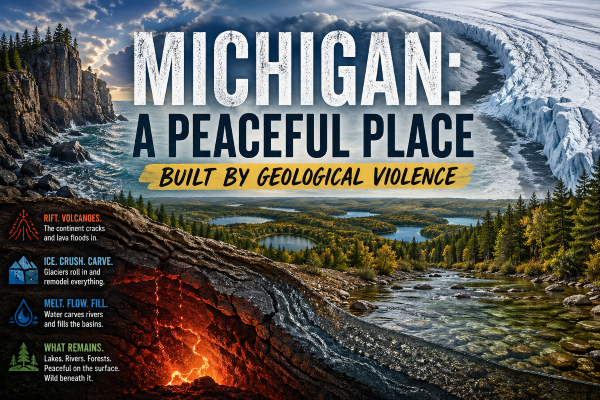
Michigan is what happens when the earth tries to tear itself apart, fails, gets buried, frozen, crushed, flooded, and then—only after all that—decides to look nice about it.
Let’s walk the sequence.
First, the continent cracks.
Deep under what is now the Upper Midwest, North America attempted a full-on breakup. Not a polite drift—an actual tear. The crust stretched, split, and opened into what geologists call the Midcontinent Rift. Lava poured out in ridiculous volumes, layering the region with thick volcanic rock. We’re talking miles of basalt—hardened, dense, and stubborn enough to outlast just about anything.
Then it stops.
The rift fails. The continent doesn’t split. Everything cools off, collapses inward, and gets buried under its own geological baggage. What you’re left with is a massive structural scar—a sag in the crust loaded with volcanic rock and sediment, quietly waiting for the next round.
Enter ice. Lots of it.
Glaciers don’t ask permission. During the Wisconsin Glaciation, ice sheets rolled over Michigan like slow-moving tanks with a grinding habit. They didn’t just cover the land—they reengineered it.
They scraped.
They crushed.
They moved entire landscapes like furniture.
That ancient rift basin? The glaciers found it and went to work, deepening and cleaning it out until it became the foundation for Lake Superior—a lake so large it looks like an inland ocean and behaves like one when it’s in a bad mood.
Everywhere else, the glaciers left a mess that somehow turned into beauty.
They pushed debris into ridges—moraines—creating the rolling hills people now call “scenic.” They dumped sand and gravel into vast outwash plains, which explains why so much of northern Michigan drains like a sieve. They buried chunks of ice, walked away, and let them melt into kettle lakes—thousands of them—scattered like potholes on a cosmic scale.
Nothing about it was neat. It was chaos with momentum.
Then the ice retreated, and water took over.
Meltwater surged across the land, carving channels through the loose glacial debris. Those channels became rivers—the Manistee River, the Jordan River, and dozens of others that now look like they were designed by someone who appreciated a good fishing spot.
They weren’t.
They’re the leftovers of drainage systems from a melting ice sheet. Temporary chaos that turned permanent.
Here’s the twist—the part that feels almost unfair.
The same sandy, porous ground that glaciers dumped everywhere now acts like a natural filtration system. Groundwater seeps through it, feeding rivers from below, keeping them cold, clear, and stable. The result? Some of the best trout water in the country, not because Michigan earned it, but because geology accidentally stuck the landing.
That’s the theme. Over and over again.
Failure creates structure.
Violence creates form.
Accident creates perfection.
Even the Great Lakes aren’t a single clean story. They’re a layered mess—tectonic scars, volcanic rock, glacial excavation, and meltwater filling the void. Superior follows that ancient rift. The others were shaped and deepened by ice exploiting whatever weaknesses it could find. It’s not elegant. It’s opportunistic.
And yet, what you see today is calm. Almost suspiciously so.
People build cabins. They fish. They kayak. They talk about “getting away from it all,” as if the ground beneath them didn’t spend its entire history getting absolutely wrecked.
Michigan isn’t peaceful. It’s what peaceful looks like after everything that could happen already did.
That quiet lake? Collapse.
That smooth hill? Bulldozed debris.
That perfect river bend? Meltwater improvisation that got lucky.
So when someone shrugs and calls Michigan “flat” or “boring,” understand what you’re actually hearing: a man staring at the aftermath of planetary-scale chaos and complaining it isn’t dramatic enough.
The drama already happened.
What you’re looking at now is the cover story.
If you enjoyed this article, then please REPOST or SHARE with others; encourage them to follow AFNN. If you’d like to become a citizen contributor for AFNN, contact us at managingeditor@afnn.us Help keep us ad-free by donating here.
Substack: American Free News Network Substack
Truth Social: @AFNN_USA
Facebook: https://m.facebook.com/afnnusa
Telegram: https://t.me/joinchat/2_-GAzcXmIRjODNh
Twitter: https://twitter.com/AfnnUsa
GETTR: https://gettr.com/user/AFNN_USA
CloutHub: @AFNN_USA