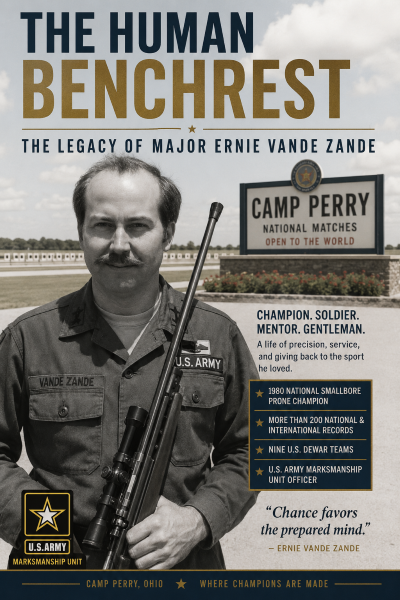
There are champions, and then there are builders.
Champions win medals, collect trophies, and occasionally remind the rest of us that perfection is not only possible but deeply irritating to watch. Builders do something more important. They leave the sport better than they found it.
Ernie Vande Zande was both.
Among America’s finest rifle shooters, he was known simply as “the Human Benchrest.” That was not a cute nickname invented by marketing consultants. It was a statement of fact. When Ernie settled into position, the rifle seemed to fire from a machine rest powered by discipline, intelligence, and decades of practice.
Born in McCook, Nebraska, on April 23, 1948, Ernie became the first four-time rifle All-American at Murray State University and helped lead the Racers to four national championships. That alone would have secured his place in shooting history. Instead, he treated it as a warm-up.
He served his country as an officer in the United States Army and was associated with the United States Army Marksmanship Unit. He later served in South Korea and retired with the rank of Major after more than two decades of military service. What is certain is that he brought the Army’s precision, discipline, and professionalism to every firing line he touched.
Then came the wins.
And the records.
And more wins.
Ernie captured the 1980 National Smallbore Prone Championship at Camp Perry. He shot on nine Dewar Teams representing the United States. He earned Distinguished honors in both smallbore and international shooting. He set more than 200 national and international records. In 1981, he fired a perfect 600 in international competition—an achievement so remarkable that the rifle he used is now preserved in the National Infantry Museum as part of the USAMU’s permanent display.
That is the sort of résumé that causes ordinary shooters to stare silently at their scorebooks and reconsider their life choices.
But if you ask people who knew Ernie what made him special, they usually start somewhere else.
They talk about his generosity.
In every competitive sport, there are two kinds of experts. One hoards information like a dragon sitting on a pile of sight settings and secret wind formulas. The other shares what he knows because he genuinely wants others to improve.
Ernie was the second kind.
His classic article, “Sights, Wind and Mirage,” remains required reading for serious rifle shooters. Generations of competitors have studied it to better understand wind, mirage, sight adjustments, and the subtle physics that separate tens from nines. Decades later, his words are still coaching shooters he never met.
That is immortality in the marksmanship world.
He did not need social media, clickbait thumbnails, or breathless promises of “one weird trick to shoot more Xs.” He had something far more valuable: credibility. When Ernie spoke, shooters listened because his advice had already been tested on the most demanding firing lines in the world.
Beyond the sport, he and his wife established the Wyatt-Vande Zande Foundation to help women escaping domestic violence pursue higher education. Even outside marksmanship, Ernie believed in lifting others.
Later in life, he lived in Panama City, Florida, where he continued to mentor shooters and remained deeply respected within the smallbore community.
When Ernie Vande Zande passed away in 2018 after battling pancreatic cancer, the shooting world lost far more than a champion. It lost a teacher, a mentor, a soldier, and a gentleman.
Records will eventually fall. That is the nature of competition.
Character does not.
The firing lines at Camp Perry are still busy. The flags still twitch. Mirage still boils. New shooters continue trying to decipher the mysterious language of wind and patience. Many of them are learning lessons Ernie first explained years ago.
That is his true legacy.
Not just the trophies.
Not just the records.
Not even the perfect scores.
His greatest achievement was proving that excellence and humility can occupy the same shooting mat.
In a world increasingly filled with noise, ego, and self-promotion, Ernie Vande Zande represented an older and better ideal: master your craft, serve your country, help others, and leave the range better than you found it.
Smallbore is better because Ernie Vande Zande was part of it.
And it is poorer because he is gone.
If you enjoyed this article, then please REPOST or SHARE with others; encourage them to follow AFNN. If you’d like to become a citizen contributor for AFNN, contact us at managingeditor@afnn.us Help keep us ad-free by donating here.
Substack: American Free News Network Substack
Truth Social: @AFNN_USA
Facebook: https://m.facebook.com/afnnusa
Telegram: https://t.me/joinchat/2_-GAzcXmIRjODNh
Twitter: https://twitter.com/AfnnUsa
GETTR: https://gettr.com/user/AFNN_USA
CloutHub: @AFNN_USA