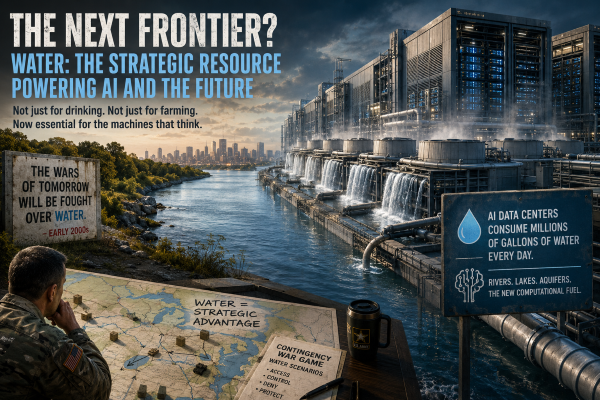
Back in the early 2000s, when I was serving as a U.S. Army contingency war planner, there was no shortage of briefings, white papers, and war games predicting that the great conflicts of the future would be fought over water. We sat in secure rooms pushing icons across maps, examining river basins, reservoirs, aquifers, and choke points. Entire scenarios were built around nations desperate for fresh water. The logic seemed sound. Population was growing. Water was finite. Climate concerns were gaining momentum. Surely the next generation of wars would be fought over who controlled the tap.
Then something funny happened.
The water wars never showed up.
At least not in the way many experts predicted.
Instead of invading neighbors for reservoirs, countries built dams. They negotiated treaties. They drilled deeper wells. They improved irrigation. They desalinated seawater. Humanity did what it usually does when faced with a resource problem: it innovated its way around the immediate crisis.
Looking back, that’s encouraging. Predictions of widespread conflict over drinking water largely failed to materialize. Most of us would happily accept being wrong about a future war.
But perhaps we were not wrong. Perhaps we were simply early.
Enter artificial intelligence.
AI has rapidly become the strategic resource race of our generation. Politicians compare it to the Manhattan Project. Technology companies are spending hundreds of billions of dollars. Nations view AI dominance as an economic and military necessity. Everyone is focused on the chips, the software, and the algorithms.
Yet almost nobody is talking about the rivers.
AI doesn’t run on magic. It runs on electricity. Massive amounts of electricity. And wherever enormous amounts of electricity are consumed, enormous amounts of heat are generated. Heat must be removed. In many cases, that means water.
A modern AI data center can consume millions of gallons of water daily depending on its cooling design, climate, and workload. The water is not necessarily contaminated, but much of it is lost through evaporation. In effect, rivers, lakes, and aquifers become components of the cooling system for giant digital brains.
The issue is not one data center.
The issue is thousands of them.
The AI race is creating an entirely new class of infrastructure. Server farms covering hundreds of acres. Gigawatts of electrical demand. Dedicated substations. New transmission corridors. Industrial-scale cooling systems. Facilities designed to serve not a city or region, but potentially the entire world.
Suddenly, water-rich regions look different.
Twenty years ago, Michigan’s greatest natural advantage was viewed as tourism, fishing, shipping, and recreation. Today, the Great Lakes represent roughly twenty percent of the world’s surface fresh water. That’s no longer just an environmental talking point. It is becoming a strategic economic asset.
If you are planning a billion-dollar AI facility, your checklist is straightforward. Do you have reliable power? Do you have available land? Do you have political support? And perhaps most importantly, do you have access to water?
The Great Lakes region answers that last question better than almost anywhere on Earth.
This is where the old water-war predictions begin to reappear, although not in the form we imagined. Instead of armies crossing borders, we may see battles fought in zoning meetings, courtrooms, environmental reviews, utility commissions, and state legislatures. Communities may find themselves asking uncomfortable questions.
Should water be allocated to agriculture or artificial intelligence?
Should local rivers cool server racks serving global corporations?
Should communities bear the environmental burden while distant investors collect the profits?
These are not theoretical questions anymore.
The irony is remarkable. For decades, water was viewed primarily as a human necessity. Now it is increasingly becoming a computational resource. The same river that once powered mills and irrigated crops may soon be cooling machine-learning clusters capable of consuming more electricity than entire towns.
As a former Army planner, I find the development fascinating. The scenarios we gamed out were not entirely wrong. The value of water may indeed be increasing. We simply failed to predict why.
The next strategic competition may not be driven by human thirst.
It may be driven by machine thirst.
And if that proves true, those old war games from twenty years ago may have been less a prediction of the future than an early glimpse of it. We just didn’t know that the customers lining up for the water would be silicon instead of flesh and blood.
If you enjoyed this article, then please REPOST or SHARE with others; encourage them to follow AFNN. If you’d like to become a citizen contributor for AFNN, contact us at managingeditor@afnn.us Help keep us ad-free by donating here.
Substack: American Free News Network Substack
Truth Social: @AFNN_USA
Facebook: https://m.facebook.com/afnnusa
Telegram: https://t.me/joinchat/2_-GAzcXmIRjODNh
Twitter: https://twitter.com/AfnnUsa
GETTR: https://gettr.com/user/AFNN_USA
CloutHub: @AFNN_USA