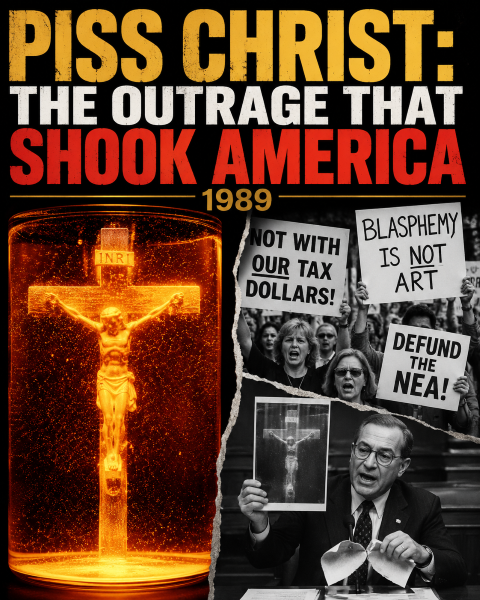
In 1987, a photographer dipped a small plastic crucifix into a container of his own urine, photographed it under dramatic lighting, and called it “Piss Christ.” Two years later, Americans discovered that the work had received support connected to the National Endowment for the Arts, and the cultural explosion began.
Back then, there was no Facebook outrage machine. No X pile-ons. No Instagram influencers demanding cancellation. There were churches, dinner tables, newspaper editorials, and Congress. Millions of ordinary Americans looked at the image and reached the same conclusion: “Why are my tax dollars involved with this garbage?”
The debate wasn’t really about photography.
It was about whether government should subsidize contempt.
Senators held hearings. Museums faced protests. Churches organized demonstrations. Americans argued passionately about the First Amendment while simultaneously asking whether freedom of speech automatically entitled someone to public funding.
Those are two entirely different questions.
The controversy became so significant that it eventually helped shape the legal battle culminating in the 1998 Supreme Court case National Endowment for the Arts v. Finley. The Court ruled that artists have broad First Amendment protections to create controversial work, but they do not have a constitutional right to taxpayer funding. That distinction became one of “Piss Christ’s” most enduring legacies.
Fast-forward nearly forty years.
Where is the revolutionary now?
Still making provocative photographs.
Still exhibiting in galleries.
Still photographing corpses, bodily fluids, explicit sexuality, racist artifacts, and other deliberately uncomfortable subjects.
One thing, however, stands out.
His most famous work remains the one involving Christianity.
Curiously, there was never an equivalent masterpiece featuring a Qur’an immersed in urine. No famous photograph desecrating another religion’s sacred objects in quite the same way. At least not one that became part of his portfolio or defined his career.
Why?
Only Serrano can answer that.
He has long said his work reflects his Catholic upbringing. Critics, however, have asked a different question: if the goal was to challenge religious authority wherever it exists, why was Christianity the only faith to receive this particular treatment? Others wonder whether some religions simply present greater personal or professional risks to provoke. The public record doesn’t answer that question, but it has remained part of the debate for decades.
Here’s another question.
If “Piss Christ” represented the pinnacle of artistic courage, where is the legacy?
What great movement did it inspire?
What breathtaking artistic renaissance followed?
Nearly four decades later, Andres Serrano is remembered almost entirely for a single photograph that shocked the public. Few outside the art world could name another piece he created. The work became famous not because it elevated civilization, but because it offended millions of Americans while touching one of Western civilization’s central religious symbols.
That’s a curious résumé.
The real legacy wasn’t artistic.
It was political, it was personal.
“Piss Christ” became one of the defining battles in America’s culture wars. It forced the country to wrestle with questions that still echo today:
Should taxpayers finance speech they find offensive?
Does calling something “art” automatically shield it from criticism?
Can government remain neutral while subsidizing expression that many citizens consider openly contemptuous of their beliefs?
Those questions haven’t disappeared.
If anything, they’ve multiplied.
Today we live in a culture where a photograph of a crucifix submerged in urine can be defended as bold artistic expression, while historic names, monuments, and other pieces of America’s past are increasingly reconsidered or renamed because they are viewed as offensive.
That’s quite a cultural evolution. Or perhaps. more accurately, devolution.
The irony is difficult to miss. Forty years ago Americans were told mature societies tolerate offensive expression. Today we’re increasingly told offensive words, names, and historical references should be removed from public life.
Apparently, some offenses build artistic careers.
Others require government erasers.
Maybe that’s the real masterpiece—not the photograph itself, but the double standard it helped reveal.
If you enjoyed this article, then please REPOST or SHARE with others; encourage them to follow AFNN. If you’d like to become a citizen contributor for AFNN, contact us at managingeditor@afnn.us Help keep us ad-free by donating here.
Substack: American Free News Network Substack
Truth Social: @AFNN_USA
Facebook: https://m.facebook.com/afnnusa
Telegram: https://t.me/joinchat/2_-GAzcXmIRjODNh
Twitter: https://twitter.com/AfnnUsa
GETTR: https://gettr.com/user/AFNN_USA
CloutHub: @AFNN_USA