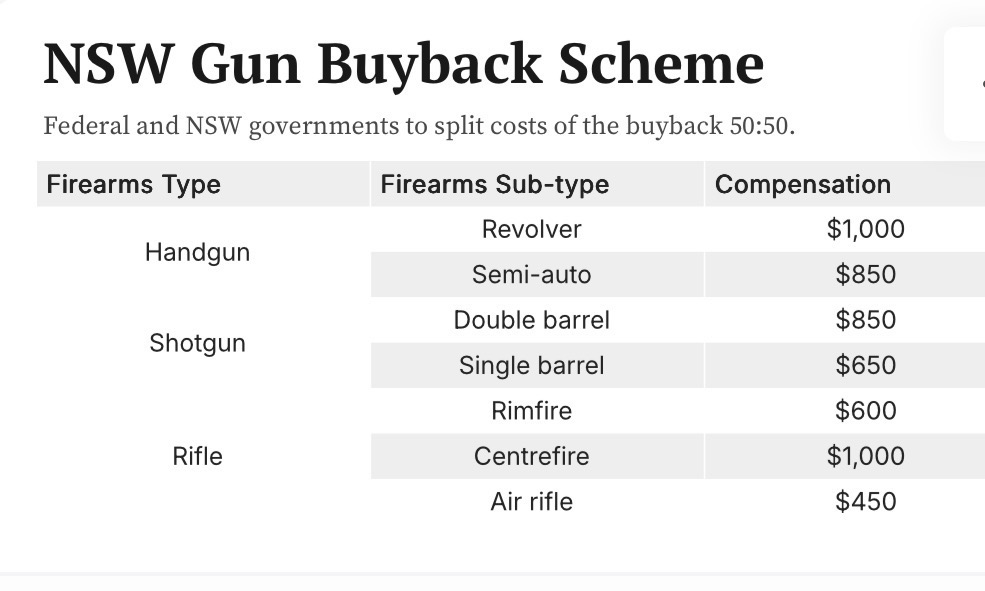
The photograph is real. Following the 2025 Bondi Beach terrorist attack, New South Wales and the Australian federal government announced what has been described as the largest gun buyback program in Australia in three decades. The compensation schedule is straightforward: up to $1,000 for certain rifles and revolvers, $850 for some handguns and shotguns, and $450 for an air rifle (Ralphie is gonna be Rich). The program begins in late 2026, and officials estimate that as many as 274,000 registered firearms could be affected.
Supporters argue that these measures are a reasonable response to terrorism. Their position is simple: fewer firearms in circulation should reduce risk and improve public safety. Australian leaders have repeatedly framed the new restrictions as a continuation of the country’s long-standing approach to firearm regulation following earlier national reforms.
Critics ask a different question.
Who owns the right to self-defense?
That question isn’t answered the same way in every democracy. In the United States, many people view self-defense as an inherent right that predates government itself. In Australia, elected governments have historically exercised broader authority over firearm regulation.
Both the Hebrew Bible and the New Testament recognize the legitimacy of self-defense, even while emphasizing justice and restraint. Jewish tradition, as reflected in the Talmud, teaches the principle, “If someone comes to kill you, rise up and kill him first” (Babylonian Talmud, Sanhedrin 72a), affirming that preserving innocent life may require defensive force. Likewise, in Luke 22:36, Jesus tells His disciples, “Let the one who has no sword sell his cloak and buy one,” a passage many interpret as acknowledging the need to be prepared for danger, though its precise meaning is debated among Christian scholars. Together, these texts have often been cited to support the view that defending innocent life is consistent with both Jewish and Christian moral teaching.
The debate becomes even more complicated when it expands beyond firearms.
The Albanese government’s Journalism Assistance Fund committed $67.6 million over three years to support news organizations by subsidizing journalist salaries. The government says the goal is to preserve journalism, particularly local and regional reporting. Critics counter that direct government funding of media organizations creates at least the appearance of a conflict between watchdogs and the institutions they are supposed to scrutinize. Both of those statements are matters of public record. The motive behind the program remains a matter of political interpretation.
Meanwhile, debates over immigration, technology regulation, housing affordability, taxation, and the expanding role of government continue across Australia. Those issues are politically charged, and reasonable people reach very different conclusions about them.
The strongest argument against these firearm policies isn’t that Australia has become a dictatorship. It hasn’t. Australia remains a constitutional democracy with competitive elections, an independent judiciary, and vigorous political debate.
The stronger argument is philosophical.
Rights are rarely surrendered all at once. More often, they are narrowed incrementally, one crisis at a time. Every society must decide where to place the boundary between individual liberty and collective security.
The image of a government assigning a fixed compensation value to a citizen’s means of self-defense is powerful because it forces that question into the open.
Some people will see a public safety program.
Others will see a warning.
And that is why Australia has become, for many observers, the canary in the coal mine.
Not because the future is predetermined.
But because free societies are constantly renegotiating the balance between liberty and security, and history suggests that once rights are surrendered, recovering them is rarely ever simple.
If you enjoyed this article, then please REPOST or SHARE with others; encourage them to follow AFNN. If you’d like to become a citizen contributor for AFNN, contact us at managingeditor@afnn.us Help keep us ad-free by donating here.
Substack: American Free News Network Substack
Truth Social: @AFNN_USA
Facebook: https://m.facebook.com/afnnusa
Telegram: https://t.me/joinchat/2_-GAzcXmIRjODNh
Twitter: https://twitter.com/AfnnUsa
GETTR: https://gettr.com/user/AFNN_USA
CloutHub: @AFNN_USA