There are stupid laws. There are obsolete laws. And then there are laws that somehow survive long enough for technological progress to transform them into legislative performance art.
Welcome to Michigan’s computer-crime statute.
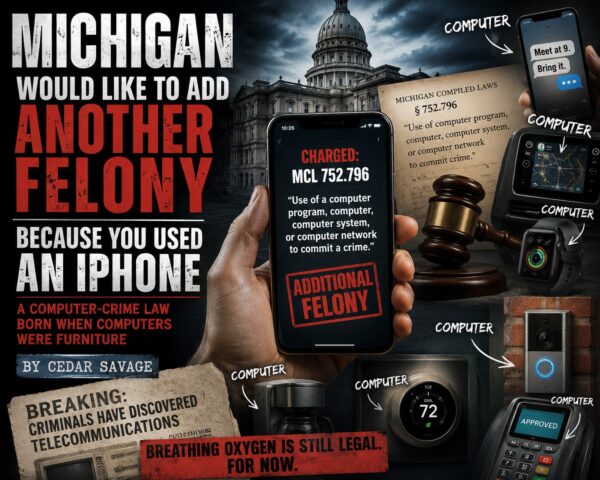
Under MCL 752.796, Michigan makes it a crime to use a “computer program, computer, computer system, or computer network” to commit, attempt to commit, conspire to commit, or solicit another person to commit a crime.
Read that again.
Use a computer to commit a crime.
In 2026.
That is rapidly approaching the legal equivalent of enhancing somebody’s sentence because they were breathing oxygen during the commission of a felony.
To understand how we arrived at this magnificent monument to legislative inertia, we need to travel back to 1979, when Michigan first enacted its computer-crime law.
And in 1979, this actually made some sense.
Computers were exotic. They were enormous beige contraptions tended by mysterious priests carrying punch cards. Your grandmother didn’t have one. Your refrigerator didn’t have one. Your truck didn’t have 37 of them. Nobody was sitting on the toilet using one to order a carburetor, check their bank account, argue with a stranger in Toledo and watch a video about Roman concrete.
If you used a computer to steal money in 1979, that was noteworthy.
The original Michigan law reflected that reality. It targeted computer use connected to particular property offenses such as embezzlement, larceny and fraudulent conversion.
Fair enough.
Then Michigan improved it.
And by “improved,” I mean the Legislature eventually took a relatively understandable law, removed the guardrails, installed a rocket engine and pointed it directly at the future.
In 1996, Michigan amended the statute and replaced the limited collection of underlying offenses with the wonderfully expansive phrase:
“To commit a crime.”
Any crime.
And that little linguistic hand grenade remains sitting in Michigan law today.
There was just one tiny problem nobody apparently anticipated.
THE ENTIRE CIVILIZED WORLD BECAME A COMPUTER.
Your telephone is a computer.
Your television is a computer.
Your truck contains computers.
Your bank is effectively a computer network with a building attached to it.
Your grocery-store checkout is a computer.
Your doorbell is a computer.
Your thermostat is a computer.
Your watch is a computer.
Your kid’s refrigerator is connected to the internet for reasons that remain unclear even to God.
You can barely buy a cheeseburger anymore without interacting with a computer network.
And yet Michigan maintains a separate criminal statute based upon the astonishing proposition that someone might use a computer while committing another crime.
No kidding.
Breaking news from Lansing: Criminals have discovered telecommunications.
Of course, there is an important legal distinction. The statute does not mean that merely possessing a smartphone while committing a crime automatically triggers another offense. Michigan courts have treated the law as requiring intentional use of the computer in furtherance of the underlying crime.
Fine.
That saves us from the absolute pinnacle of stupidity.
But it doesn’t solve the underlying problem.
Because intentionally using a computer in 1979 and intentionally using a computer in 2026 are fundamentally different propositions.
In 1979, using a computer required effort.
In 2026, avoiding one requires effort.
Imagine two idiots planning the exact same misdemeanor.
Idiot Number One walks across the street and tells Idiot Number Two his brilliant criminal plan.
Old school.
Organic.
Artisanal crime.
But suppose Idiot Number One instead sends him a text message.
Congratulations.
We have entered CYBERSPACE.
Apparently somebody needs to alert Cyber Command because Kevin used an iPhone.
And here’s where this stops merely being funny.
Michigan law expressly allows prosecution and punishment under the computer statute in addition to prosecution and punishment for the underlying crime.
That’s where citizens should start asking questions.
What exactly is the additional social harm being punished?
If somebody hacks into a hospital network, steals financial information, destroys computer systems, deploys malware or breaks into a government database, absolutely prosecute the computer offense.
The computer fundamentally enabled or magnified the crime.
That’s cybercrime.
But if someone commits an ordinary offense that already exists in the criminal code and happens to use the ordinary communications infrastructure of modern civilization while doing it, why should touching a smartphone magically create another criminal charge?
Because computers?
That argument made considerably more sense when Ronald Reagan was running for president and a 10-megabyte hard drive looked like industrial equipment.
Technology changed.
The law essentially didn’t.
And therein lies the larger problem.
Legislatures love creating criminal statutes.
They are considerably less enthusiastic about periodically walking through the criminal code with a garbage bag and asking whether laws written for another technological civilization still make sense.
Statutes accumulate.
Enhancements accumulate.
Definitions expand.
Prosecutorial tools accumulate.
And almost nothing ever gets deleted.
Every generation adds another layer of barnacles to the criminal code until eventually a citizen can violate three statutes while attempting to violate one.
The irony is that Michigan’s original 1979 approach was arguably more intellectually coherent than what replaced it.
It identified particular crimes where computers created a novel method of committing fraud or theft.
Then, in 1996—just as computers were beginning their conquest of every desk, pocket, vehicle and household appliance—we broadened the statute to essentially ANY CRIME.
Fantastic timing.
It’s like passing an enhanced penalty for “using electricity during the commission of a crime” in 1895 and then forgetting about it for 130 years.
“Your Honor, the defendant committed burglary.”
“Terrible.”
“He also turned on a light.”
“Dear God.”
“Electricity was involved.”
“STACK THE CHARGES.”
That sounds ridiculous because electricity became infrastructure.
Computing has done exactly the same thing.
The distinction between “computer activity” and ordinary human activity has collapsed.
Our communications are computerized. Our commerce is computerized. Our transportation is computerized. Our entertainment is computerized. Our government is computerized.
Soon your toaster will probably require two-factor authentication before surrendering your English muffin.
The solution isn’t abolishing computer-crime laws.
Quite the opposite.
Modern society desperately needs strong laws against actual cybercrime: unauthorized access, data theft, ransomware, infrastructure attacks, electronic financial fraud and deliberate attacks against computer systems.
Those offenses exploit capabilities unique to computers.
But “used a computer while committing another crime” is becoming an increasingly meaningless category.
Michigan should drag this statute back into the Legislature, blow the dust off it and ask a very simple question:
What specific additional harm are we trying to punish?
If there is an answer, write the statute around that harm.
If there isn’t, stop pretending that using an iPhone in 2026 is some exotic aggravating circumstance.
Because eventually technology makes yesterday’s extraordinary behavior completely ordinary.
And laws should recognize that.
Otherwise, maybe Lansing should finish the job.
MCL 752.999:
“Use of oxygen during commission of a crime.”
Punishable by an additional five years.
After all, preliminary research indicates nearly 100 percent of Michigan criminals have been breathing continuously before, during and immediately after their offenses.
This epidemic must be stopped.
**Disclaimer:** No, I did not get arrested, charged, investigated, raided, indicted, or otherwise discover this law through personal experimentation. I learned about it the old-fashioned way: **I sat on a jury.** Sometimes civic duty teaches you things about your government you probably would have been happier not knowing.
If you enjoyed this article, then please REPOST or SHARE with others; encourage them to follow AFNN. If you’d like to become a citizen contributor for AFNN, contact us at managingeditor@afnn.us Help keep us ad-free by donating here.
Substack: American Free News Network Substack
Truth Social: @AFNN_USA
Facebook: https://m.facebook.com/afnnusa
Telegram: https://t.me/joinchat/2_-GAzcXmIRjODNh
Twitter: https://twitter.com/AfnnUsa
GETTR: https://gettr.com/user/AFNN_USA
CloutHub: @AFNN_USA
By does the law have an exception for an Android phone? Asking for a friend! 🙂