The next time somebody at the range sees your 6.5 Creedmoor and mutters something clever about a “6.5 Man Bun,” don’t get mad.
Ask him one simple question:
“What was Creedmoor?”
Then enjoy the silence.
Because there’s a pretty good chance the knuckle-dragger making fun of your cartridge doesn’t know that “Creedmoor” isn’t some marketing word invented by Hornady in 2007. It comes from one of the most important places in the entire history of American competitive rifle shooting.
And that history begins more than 150 years ago.
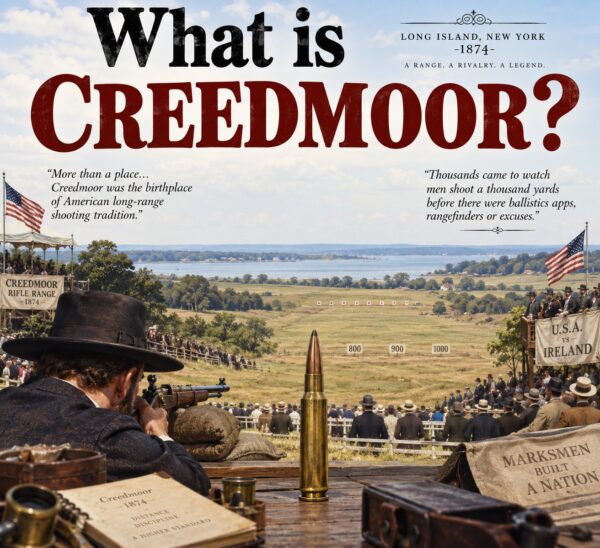
Creedmoor was a rifle range on Long Island, New York. The newly formed National Rifle Association acquired approximately 70 acres at Creed’s Farm in 1872, and the range opened in 1873. The place became known as Creedmoor—a combination traditionally attributed to “Creed” and the moor-like appearance of the property.
Then came 1874.
Ireland had one of the finest long-range rifle teams on Earth and challenged the Americans to prove themselves. On September 26, the Irish and American teams met at Creedmoor in what amounted to a nineteenth-century international championship.
They fired at 800, 900 and 1,000 yards.
With black powder.
In the 1870s.
And thousands of Americans showed up to watch.
Estimates vary, but contemporary and historical accounts generally put attendance somewhere around 8,000 to 10,000 spectators. People arrived by railroad. Newspapers covered it. Results were transmitted by telegraph. Crowds followed the scores.
Think about that for a second.
We sometimes struggle today to convince twelve people to stick around for the awards ceremony at a rifle match.
In 1874, roughly ten thousand people showed up to watch dudes shoot rifles at 1,000 yards.
That’s America. God Bless Her.
And the match was magnificent.
The Americans were shooting American-made Remington and Sharps breechloaders against the Irish team’s famous Rigby muzzleloaders. It eventually came down to the final American shot at 1,000 yards.
Colonel John Bodine needed the shot.
He fired.
Bull’s-eye.
America won 934–931.
The crowd erupted.
That wasn’t just another Saturday club match. Creedmoor helped establish long-range rifle competition as a serious American sport. The international matches (Now ICFRA World Championships) that followed became ancestors of the great long-range traditions that eventually included Palma competition still fired today with .223 and .308 rifles at those same distances.
Now fast-forward about 133 years.
A retired Marine competitive shooter named Dennis DeMille was involved with Creedmoor Sports and talking with Hornady about what serious competitive shooters actually needed in a modern cartridge.
The result eventually became the 6.5 Creedmoor.
Not the 6.5 Man Bun.
Not the 6.5 Hipster.
Not the 6.5 Starbucks.
Creedmoor.
The name deliberately connected a modern long-range competition cartridge with one of the sacred names in American long-range rifle history.
That’s the joke most of the people making the jokes don’t understand.
The cartridge wasn’t named after a beard oil company in Portland. It carries the name of the range where American riflemen stood toe-to-toe with some of the finest marksmen in the world and beat them at 800, 900 and 1,000 yards—in 1874.
Yet somehow we’ve reached a point where the guy who bought a .300 Win. Mag. because his uncle told him “real men shoot thirties” wants to explain that your Creedmoor isn’t a serious rifle cartridge.
Okay, Buffalo Bill.
Tell me more.
This is one of the strangest psychological quirks in American gun culture. We supposedly worship tradition, but sometimes we don’t actually know very much of it.
We inherit opinions instead.
Grandpa used a .30-06.
Jack O’Connor liked the .270.
The Army used the .308.
Therefore those cartridges are legitimate.
Something developed in our own lifetime?
Suspicious.
And when the new cartridge starts winning matches, bucking wind efficiently, recoiling less and allowing ordinary shooters to buy extremely accurate factory ammunition?
Well, obviously we can’t discuss ballistic coefficients and external ballistics.
Better question the shooter’s masculinity.
“6.5 Man Bun!”
Outstanding argument, Professor.
The particularly delicious part is that 6.5mm bullets aren’t remotely new. Europeans figured out the virtues of long, slender 6.5mm projectiles more than a century ago. What was clever about the Creedmoor wasn’t discovering the diameter. It was packaging excellent aerodynamic bullets into a sensible, standardized short-action cartridge that ordinary shooters could buy off a shelf.
And it worked.
Boy, did it work.
Competition shooters adopted it. Hunters discovered it. Rifle manufacturers chambered everything for it. Ammunition companies loaded it. New shooters could walk into a store, buy a rifle and match ammunition, and achieve performance that previously might have required considerable handloading knowledge.
Naturally, this was intolerable.
Because nothing irritates an equipment tribe quite like discovering that the other tribe’s equipment actually works.
So here’s my proposal.
The next time somebody sees your 6.5 Creedmoor and says:
“Nice man-bun rifle.”
Smile.
Then ask:
“Who won the 1874 Creedmoor International Rifle Match?”
Ask him what distances they fired.
Ask him where Creedmoor was.
Ask him why the name matters.
Ask him what the connection is between Creedmoor and the development of American long-range rifle competition.
If he knows the answers, congratulations—you’ve found another student of rifle history, and now you two can properly insult each other’s cartridges like educated gentlemen.
If he doesn’t?
Hand him his .30-caliber thunder stick, point toward the firing line and tell him:
“Less talking. More shooting.” That barn door probably isn’t big enough for you to hit…
Because cartridges don’t have man buns.
Cartridges don’t have masculinity.
Cartridges don’t have feelings.
Targets have scores.
And before you ridicule a cartridge named after one of the most historically important places in American competitive shooting, you might want to learn enough American rifle history to know what the word Creedmoor actually means.
Then hit the range.
Because if your knowledge of marksmanship is measured by how loudly you make fun of somebody else’s cartridge, there’s a decent chance that barn is still perfectly safe.
Even from the inside.
_________________________________
If you enjoyed this article, then please REPOST or SHARE with others; encourage them to follow AFNN. If you’d like to become a citizen contributor for AFNN, contact us at managingeditor@afnn.us Help keep us ad-free by donating here.
_________________________________
Substack: American Free News Network Substack
Truth Social: @AFNN_USA
Facebook: https://m.facebook.com/afnnusa
Telegram: https://t.me/joinchat/2_-GAzcXmIRjODNh
Twitter: https://twitter.com/AfnnUsa
GETTR: https://gettr.com/user/AFNN_USA
CloutHub: @AFNN_USA