
Use of force without direct Congressional authorization is often problematic. But that doesn’t make it illegal or unconstitutional.
Since September 2nd, the Trump administration has conducted multiple “kinetic strikes” (love that term) on suspected drug traffickers at sea. Most were in the Caribbean, but recently the strikes have moved into the Pacific Ocean. I’ve heard the usual suspect screeching these boats are deep sea fishing trips. This brings up a simple question, where exactly were these attacks?
Took a few weeks (NY Times, where are you?), but the Encyclopedia Britannica has the actual locations of the kinetic strikes. Granted, I’ve not used a rod and reel in ages, but this looks a bit far out for fishing:

From STRATFOR.COM, a great site I’ve been hooked on for 30 years, some details on the strikes.
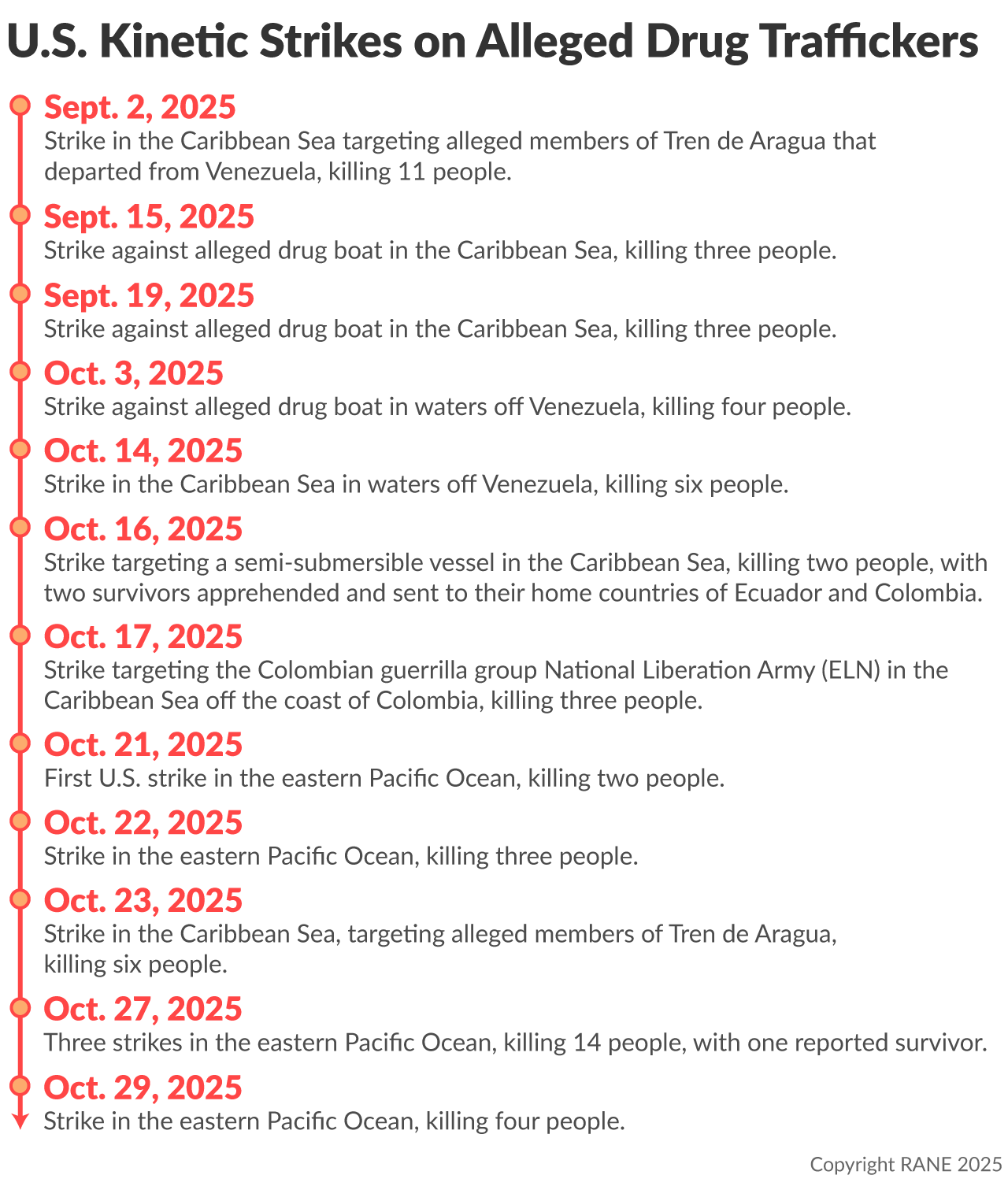
I really found interesting the strike on October 16th. Who would have thunk you could fish off a submersible? So yes, the ships attacked are narcotics traffickers moving drugs into the United States. The question, is this a threat justifying deadly force on international water?
Let’s take a look at other times we have used military force without direct congressional authorization. The US has not had formally declared war since World War II, but has passed multiple Authorizations For Use Of Military Force (MUMFs). Presidents have also used military force on their own authority to safeguard the interest of the United States or her allies:
-Thomas Jefferson, 1806, Tripoli, First Barbary War.
-James Madison/James Monroe, 1814-1835, Caribbean engagements with pirates on the open seas.
-James Madison, 1815, Second Barbary War.
-James Monroe, 1822, Cuba.
-John Tyler, 1844, Texas, troops sent to defend Texas from Mexican forces.
-Franklin Pierce, 1856, Panama & New Republic of Grenada, forces sent to protect American interest during an insurrection.
-Franklin D Roosevelt, 1941, Greenland and Iceland, the countries were taken into US custody to secure them from Germany.
-Ronald Reagan, 1986, US forces attack Libya in response to its attacks in the previous years.
-Ronald Reagan, 1988, US forces stuck Iranian assets in retaliation to their mining of shipping lanes in the Persian Gulf.
-George HW Bush, 1989, Panama invasion.
-Barrack Obama, 2011, Libyan incursion.
In researching this column, I did find an article from an MSN writer, When Republicans Opposed Obama’s Unauthorized Use Of Force. The author, Mr. Terrence Jeffrey, seemed a bit scornful of Republicans (and some Democrats) who opposed Obama’s actions in Libya. The difference is unlike Panama 1989 or Grenada 1983, the Libyan incursion was a foreign policy disaster.
In the aftermath of the Iraq War, Muammar Gaddafi surrendered his WMD program, settled claims for the Lockerbie Scotland airline attack, and stoped supporting terrorist groups. In exchange, we allowed him to stay in power, and he supported us with intelligence in the area. By letting Gaddafi to stay, Libya became a stable non-hostile nation. Obama and Hillary Clinton screwed that up something fierce.
This brings us to the current situation. Is it legitimate to use US armed forces against narcotics traffickers shipping deadly drugs into our country? As Fentanyl deaths have topped seventy-three thousand in 2022 (almost twice the number of auto fatalities a year), this is a clear and present danger. Is the president using his authority within the Constitution to combat a threat? No and yes.
The use of force without direct Congressional authorization is a gray area. Reading the Federalist Papers and other documents, it was understood the president could act to handle immediate threats without the direct approval of the legislative branch. How far can he go without that specific authority is part of the ingrained tension in our government. The continued struggle to see which branch is first among equals.
Article I does, however, give Congress one unquestioned authority, the power of the purse. They can cut funding for specific operations, as they did in the aftermath of Vietnam. With a lack of consensus in the congress over this matter, I don’t see this happening.
In summary, is what Trump’s is doing effective? I think so. Is it legal? Statutorily it’s vague, but we have historical precedent for similar actions. Has it been legally stopped by the Congress? No, and it will not be. Assume Democrats take both houses next year, they must pass a budget cutting off funding for these operations. President Trump would unquestionably veto the bill. An even safer assumption is the veto will not be overridden by 2/3 majority of both houses. So yes, the operations against the drug running “Maryland fathers” etc. will continue, and neither Dime Store Obama (Mr. Jeffries), UpChuck Schumer nor AOC will stop this. And Americans will be alive thanks to these operations.
Michael A. Thiac is a retired Army intelligence officer, with over 23 years experience, including serving in the Republic of Korea, Japan, and the Middle East. He is also a retired police patrol sergeant, with over 22 years’ service, and over ten year’s experience in field training of newly assigned officers. He has been published at The American Thinker, PoliceOne.com, and on his personal blog, A Cop’s Watch.
Opinions expressed are his alone and do not necessarily reflect the opinions of current or former employers.
If you enjoyed this article, then please REPOST or SHARE with others; encourage them to follow AFNN. If you’d like to become a citizen contributor for AFNN, contact us at managingeditor@afnn.us Help keep us ad-free by donating here.
Substack: American Free News Network Substack
Truth Social: @AFNN_USA
Facebook: https://m.facebook.com/afnnusa
Telegram: https://t.me/joinchat/2_-GAzcXmIRjODNh
Twitter: https://twitter.com/AfnnUsa
GETTR: https://gettr.com/user/AFNN_USA
CloutHub: @AFNN_USA