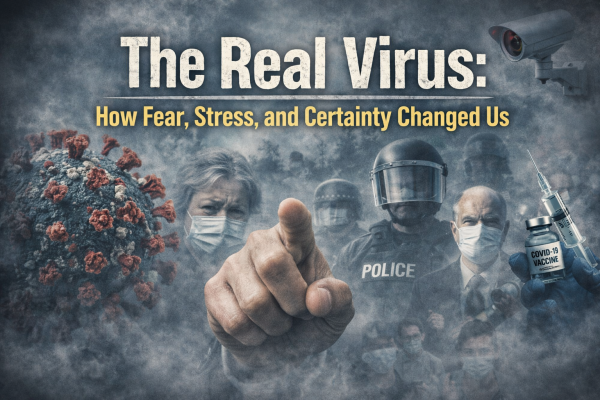
You didn’t need a history degree to recognize what was happening during the pandemic—you just needed to pay attention to how quickly ordinary people changed under pressure. Not all at once, not everywhere, but enough to notice a pattern. Stress, fear, and anxiety didn’t just shape policy; they reshaped behavior. And in many cases, they turned neighbors into enforcers, coworkers into compliance officers, and everyday citizens into self-appointed guardians of what was suddenly declared “right.”
At the beginning, it made sense. A novel virus, incomplete information, conflicting expert opinions—people were looking for certainty in an uncertain environment. That’s human. We’re wired to seek safety, to find structure when things feel out of control. But somewhere along the line, caution hardened into rigidity, and concern for others morphed into suspicion of others. The shift wasn’t dramatic like flipping a switch—it was gradual, subtle, and all the more powerful because of it.
Fear does strange things to people. It narrows focus. It simplifies complex problems into binary choices: safe or unsafe, compliant or dangerous, with us or against us. Once that mindset takes hold, nuance becomes the enemy. Questions are no longer curiosity—they’re defiance. Hesitation isn’t caution—it’s selfishness. And suddenly, people who would normally value independence and personal judgment start outsourcing both to whatever authority appears most confident in the moment.
That’s where the social dynamic really changed.
We saw a rise in what could be called “moral outsourcing.” Instead of individuals weighing risks and responsibilities for themselves, many deferred entirely to institutions—government agencies, corporations, public health officials—and then adopted those positions not just as guidance, but as identity. It wasn’t enough to follow the rules; you had to signal that you believed in them. And if someone didn’t? That wasn’t just disagreement—it was a threat.
From there, the slope gets slippery fast.
In workplaces across the country, policies rolled out quickly, often with little room for discussion. Employers, trying to navigate liability and public perception, defaulted to the most restrictive interpretations. It was safer, legally and reputationally, to be overly strict than to risk being seen as too lenient. That’s how you end up with blanket policies applied unevenly, and exemption processes that exist on paper but feel performative in practice.
Cases like the one involving Blue Cross Blue Shield of Michigan didn’t emerge out of nowhere—they’re a downstream effect of that environment. A jury later looked at the facts and concluded that, at least in that instance, the system failed to properly respect an individual’s rights. That doesn’t mean every mandate was wrong, or every employer acted unfairly. It means that under pressure, some decisions crossed a line.
And that’s the part worth examining.
Because the real story of the pandemic isn’t just about a virus. It’s about how people behave when the stakes feel high and the timeline feels compressed. When decisions have to be made quickly, there’s a natural tendency to favor action over reflection. Doing something—anything—feels better than doing nothing. But speed comes at a cost. The faster policies are implemented, the less time there is to consider second-order effects, unintended consequences, and edge cases.
That’s where individuals get lost in the system.
Religious beliefs, medical nuances, personal circumstances—these don’t fit neatly into broad policy frameworks. They require attention, patience, and sometimes exceptions. But exceptions are messy, and in a high-pressure environment, messy is inconvenient. So the system defaults to uniformity, even when the law requires flexibility.
Meanwhile, socially, the temperature kept rising.
Public discourse became sharper, less forgiving. Labels replaced conversations. People began sorting each other into categories based on compliance, as if a single decision could define someone’s entire character. And in that environment, it became easier—almost natural—to justify harsh judgments. If someone was perceived as increasing risk, then anything done to counter that risk could be rationalized as necessary.
That’s how ordinary people end up saying extraordinary things.
Not because they’re inherently malicious, but because fear reframes the moral landscape. When you believe the stakes are life and death, the threshold for what feels acceptable shifts. Actions that would normally be seen as excessive start to feel justified. Social pressure amplifies that effect, creating a feedback loop where the most rigid positions often get the most reinforcement.
But fear, for all its utility, is a terrible long-term guide.
It’s reactive, not reflective. It prioritizes immediate safety over sustainable balance. And perhaps most importantly, it doesn’t know when to stand down. Even as more data became available, even as risks became better understood, the mindset that formed in the early days proved harder to unwind than the policies themselves.
Now, with some distance, we’re starting to see the correction phase. Legal challenges, workplace disputes, public reassessments—these are signs of a system trying to recalibrate. Not perfectly, not universally, but noticeably. Juries stepping in, courts weighing decisions, organizations revisiting policies—that’s the slow machinery of accountability doing its job.
The bigger question is whether the cultural lesson sticks.
Have we recognized how quickly fear can override our better instincts? Have we learned to pause before turning disagreement into condemnation? Have institutions figured out how to balance urgency with restraint?
Those answers are still developing.
Because the next crisis—whatever form it takes—will bring its own version of uncertainty, pressure, and fear. The variables will change, but the human response won’t. We’ll still want clarity, still seek authority, still feel the pull toward conformity when things get uncomfortable.
The challenge is remembering this moment when that happens.
Not to reject caution, but to resist excess. Not to ignore risk, but to weigh it carefully. And above all, to recognize that stress, fear, and anxiety—while powerful motivators—are also the very forces most likely to push individuals and institutions beyond the bounds they would normally respect.
The pandemic didn’t just test our systems. It tested our character.
And if there’s a lesson worth holding onto, it’s this: the real enemy isn’t just the crisis itself—it’s how we choose to respond when we’re afraid.
If you enjoyed this article, then please REPOST or SHARE with others; encourage them to follow AFNN. If you’d like to become a citizen contributor for AFNN, contact us at managingeditor@afnn.us Help keep us ad-free by donating here.
Substack: American Free News Network Substack
Truth Social: @AFNN_USA
Facebook: https://m.facebook.com/afnnusa
Telegram: https://t.me/joinchat/2_-GAzcXmIRjODNh
Twitter: https://twitter.com/AfnnUsa
GETTR: https://gettr.com/user/AFNN_USA
CloutHub: @AFNN_USA