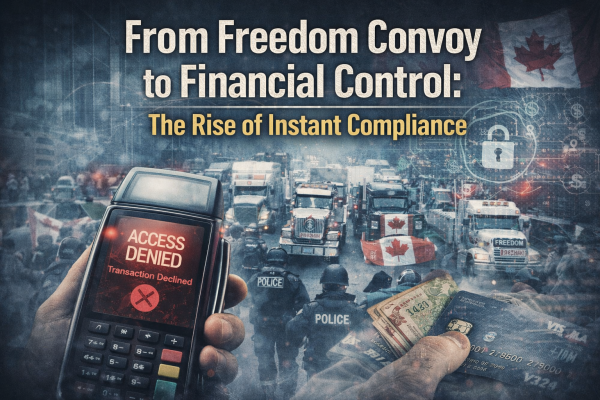
If you want a glimpse of how modern pressure can scale fast, look north to the winter of 2022 and the protests known as the Freedom Convoy. What began as a cross-country movement of truckers opposing cross-border vaccine requirements turned into a broader protest against mandates and restrictions. The response from the Canadian government under Justin Trudeau was decisive: emergency powers were invoked, certain financial accounts connected to the protests were frozen, and law enforcement moved to clear blockades. Supporters called it necessary to restore order; critics saw it as a warning shot—how quickly financial access and mobility can be restricted in a modern, digitally connected system.
That’s the part worth paying attention to—not just the politics of that moment, but the mechanics. For most of history, even the most heavy-handed regimes struggled with reach. Enforcement was slow, patchy, and often dependent on local compliance. Today, the tools are different. Banking is digital. Identification is centralized. Communication is instant. The same systems that make daily life frictionless—tap to pay, scan to enter, app to verify—also create the possibility of immediate exclusion. Not theoretical exclusion. Immediate. You can be fine at 9:00 a.m. and effectively locked out of parts of society by noon if the switch is flipped.
We saw smaller versions of this dynamic during the pandemic. Digital passes, workplace compliance systems, app-based verification—none of these were inherently sinister on their own. In many cases, they were built quickly to solve real logistical problems. But they introduced a new layer of control that didn’t exist at scale even a decade ago: the ability to gate access in real time. Not weeks later. Not after a court hearing. Right now.
Consider communities that operate outside much of that digital infrastructure, like the Amish. In places, they faced fines or restrictions tied to compliance measures that assumed access to technology they deliberately avoid. Whether one agrees with those policies or not, the tension is obvious—systems designed for universal application don’t always account well for people who live intentionally outside the system. And when compliance is tied to tools you don’t use, participation becomes complicated very quickly.
Now expand that concept.
Layer in facial recognition. Layer in cashless transactions. Layer in integrated databases that connect identity, finance, and access. None of this is science fiction—it’s already in varying stages of deployment around the world. The argument in favor is always efficiency and security. Faster verification. Reduced fraud. Streamlined services. And those benefits are real. But so is the tradeoff: when systems are tightly integrated, they become powerful levers.
In the past, social or economic penalties required time and coordination. Today, they can be automated.
That’s not inherently authoritarian. It’s capability. What matters is how it’s used—and what safeguards exist to prevent misuse. The concern raised by critics of pandemic-era policies, and events like the Canadian protests, is that the guardrails aren’t always as robust as the systems themselves. It’s easier to build the tool than it is to define—and enforce—its limits.
And once a capability exists, it rarely disappears.
That’s the quiet shift we’re living through. Not a sudden transformation into some dystopian state, but a steady increase in the ability of institutions—public and private—to shape behavior through access. Incentives and penalties have always been part of society. What’s new is the speed, scale, and precision with which they can be applied.
You don’t need to imagine a dramatic scenario to see the implications. Small decisions matter. What happens when access to transportation, banking, or employment is tied to compliance with a rapidly changing set of rules? What recourse exists if those rules are applied unevenly or incorrectly? How quickly can someone contest a decision—and what happens in the meantime?
These aren’t abstract questions anymore.
The Canadian trucker protests didn’t create these dynamics—they revealed them. The pandemic didn’t invent digital control systems—it accelerated their adoption. And communities like the Amish didn’t become vulnerable overnight—they simply highlighted what happens when one-size-fits-all systems meet people who don’t fit the mold.
So where does that leave us?
With a set of tools more powerful than anything past governments had, paired with a legal and cultural framework still catching up to those capabilities. The technology isn’t going away. If anything, it’s going to become more embedded, more seamless, more invisible.
The real issue isn’t whether these systems exist. It’s whether there are clear, enforceable limits on how they’re used—and whether those limits hold under pressure.
Because pressure is when lines blur.
And if the last few years showed anything, it’s that in moments of crisis, the temptation to prioritize control over caution—to act first and refine later—is strong. Sometimes necessary. Sometimes excessive.
The challenge going forward isn’t to reject modern tools, but to recognize their power. To build in friction where it matters. To ensure that speed doesn’t outrun accountability. And to remember that the same systems that make life easier can, if unchecked, make exclusion just as efficient.
That’s not a prediction. It’s a possibility.
And like most possibilities, it depends less on the technology itself and more on the people—and institutions—deciding how far to take it.
If you enjoyed this article, then please REPOST or SHARE with others; encourage them to follow AFNN. If you’d like to become a citizen contributor for AFNN, contact us at managingeditor@afnn.us Help keep us ad-free by donating here.
Substack: American Free News Network Substack
Truth Social: @AFNN_USA
Facebook: https://m.facebook.com/afnnusa
Telegram: https://t.me/joinchat/2_-GAzcXmIRjODNh
Twitter: https://twitter.com/AfnnUsa
GETTR: https://gettr.com/user/AFNN_USA
CloutHub: @AFNN_USA