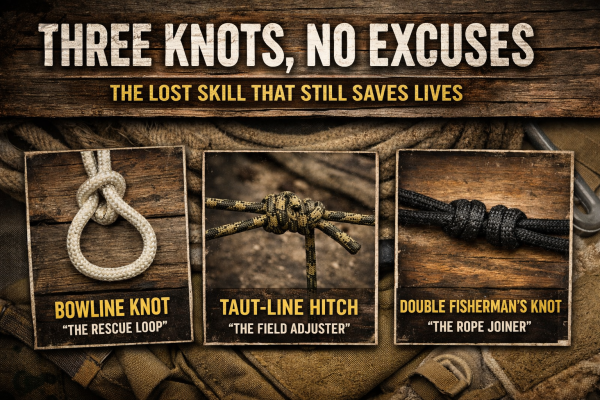
There was a time—not that long ago—when a man who couldn’t tie a knot was considered about as useful as a screen door on a submarine. Today, we’ve got people carrying $1,200 smartphones, satellite GPS, and enough titanium gadgets clipped to their belt to look like a walking REI catalog… and they can’t tie a loop that won’t slip under load.
Progress, they call it.
Here’s the uncomfortable truth: rope hasn’t gone obsolete. People have.
Rope is still one of the most versatile, failure-resistant tools ever put in human hands. It doesn’t need batteries. It doesn’t care about signal strength. It doesn’t crash, freeze, or require a firmware update. But it does demand one thing modern culture avoids like the plague—competence.
And competence starts with three knots.
Not fifty. Not a Boy Scout merit badge sash full of decorative nonsense. Three.
The fixed loop. The adjustable tension. The permanent join.
Call them what they are: the bowline, the taut-line hitch, and the double fisherman’s knot. If you can tie those three without thinking, you can solve about 99% of the real problems you’ll encounter with rope in the wild—or in life.
Let’s make this practical.
Someone falls through ice. You don’t have time to debate YouTube tutorials. You need a loop that won’t cinch down and choke them out. That’s your bowline. Tie it, throw it, pull. That’s not a hobby—that’s a decision point between recovery and regret.
You’re setting up shelter and the weather turns sideways—wind, sleet, the kind of cold that makes your hands feel like someone else’s problem. Your lines slacken, your tarp starts flapping like a surrender flag. You don’t rebuild the whole system—you adjust it. That’s your taut-line hitch. Slide, tension, lock. Done.
You run out of rope because, of course, you do. You always do. Now you need to extend your line without creating a weak point that’s going to fail at the worst possible moment. That’s your double fisherman’s. Two lines become one, and they stay that way.
Three knots. That’s it. That’s the toolkit.
Now, let’s address the modern “strategy” most people use with rope: panic tying. You’ve seen it. A guy grabs a line and just starts stacking knots like he’s trying to impress a Boy Scout court of honor—overhand on top of half hitch on top of something that might be a square knot if you squint hard enough. It looks secure. It feels secure. It is, in fact, a complete disaster.
Because sure—if you tie enough random knots, something might hold. For a while. But now you’ve turned a perfectly good rope into a tangled monument to bad decisions. When it’s time to untie it? Congratulations, you’ve invented a permanent installation. You didn’t secure your gear—you sacrificed your rope.
That’s where the bowline quietly separates the amateurs from the adults. It gives you a loop that won’t slip under load—and just as importantly—won’t weld itself into a useless knot when you’re done. Use it, load it, trust it… then untie it and use the rope again. Imagine that: a solution that works now and doesn’t punish you later.
So why is this a “lost skill”?
Because we replaced skill with stuff.
We’ve convinced ourselves that a ratchet strap is a substitute for knowledge. That a carabiner is a personality trait. That if something goes wrong, we’ll just “look it up.” As if the moment you’re standing in cold water, or holding tension on a line that’s the only thing keeping a problem from getting worse, is the perfect time to scroll for answers.
Here’s a professional observation: under stress, people don’t rise to the occasion—they fall back on their level of training. If your level of training is “I saw this once on YouTube,” you’re about to have a very educational experience.
Knots expose that gap immediately.
You can’t fake them. You can’t bluff your way through them. Either your hands know what to do, or they don’t. And when they don’t, everything downstream starts to unravel—sometimes literally.
This is why knots show up everywhere serious people operate: rescue, climbing, boating, diving, hunting, fieldcraft. Not because they’re quaint. Because they work.
Even in the most high-speed environments—guys with more gear than a small nation—rope and knots are still part of the equation. Why? Because they’re simple, redundant, and brutally reliable. The more complex your world gets, the more valuable simple skills become.
That’s the paradox modern culture missed.
We’ve optimized for convenience and lost capability.
But here’s the good news: this one’s easy to fix.
You don’t need a course. You don’t need a certification. You don’t need a weekend retreat with a guy named Aspen who talks about “intentional cordage journeys.”
You need ten feet of rope and about 15 minutes of focused effort.
Learn one knot at a time. Tie it slow. Then tie it faster. Then tie it without looking. Then tie it in the dark. Then tie it when your hands are cold. Then tie it until you can carry on a conversation while your fingers do the work without asking permission from your brain.
That’s when it becomes real.
And if you want to make it stick—teach it.
Teach your kids. Teach your buddies. Turn it into a challenge. “Sixty seconds. Tie a bowline behind your back.” Make it competitive. Make it slightly uncomfortable. That’s how skills get burned in.
Because here’s the bottom line: nobody ever regretted knowing how to tie a solid knot.
But plenty of people have regretted not knowing when it counted.
Three knots. No excuses.
The rope is still waiting.
If you enjoyed this article, then please REPOST or SHARE with others; encourage them to follow AFNN. If you’d like to become a citizen contributor for AFNN, contact us at managingeditor@afnn.us Help keep us ad-free by donating here.
Substack: American Free News Network Substack
Truth Social: @AFNN_USA
Facebook: https://m.facebook.com/afnnusa
Telegram: https://t.me/joinchat/2_-GAzcXmIRjODNh
Twitter: https://twitter.com/AfnnUsa
GETTR: https://gettr.com/user/AFNN_USA
CloutHub: @AFNN_USA
Excellent. An additional “go to”, at least in the marine environment, is the cleat hitch, used ( guesstimate) millions of times per day. Done properly it can be untied while under load, and doesn’t render itself requiring a knife to undo.