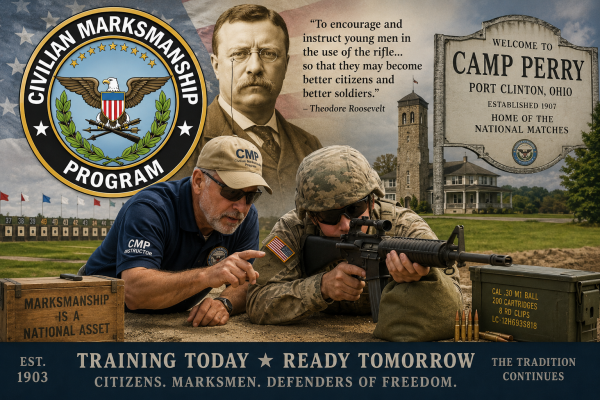
When Americans hear “Civilian Marksmanship Program,” many picture old rifles, junior air-gun teams and retired men arguing about X-counts at Camp Perry.
That is all true.
It is also a wildly incomplete picture.
The CMP was created because Congress and President Theodore Roosevelt understood that marksmanship was not merely recreation. It was national preparedness. The poor shooting demonstrated by many American soldiers during the Spanish-American War helped convince national leaders that the country needed a deeper reserve of trained marksmen before the next emergency arrived. In 1903, the federal government established the National Board for the Promotion of Rifle Practice and the National Matches—the institutional ancestors of today’s CMP.
For most of the twentieth century, the program operated under the Army. Then, in 1996, Congress and President Bill Clinton removed it from direct government administration and created the Corporation for the Promotion of Rifle Practice and Firearms Safety as a federally chartered nonprofit, a 501c3.
The expectation may have been that the old marksmanship program would quietly fade away once Washington stopped providing annual appropriations. Instead, the CMP became self-sustaining through congressionally authorized sales of surplus military firearms and ammunition. Those proceeds fund its ranges, training, youth programs and competitions rather than another annual raid on the taxpayer.
And then came Iraq.
After the 2003 invasion, the Army encountered a battlefield where soldiers frequently needed to identify and engage threats beyond ordinary close-range qualification distances. The service began expanding the Squad Designated Marksman concept: one soldier within an infantry squad trained to deliver more accurate fire at intermediate ranges without becoming a separate sniper.
There was one small bureaucratic inconvenience: the Army did not have enough qualified instructors to rapidly train all the soldiers who needed the skill.
So the CMP reached into America’s civilian competitive-shooting community.
With assistance from the U.S. Army Marksmanship Unit, the CMP assembled a cadre of approximately 40 volunteer civilian Military Rifle Instructors. These experienced competitors traveled to installations including Fort Campbell, Kentucky, and Fort Hood, Texas, where they helped conduct Squad Designated Marksman courses for soldiers preparing to deploy. The program was intended to place a trained designated marksman in each combat squad.
Think about that for a moment.
Civilian rifle competitors left their homes, traveled to Army posts and volunteered their expertise to train active-duty soldiers heading to war. God Bless America!
The supposed hobbyists became a reserve pool of advanced marksmanship instructors when the military needed them.
That is precisely why the CMP exists. And visionary leaders like Roosevelt knew it.
Competitive shooters spend years mastering positions, sight adjustment, trigger control, trajectory, wind judgment and the diagnosis of shooting errors. On a pleasant Saturday, those skills produce medals and bragging rights. During national mobilization, they become a body of knowledge that can be transferred directly to soldiers and future recruits.
Apparently, shooting competitions were not merely grown men playing with expensive guns in funny looking shooting coats after all.
The CMP continues supporting the Armed Forces through the National Matches and the Small Arms Firing Schools. Federal law requires these schools to be assembled annually. Today, the U.S. Army Marksmanship Unit, military shooting teams and certified CMP instructors provide classroom and live-fire instruction to civilians, while the CMP supplies much of the organization, facilities and range infrastructure. The schools now train more than 1,000 US Civilians annually.
America may have hundreds of millions of privately owned firearms, but ownership alone creates neither competence nor preparedness. A rifle in a closet is an object. A disciplined shooter who understands safety, maintenance, trajectory and accurate fire is an asset.
The CMP transforms the first into the second.
Its youth programs teach responsibility. Its matches preserve advanced skills. Its instructor network spreads firearms safety. Its ranges maintain national training infrastructure. And, as the Iraq-era Squad Designated Marksman effort demonstrated, its civilian competitors can reinforce the military when official training capacity falls short.
Modern warfare may feature drones, satellites and artificial intelligence, but somebody still has to identify the enemy, control the weapon and place the shot.
The CMP is recreational sport with a strategic side effect: it keeps America’s reservoir of marksmanship knowledge alive.
That is not an obsolete tradition.
It is national-security insurance—funded largely without an annual federal appropriation and maintained by citizens who still know which end of the rifle faces downrange.
If you enjoyed this article, then please REPOST or SHARE with others; encourage them to follow AFNN. If you’d like to become a citizen contributor for AFNN, contact us at managingeditor@afnn.us Help keep us ad-free by donating here.
Substack: American Free News Network Substack
Truth Social: @AFNN_USA
Facebook: https://m.facebook.com/afnnusa
Telegram: https://t.me/joinchat/2_-GAzcXmIRjODNh
Twitter: https://twitter.com/AfnnUsa
GETTR: https://gettr.com/user/AFNN_USA
CloutHub: @AFNN_USA