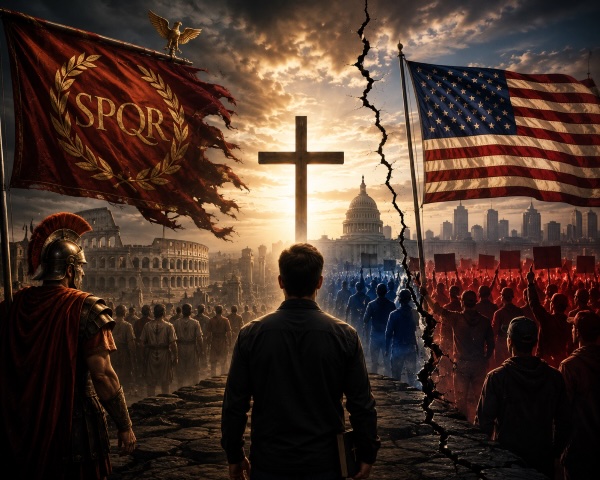
The Romans worried about Rome.
We worry about America.
Different empire. Different century. Same anxiety.
Every generation eventually reaches the point where people begin asking whether the system still works. Trust begins to erode. Institutions lose credibility. Political opponents stop being viewed as fellow citizens with different ideas and instead become existential enemies. Every election is portrayed as “the most important in history,” and every defeat is treated as proof that democracy itself has failed.
Sound familiar?
Whether those fears are justified or exaggerated, the perception alone carries enormous consequences. A constitutional republic survives on something far more fragile than ballots and court rulings. It survives because enough people voluntarily accept the legitimacy of the outcome—even when they lose.
When that confidence disappears, the nation begins to fracture into tribes.
And tribes have very short memories and very long grudges.
For Christians, however, this isn’t unfamiliar territory. In many ways, the New Testament was written for believers living under governments they neither elected nor trusted. Rome was hardly a shining example of liberty. It was corrupt, politically ruthless, and eventually openly hostile to Christianity. Yet nowhere do we find Jesus or the apostles placing their hope in political revolution.
Instead, they consistently redirected people’s eyes toward something higher.
That doesn’t mean politics are unimportant. Far from it. Christians should vote. They should serve in public office. They should defend justice, speak for the voiceless, and seek the good of their communities. Jeremiah instructed the Jewish exiles to “seek the peace and prosperity of the city” where they had been carried into captivity. Think about that for a moment. Babylon had destroyed Jerusalem, burned the Temple, and carried God’s people away in chains. Yet God still told His people to pray for Babylon and work for its welfare.
Why?
Because God’s people don’t abandon their principles simply because they’re surrounded by imperfect governments.
Jesus reinforced the same idea when His opponents tried to trap Him with a political question about taxes. Holding up a Roman coin, He answered, “Render unto Caesar the things that are Caesar’s, and unto God the things that are God’s.” It was a brilliant answer because it established both a duty and a limit. Governments have legitimate authority—but they do not possess ultimate authority. Caesar could mint coins bearing his image. He could never claim ownership over people made in God’s image.
That distinction may be one of the most important lessons Christians need to recover today.
The Bible consistently presents faithful believers as good citizens—but terrible idolaters.
Joseph faithfully administered Egypt without adopting Egyptian gods. Daniel became one of Babylon’s highest-ranking officials while refusing to worship Nebuchadnezzar’s golden image. Esther worked within the Persian government to save her people. Nehemiah served as cupbearer to a pagan king with remarkable loyalty. None of them were anarchists. None of them confused patriotism with worship either.
The apostles followed the same pattern. They respected civil authority, paid taxes, and urged believers to pray for rulers. Yet when those rulers demanded what belonged only to God, the answer was immediate and unmistakable: “We must obey God rather than men.”
Notice the order.
Not instead of government.
Above government.
That hierarchy has protected Christians for two thousand years from both anarchy and tyranny.
History shows what happens when that order is forgotten.
Kings claimed divine authority because people misread Romans 13. Slaveholders quoted Scripture while denying the humanity of those they enslaved. Authoritarian governments have always preferred churches that preach unconditional obedience over biblical discernment. The lesson isn’t that government is evil. The lesson is that even good institutions become dangerous when they demand the loyalty that belongs to God alone.
America now faces its own test.
The greatest threat may not be a single election, a particular candidate, or one political party. It may be the gradual collapse of public trust itself. Once enough people believe elections no longer reflect the will of the people, every transfer of power becomes suspect. Political parties become tribes. Tribes become enemies. Compromise becomes surrender. Every disagreement feels apocalyptic.
Christians should be the first to recognize this temptation because we’ve seen it before—not only in history books, but in Scripture itself.
Our hope has never depended on whether our preferred candidate occupies the White House.
Our peace has never been guaranteed by Congress.
Our security has never rested in the Supreme Court.
If it did, the early Church would have collapsed before it ever reached its second generation.
Instead, Christianity flourished under emperors, kings, dictators, democracies, republics, and every form of government in between because its foundation was never political. It was spiritual.
Paul reminds believers in Philippians that “our citizenship is in heaven.” That isn’t an excuse to neglect our earthly citizenship. Quite the opposite. It allows us to engage in politics without being consumed by it. We can love our country deeply without believing it is infallible. We can criticize our leaders without hating our nation. We can lose elections without losing hope because our ultimate King never appears on a ballot.
Perhaps that is the quiet genius of Christianity.
It produces citizens who are difficult to manipulate.
They refuse to worship government, but neither do they despise it. They honor authority, yet reserve their highest allegiance for God. They pray for their leaders—even the ones they didn’t vote for. They serve their country faithfully while remembering that every earthly nation, no matter how exceptional, is temporary.
Empires eventually become archaeological sites.
Political parties become chapters in history books.
Campaign slogans fade.
Flags weather.
The Kingdom of God alone endures.
So if the years ahead bring greater polarization, disputed elections, louder political tribes, and growing uncertainty, Christians need not panic. We have walked this road before. The Church has survived Neros, kings, revolutions, world wars, and dictators. It has outlived every empire that once believed itself permanent.
Our duty to America is real.
Our duty to God is greater.
When we keep those loyalties in the proper order, we become exactly the kind of citizens every republic needs—and exactly the kind of disciples Christ calls us to be.
_________________________________
If you enjoyed this article, then please REPOST or SHARE with others; encourage them to follow AFNN. If you’d like to become a citizen contributor for AFNN, contact us at managingeditor@afnn.us Help keep us ad-free by donating here.
_________________________________
Substack: American Free News Network Substack
Truth Social: @AFNN_USA
Facebook: https://m.facebook.com/afnnusa
Telegram: https://t.me/joinchat/2_-GAzcXmIRjODNh
Twitter: https://twitter.com/AfnnUsa
GETTR: https://gettr.com/user/AFNN_USA
CloutHub: @AFNN_USA