Perhaps we’ve been looking at America’s beef crisis all wrong.
Beef is expensive. The cattle herd is historically small. Drought hammered ranchers. Feed got expensive. Equipment got expensive. Interest got expensive. Land got expensive. Mexican cattle imports were disrupted because a flesh-eating parasite decided to make a comeback.
Obviously, the solution is simple.
Eat bugs.
Why bother fixing the economics of raising cattle when we can just put a little cricket aioli on a toasted brioche bun and call it sustainable?
Welcome to American agricultural policy, where we have somehow developed the remarkable ability to simultaneously complain that farmers aren’t producing enough food while adopting policies that can make producing that food less attractive.
The beef shortage isn’t imaginary. USDA reported in July that America had about 28.5 million beef cows, another 1 percent below last year, while the projected 2026 calf crop fell to 32.5 million head. Agricultural economists are warning that feeder-cattle supplies remain extremely tight and that rebuilding the herd isn’t happening quickly.
This isn’t a PlayStation game.
You cannot hit RESPAWN COW.
A rancher deciding to expand today doesn’t have another 1,200-pound steer standing in the pasture tomorrow morning. He retains breeding females that otherwise could have been sold. He feeds them. Waters them. Breeds them. Pays the veterinarian. Pays taxes. Pays interest. Fixes fences. Buys diesel. Prays for rain. Gets a calf. Raises the calf.
Then, eventually, we get hamburger.
That process takes years.
And for once, the market is actually sending cattle producers a very clear message:
WE NEED MORE COWS.
Prices rise. Producers see an economic incentive to expand. Ranchers retain heifers. Herds eventually rebuild. Supply eventually increases. Prices eventually moderate.
Adam Smith could explain this using a napkin and three beers.
Washington apparently required a committee.
Because now that beef prices are politically uncomfortable, the federal government has announced plans to allow as much as 300,000 metric tons of additional ground beef to enter the United States at reduced tariffs during a 90-day period.
Why?
To lower beef prices.
When?
Right before the midterm elections.
Nothing suspicious here, folks. Please continue chewing.
Reuters reports that American cattle producers immediately objected, warning that dumping below-market imported beef into the market could discourage the very herd expansion America needs. Cattle futures dropped following the announcement. Economists also questioned whether the imports represent enough beef to meaningfully reduce supermarket prices.
This isn’t merely farmers whining because somebody else wants to sell hamburger.
There is an important economic argument underneath their complaint.
America has a cattle shortage.
The cure for a cattle shortage is more cattle.
More cattle require investment.
Investment requires the expectation of profit.
And the expectation of profit requires producers to believe Washington isn’t going to change the rules whenever the price of hamburger becomes inconvenient during an election year.
The U.S. Cattlemen’s Association put it rather plainly: government intervention could threaten cattle prices and undermine confidence in the domestic beef market.
Imagine applying this philosophy to anything else.
We discover America doesn’t have enough electricians.
Electricians consequently start earning more money.
Young Americans look at those wages and think, Maybe I should become an electrician.
Excellent.
The market is fixing the shortage.
Then Washington announces:
ELECTRICIANS ARE TOO EXPENSIVE.
Therefore, for the next 90 days, we’re importing 300,000 discounted electricians.
And afterward everyone gathers around a conference table wondering why nobody wants to spend four years becoming an electrician.
That’s essentially the cattleman’s complaint.
And let’s remember who we’re talking about.
The American rancher isn’t some multinational corporation with an office full of analysts determining whether the third-quarter EBITDA projection satisfies institutional investors.
He’s frequently a family business sitting on enormous capital assets, carrying enormous risk, depending upon weather he cannot control, commodity markets he cannot control, fuel prices he cannot control, feed prices he cannot control, interest rates he cannot control, disease outbreaks he cannot control and government policy he most certainly cannot control.
When things go wrong, he doesn’t get to send the cow back to Amazon.
And lately things have gone wrong.
Years of drought helped force producers to liquidate cattle. Feed became expensive. Herd numbers declined. Mexican cattle supplies were interrupted by New World screwworm concerns. Processing economics became ugly.
Eventually supply and demand performed exactly as advertised.
Less beef + continued demand = expensive beef.
Americans looked at the grocery-store cooler and screamed.
And politicians discovered economics.
Not the boring kind where supply takes years to rebuild.
The exciting kind where something can happen before Election Day.
Reuters reports the 90-day import announcement comes as high food prices have become a major voter concern ahead of November’s midterms. That doesn’t prove the policy was created for electoral purposes. But if someone schedules a 90-day economic intervention roughly 74 days before an election, citizens are allowed to raise one eyebrow without being fitted for a tinfoil hat.
And here’s the bipartisan rule we ought to establish:
Government should not manipulate agricultural markets for political convenience.
Not Republican government.
Not Democratic government.
Not MAGA government.
Not progressive government.
Nobody.
Because the cow doesn’t know who’s president.
She just knows whether somebody can afford to raise her.
This is where our national conversation about food becomes particularly absurd.
For years we’ve heard lectures about beef’s environmental footprint. Cows require land. Cows require feed. Cows require water. Cows burp methane. Some environmental advocates have encouraged people to reduce meat consumption, while alternative proteins—including insects—have periodically been promoted as more sustainable food sources.
Fine. People are free to eat whatever they want.
If you’d like a grasshopper taco, knock yourself out.
I’ll have the ribeye.
But there’s something profoundly backwards about treating the American cattle producer as yesterday’s environmentally inconvenient industry while simultaneously becoming alarmed when America doesn’t have enough cattle.
You can’t spend years making cattle production harder, watch producers shrink their herds, discover hamburger costs seven bucks a pound, and then announce:
WHY DID THE FARMERS DO THIS TO US?
The farmer didn’t.
The cow didn’t.
Supply and demand didn’t.
Supply and demand is the one character in this story behaving consistently.
And if Americans truly decide beef isn’t worth producing anymore, then let’s at least be honest about what comes next.
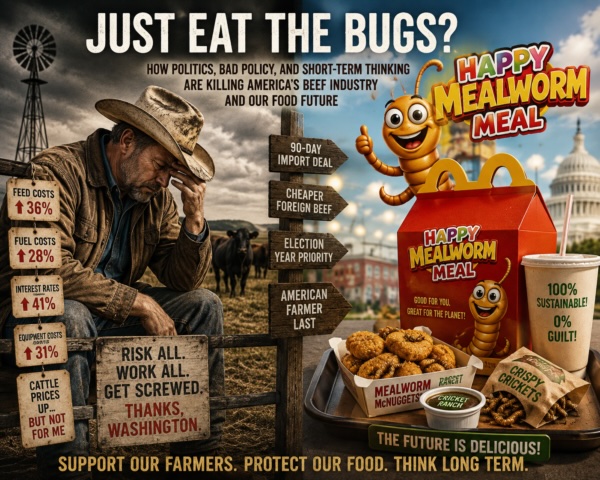
Welcome to McCricket.
Would you like your Mealworm McNuggets in six-piece or ten-piece?
For only 99 cents more, upgrade to the Extra-Large Sustainable Larvae Combo.
Don’t forget our new environmentally responsible dipping sauces: Ranch, Barbecue and Government Subsidy.
Maybe we’ll even get a children’s meal.
The Happy Mealworm.
Collect all six Department of Agriculture USDA action figures.
But before we fire up the cricket fryer, perhaps there’s another option.
We could decide that having a strong domestic agricultural system is actually a matter of national security.
We could recognize that American farmers and ranchers aren’t simply interchangeable suppliers in a global spreadsheet.
They’re the people producing our food.
That matters.
A country that becomes dependent upon foreign nations for steel discovers the consequences during war.
A country that becomes dependent upon foreign nations for pharmaceuticals discovers the consequences during a pandemic.
And a country that becomes unnecessarily dependent upon foreign nations for food may someday discover that cheap hamburger wasn’t quite as cheap as advertised.
Imports have a legitimate role in American agriculture. Trade isn’t inherently bad. Foreign beef isn’t inherently unsafe. Consumers deserve affordable food.
But deliberately depressing domestic prices to obtain short-term consumer relief while simultaneously telling cattlemen that America desperately needs them to rebuild their herds is economic schizophrenia.
We cannot tell the rancher:
“Produce more.”
And simultaneously tell the market:
“But don’t let the price rise enough to make producing more attractive.”
Pick one.
If the American cattle herd is too small, then America needs cattlemen willing to risk their money rebuilding it.
That means those producers need confidence that the government isn’t going to pull the rug out from underneath them whenever grocery prices become politically inconvenient.
Because someday the rancher may finally decide he’s had enough.
He’ll sell the cows.
Sell the equipment.
Sell the land.
Take his capital somewhere easier.
And Washington will commission a $14 million study to determine why American beef production disappeared.
The report will be 487 pages long.
The conclusion could have been written on a cocktail napkin:
We screwed the farmer.
And by then, don’t worry.
There will still be plenty of protein.
Just grab the ketchup.
And eat the bugs. Smile and be happy it’s cheap.
_________________________________
If you enjoyed this article, then please REPOST or SHARE with others; encourage them to follow AFNN. If you’d like to become a citizen contributor for AFNN, contact us at managingeditor@afnn.us Help keep us ad-free by donating here.
_________________________________
Substack: American Free News Network Substack
Truth Social: @AFNN_USA
Facebook: https://m.facebook.com/afnnusa
Telegram: https://t.me/joinchat/2_-GAzcXmIRjODNh
Twitter: https://twitter.com/AfnnUsa
GETTR: https://gettr.com/user/AFNN_USA
CloutHub: @AFNN_USA