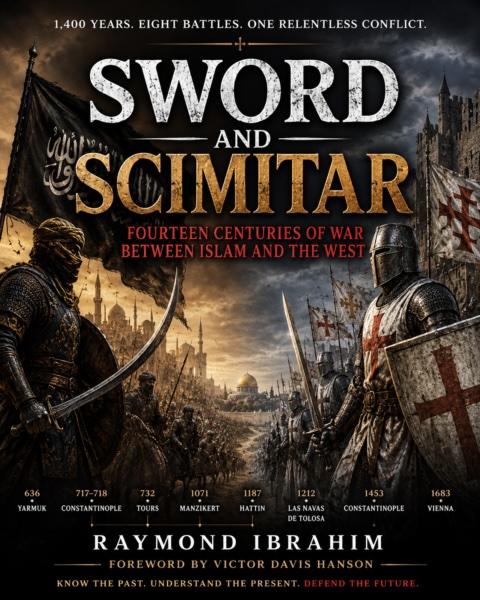
Raymond Ibrahim’s Sword and Scimitar: Fourteen Centuries of War between Islam and the West commits one of the great sins of modern historical writing: It starts the story at the beginning.
Apparently, this is controversial.
The popular Western version of the Crusades sometimes sounds roughly like this: Europe was sitting around polishing swords, drinking questionable medieval beer, and wondering what everybody should do that weekend when Pope Urban II suddenly yelled, “ROAD TRIP!” and thousands of Christians invaded the peaceful Middle East for no discernible reason.
Ibrahim backs the historical truck up about 450 years.
And suddenly the scenery changes.
His thesis is straightforward and uncomfortable: the military conflict between Islam and Christian civilization did not begin with the First Crusade in 1095. It had already been underway for centuries. Sword and Scimitar follows that struggle through eight great battles and sieges stretching from Yarmuk in 636 to Vienna in 1683. Ibrahim describes the book himself as a military history centered on eight decisive encounters, while using them to tell the much larger story occurring between them.
That means we don’t begin with Crusaders charging toward Jerusalem.
We begin with Christian civilization losing enormous pieces of its world.
Yarmuk, 636: The Door Gets Kicked Open
The Battle of Yarmuk is where Ibrahim begins the military story. Byzantine (Christian) forces confront the rapidly expanding armies of the new Islamic state and suffer a catastrophic defeat.
The consequences are enormous.
Syria and Palestine, lands deeply embedded in the Christian Roman world, are opened to Muslim conquest. Egypt follows. North Africa follows. Eventually Muslim armies cross into Spain.
These weren’t historically Islamic territories that Europeans later wandered into. Much of this territory had belonged to the Roman and Byzantine Christian world.
That’s one of Ibrahim’s most important corrections to the popular narrative.
Before Christianity was invading the Muslim Middle East during the Crusades, Islam had conquered enormous portions of what had previously been Christian civilization. The publisher summarizes Ibrahim’s argument as Muslim forces eventually occupying nearly three-quarters of historic Christendom before the Crusades began.
That doesn’t automatically justify everything Crusaders later did.
It does something more important.
It supplies context.
History without context isn’t history. It’s propaganda wearing reading glasses.
Constantinople, 717–718: Civilization Hangs on a Wall
Next comes one of history’s great defensive stands.
The Umayyad Caliphate attempts to capture Constantinople. Had the city fallen, southeastern Europe would have been exposed to further expansion at a dramatically earlier point in history.
The Byzantines survive.
Barely.
This is one of the recurring lessons of Ibrahim’s book: events we now treat as obscure medieval trivia weren’t obscure to the people experiencing them.
They thought their civilization might disappear.
Because sometimes it nearly did.
Tours, 732: Charles Martel Says “That’s Far Enough”
Muslim armies had already crossed North Africa, conquered most of the Iberian Peninsula and pushed northward into Frankish territory when they encountered Charles Martel near Tours and Poitiers.
Martel wins.
Historians debate exactly how decisive Tours was in stopping Islamic expansion into Western Europe. Ibrahim unsurprisingly comes down strongly on the side of its significance.
But step back from that argument and notice the map.
An Islamic army is fighting in France in 732.
That’s only about a century after Muhammad’s death.
Islam hadn’t merely become a religion.
It had become one of the fastest-expanding political and military civilizations the world had ever seen.
Manzikert, 1071: Somebody Might Want to Call Rome
Then comes disaster.
At Manzikert, the Seljuk Turks defeat the Byzantine army.
Anatolia—the heartland of the Byzantine Empire and much of modern Turkey—becomes increasingly vulnerable to Turkish settlement and conquest.
And here’s where the chronology becomes inconvenient.
Manzikert: 1071.
Pope Urban II calls the First Crusade: 1095.
That’s twenty-four years.
Suddenly the Crusades aren’t floating in historical space.
The Byzantine emperor had appealed westward for military assistance against the Turks. Jerusalem had been under Muslim rule for centuries, Christian territories had steadily contracted, and Byzantium was losing the strategic depth protecting Constantinople.
Then Urban called for armed assistance and recovery of the Holy Land.
You don’t have to canonize every Crusader to recognize that this changes the story considerably.
The Crusades: Wait, There Were Events Before 1095?
This is where Ibrahim takes a sledgehammer to the cartoon version of Crusade history.
His provocative argument is that the Crusades were substantially reactive, arising after centuries of Muslim conquest rather than constituting the opening act of Christian-Muslim warfare.
One of his most memorable lines is:
“Shocking as it may seem, love… was the primary driving force behind the crusades.”
He means medieval Christian agape—the belief that Christians had obligations toward fellow Christians and sacred places under threat—not modern romantic affection.
Were Crusaders brutal?
Absolutely.
Welcome to medieval warfare.
Nobody arrived at Antioch carrying a Geneva Convention card.
Ibrahim doesn’t need Crusaders to be perfect. His larger point is that judging the Crusades while deleting the preceding centuries produces a fundamentally distorted picture.
Hattin, 1187: Saladin Wrecks the Crusader Army
Then Ibrahim gives the other side its victory.
Saladin crushes the Crusader army at Hattin.
Jerusalem subsequently falls.
This is important because Sword and Scimitar isn’t eight chapters of “Christians win, roll credits.” Ibrahim deliberately structures the book around four major Muslim victories and four Christian victories.
Sometimes brilliant leadership wins.
Sometimes arrogance loses.
Sometimes armies become complacent.
Sometimes internal political squabbling accomplishes what the enemy couldn’t.
There’s probably a lesson in there somewhere, but surely modern civilization has evolved beyond factionalism, political stupidity and leaders fighting each other while major threats develop outside the gates.
Moving right along.
Las Navas de Tolosa, 1212: Spain Starts Coming Back
The Reconquista receives its great turning point at Las Navas de Tolosa.
Christian kingdoms defeat the Almohad forces in Spain.
This matters enormously to Ibrahim because Spain demonstrates the broader pattern he wants readers to see.
Muslim conquest.
Centuries of occupation and conflict.
Christian counterattack.
Recovery.
Yet modern terminology often gives us the impression that “conquest” and “reconquest” somehow describe morally identical starting points.
Ibrahim asks readers to remember what came first.
Chronology: still undefeated.
Constantinople, 1453: The Roman Empire Finally Dies
This chapter is brutal.
Mehmed II’s Ottoman army surrounds Constantinople. Cannons batter walls that had protected the city for roughly a thousand years.
Emperor Constantine XI fights.
The walls break.
The city falls.
The Byzantine—or Eastern Roman—Empire ends.
A civilization stretching directly back to ancient Rome is extinguished.
For Ibrahim, Constantinople isn’t merely another territorial acquisition. It represents the culmination of centuries of pressure against the eastern Christian world.
And yet even this wasn’t the end.
Because the Ottomans kept moving west.
Vienna, 1683: Stop Means Stop
More than a thousand years after Yarmuk, Ottoman armies arrive outside Vienna.
Think about that timeline.
636 to 1683.
The actors changed. Arabs, Berbers, Turks, different caliphates, dynasties and sultanates came and went.
But Ibrahim sees continuity in the ideological framework surrounding expansion.
At Vienna, the Ottoman advance finally meets catastrophe when the Christian relief army arrives, famously including the Polish winged hussars under King Jan III Sobieski.
The siege collapses.
The Ottoman tide begins its long retreat from Central Europe.
Western civilization survives another Monday.
The Argument Ibrahim Really Wants You to Understand
The battles are fantastic military history, but they aren’t the book’s deepest point.
Ibrahim argues that Western civilization has forgotten the continuity of the conflict.
His thesis is deliberately provocative:
“Muslim hostility for the West is not an aberration but a continuation of Islamic history.”
That is the sentence around which the entire book revolves.
Ibrahim’s argument isn’t simply that Muslims and Christians happened to fight repeatedly. Every civilization fought wars.
His contention is that jihad supplied a religious framework that repeatedly legitimized expansion against non-Muslim territories and that this framework survived the rise and fall of individual Islamic empires.
In other words, rulers changed.
Flags changed.
Languages changed.
The theology didn’t disappear.
That is why Ibrahim spends so much time with Muslim sources. His ability to work with Arabic material is particularly important to the book, which also draws upon Greek and other contemporary sources. Even reviewers who disagree with his conclusions have noted his extensive sourcing and use of contemporary Muslim and Christian perspectives.
And that leads to perhaps the most serious lesson in Sword and Scimitar.
Listen to civilizations when they tell you what they believe.
Don’t automatically translate their motives into whatever explanation makes modern Western people most comfortable.
Sometimes religion actually means religion.
Sometimes conquest means conquest.
Sometimes somebody standing outside your city wall with 100,000 soldiers isn’t experiencing socioeconomic anxiety.
The Most Uncomfortable Lesson
Perhaps Ibrahim’s most devastating observation isn’t about Islamic civilization at all.
It’s about us.
He writes:
“The West has learned to despise its heritage and religion.”
His argument is that this historical amnesia leaves Western civilization poorly equipped to recognize patterns its ancestors understood intimately.
You don’t have to hate Muslims to study Islamic history.
You don’t have to hate Christians to study the Crusades.
You don’t have to apologize for either civilization before opening the book.
You simply have to be willing to ask the forbidden historical question:
What actually happened?
Then follow the evidence wherever it goes.
That may be the greatest strength of Sword and Scimitar. Ibrahim forces the reader to zoom the historical camera out.
At maximum zoom, 1095 looks like Christians invading the Islamic world.
Zoom out 450 years and something very different appears: Yarmuk, Syria, Jerusalem, Egypt, North Africa, Spain, Constantinople, Tours, Sicily, Anatolia and Manzikert.
Suddenly the Crusades aren’t Chapter One.
They’re somewhere around Chapter Four.
And that’s one hell of a difference.
Ibrahim closes his argument with a warning considerably more eloquent than anything I could add:
“A still swinging Scimitar will always overcome a strong but sheathed Sword.”
You can argue with Ibrahim’s interpretation.
You can argue about individual battles.
You can argue about how much weight should be assigned to theology, politics, economics, dynastic ambition or simple human greed.
That’s what historians are supposed to do.
But there’s one thing you shouldn’t do.
Start a 1,400-year story halfway through and call it history.
_________________________________
If you enjoyed this article, then please REPOST or SHARE with others; encourage them to follow AFNN. If you’d like to become a citizen contributor for AFNN, contact us at managingeditor@afnn.us Help keep us ad-free by donating here.
_________________________________
Substack: American Free News Network Substack
Truth Social: @AFNN_USA
Facebook: https://m.facebook.com/afnnusa
Telegram: https://t.me/joinchat/2_-GAzcXmIRjODNh
Twitter: https://twitter.com/AfnnUsa
GETTR: https://gettr.com/user/AFNN_USA
CloutHub: @AFNN_USA