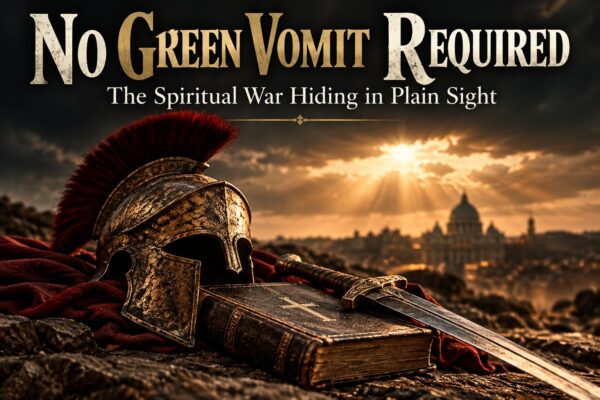
There is something deeply inconvenient about Ephesians 6.
Especially in America in 2026, where we have become extraordinarily talented at identifying exactly who is responsible for everything wrong with civilization.
It’s the Democrats.
It’s the Republicans.
It’s the Catholics.
It’s the Protestants.
It’s the liberals, conservatives, immigrants, billionaires, bureaucrats, bishops, atheists, boomers, millennials, or whichever collection of human beings irritated you before breakfast.
Then the Apostle Paul wanders into the argument and ruins everybody’s fun.
“For our struggle is not against flesh and blood, but against the rulers, against the authorities, against the powers of this dark world and against the spiritual forces of evil in the heavenly realms.” — Ephesians 6:12.
Well, crap.
That passage came back to me listening to Catholic priest and exorcist Father Chad Ripperger talking with Shawn Ryan about spiritual warfare and corruption within the Church. Ripperger makes some extraordinary claims based upon his experiences performing exorcisms. Some are impossible for an outsider to verify, and Christians should be particularly careful about treating something allegedly spoken by a demon as reliable intelligence.
After all, if Satan is the father of lies, perhaps we shouldn’t promote him to confidential informant.
But underneath the spectacular stories is a much more serious theological argument, and this one deserves attention.
What if spiritual warfare usually doesn’t look like The Exorcist?
What if evil’s most effective weapons aren’t levitating furniture, spinning heads and Latin shouting matches?
What if they are considerably more boring?
Pride.
Lust.
Greed.
Fear.
Cowardice.
Deception.
Hatred.
Division.
Now things get uncomfortable.
Suppose for a moment that Satan actually wanted to destroy Christianity. Would the best strategy really be sending some horned creature marching through the Vatican carrying a pitchfork?
Probably not.
Nothing fills church pews quite like obvious persecution. Christianity was practically built on it. Feed Christians to lions and somebody will probably build a basilica over the spot.
Corruption from inside is much more efficient.
A priest abuses a child.
A superior discovers it and protects the institution instead of the victim.
Someone else knows but remains silent.
Money disappears.
Power becomes more important than truth.
Reputation becomes more important than repentance.
Pretty soon the institution proclaiming Christian morality looks incapable of following its own rules.
You don’t have to destroy the church.
You just have to make people stop believing it.
That is why Ephesians 6 deserves another reading.
Paul doesn’t tell Christians to hunt demons behind every tree. Nor does he tell them to identify human beings as agents of Satan and commence smiting.
His repeated command is much less exciting:
Stand.
And look carefully at the equipment he issues.
Truth.
Righteousness.
The Gospel of peace.
Faith.
Salvation.
The Word of God.
Prayer.
This is possibly the strangest combat load in military history.
No sword except God’s Word. No artillery. No close-air support. Not even a decent entrenching tool.
Because apparently this isn’t that kind of war.
And here is where modern Christianity should become very uncomfortable.
If our supposed spiritual warfare produces hatred, dishonesty, paranoia, arrogance, obsession and division, perhaps we should conduct an equipment inspection.
Because those aren’t the weapons Paul issued.
Christians can become so busy identifying evil in everyone else that we forget one of Christianity’s most basic propositions: the battlefield runs straight through the human heart.
That doesn’t excuse human wrongdoing.
Quite the opposite.
If a priest molests a child, the devil doesn’t go to prison.
The priest should.
If a bishop conceals abuse, supernatural warfare doesn’t eliminate his responsibility.
If a politician lies, a businessman steals or a husband commits adultery, “Satan tempted me” isn’t a theological Get Out of Jail Free card.
Christianity recognizes temptation precisely because humans retain the ability—and responsibility—to resist it.
Perhaps that is the most important part of Ripperger’s message, regardless of what anyone thinks about his more extraordinary accounts of exorcism.
The greatest victories of evil may not involve possession at all.
Maybe they’re much simpler.
Convince good people that lying is acceptable because their cause is righteous.
Convince religious leaders that protecting the institution matters more than telling the truth.
Convince political factions that their opponents aren’t merely wrong but evil.
Convince Christians that hatred becomes virtuous when directed at sufficiently horrible people.
And finally, convince everybody that the enemy is always somebody else.
Paul saw that trap almost two thousand years ago.
Our struggle is not against flesh and blood.
That doesn’t mean flesh and blood doesn’t commit terrible acts. It means there is something deeper happening when lies, hatred, greed, lust, pride and division become normalized.
And maybe that’s why the armor of God sounds so surprisingly ordinary.
Tell the truth.
Do what is right.
Seek peace.
Keep the faith.
Know Scripture.
Pray.
Stand your ground.
Not particularly cinematic.
No green vomit required.
But if Paul was right about the nature of the war, perhaps we’ve spent far too much time screaming at the other soldiers while completely forgetting which direction the enemy is coming from.
If you enjoyed this article, then please REPOST or SHARE with others; encourage them to follow AFNN. If you’d like to become a citizen contributor for AFNN, contact us at managingeditor@afnn.us Help keep us ad-free by donating here.
Substack: American Free News Network Substack
Truth Social: @AFNN_USA
Facebook: https://m.facebook.com/afnnusa
Telegram: https://t.me/joinchat/2_-GAzcXmIRjODNh
Twitter: https://twitter.com/AfnnUsa
GETTR: https://gettr.com/user/AFNN_USA
CloutHub: @AFNN_USA