When most scuba divers talk about world-class wreck diving, the conversation usually drifts toward tropical destinations. Warm water. Palm trees. Coral reefs. Blue water measured in shades of turquoise.
And yet, tucked away on the shores of Lake Huron in northeast Michigan, NOAA’s Thunder Bay National Marine Sanctuary quietly offers one of the most perfectly designed recreational wreck-diving progressions in North America.
The sanctuary protects nearly 100 discovered historic shipwrecks, with historical research suggesting that more than 200 vessels may ultimately be identified throughout the region. The cold, freshwater environment has preserved many of these sites so well that divers often describe them as underwater museums. NOAA designated the sanctuary in 2000 to protect this extraordinary collection of Great Lakes maritime history.
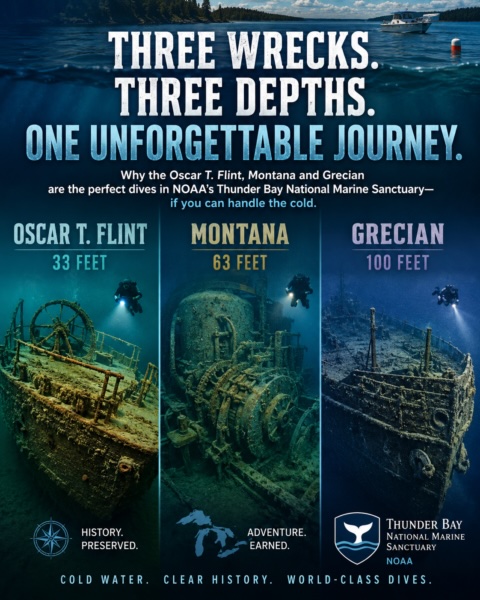
If you were designing a recreational scuba curriculum from scratch, you would be hard-pressed to create a better three-dive progression than the Oscar T. Flint, the Montana, and the Grecian.
The first stop is the Oscar T. Flint, resting in approximately 32 to 33 feet of water. The steam barge caught fire in 1909 and sank with its limestone cargo still aboard. The wreck remains remarkably accessible, allowing newly certified divers to experience a genuine Great Lakes shipwreck without venturing into advanced depths. NOAA lists the wreck at 32 feet.
The next step is the Montana, lying in 63 feet of water. Here, divers encounter something far more substantial. The 236-foot wooden steam barge burned to the waterline in 1914 before settling on the bottom of Thunder Bay. Massive machinery still dominates the site, including an enormous boiler, a towering steam engine, a propeller, and much of the preserved hull. NOAA specifically describes the Montana as an excellent dive site.
And then comes the graduate course: the Grecian.
Officially listed at 100 feet, some divers jokingly insist they can always find 101 or 102 feet somewhere on the dive. The nearly 300-foot steel freighter sank in 1906 while under tow for repairs. Its intact bow and stern, exposed steel framework, boilers, engine, and deck machinery make it one of the sanctuary’s signature wrecks. NOAA lists the site at 100 feet, while historical documents place it between 98 and 102 feet depending on the specific portion of the wreck being measured.
Thirty-three feet.
Sixty-three feet.
One hundred feet.
It’s almost as if someone intentionally built a recreational training ladder beneath the surface of Lake Huron.
There is only one problem.
The water.
Unlike tropical wreck destinations, Thunder Bay asks divers to make a trade. In exchange for exceptional preservation, minimal biological growth, outstanding visibility, and shipwrecks that still resemble ships instead of piles of debris, divers must accept cold water.
And perhaps that’s why Thunder Bay remains one of recreational diving’s best-kept secrets.
The shipwrecks are extraordinary. The history is unmatched. The progression from beginner to advanced recreational diver is nearly perfect.
You just have to earn it by zipping up a dry suit, or being Michigan tough in a 7mm wetsuit.
If you enjoyed this article, then please REPOST or SHARE with others; encourage them to follow AFNN. If you’d like to become a citizen contributor for AFNN, contact us at managingeditor@afnn.us Help keep us ad-free by donating here.
Substack: American Free News Network Substack
Truth Social: @AFNN_USA
Facebook: https://m.facebook.com/afnnusa
Telegram: https://t.me/joinchat/2_-GAzcXmIRjODNh
Twitter: https://twitter.com/AfnnUsa
GETTR: https://gettr.com/user/AFNN_USA
CloutHub: @AFNN_USA