For generations, American gun owners have relied upon four wonderfully uncomplicated words: “shall not be infringed.” And for good reason. The Second Amendment protects an individual constitutional right to keep and bear arms, and Supreme Court decisions including Heller, McDonald, and Bruen have reinforced that principle.
But here’s an uncomfortable question Christians who love the Second Amendment ought to consider:
Where does our duty to protect innocent human life actually come from? Does it come from the Constitution—or does it originate somewhere considerably higher?
For Christians, the answer should be clear.
The duty to protect innocent life comes from God. The Constitution does not create that duty, and the Second Amendment does not create the underlying right. It recognizes and protects a pre-existing right to keep and bear arms—one that, as Christians, we understand as God-given.
That distinction matters.
Government didn’t invent my responsibility toward my family. Government didn’t create the sanctity of innocent human life. And government didn’t hand mankind the concept of self-defense in 1791.
The duty came first.
The right came first.
The constitutional protection came afterward.
That is an important distinction because constitutions are written by men. Rights such as these are not.
It is also why I believe Christians who lawfully keep and bear arms—hunters, competitive shooters, veterans, peace officers, and ordinary citizens—should consider something I call The Armed Christian Creed.
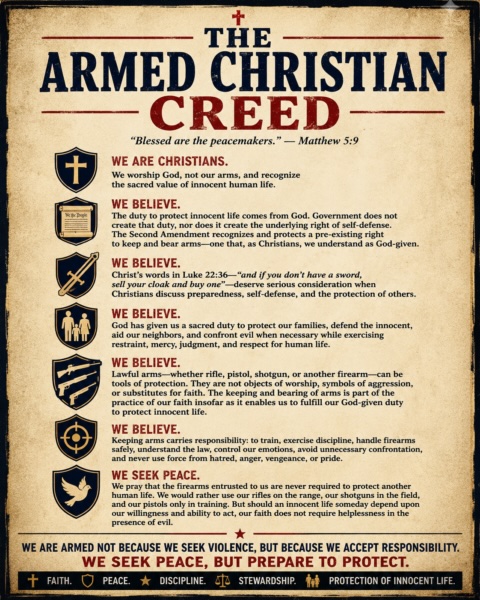
The Armed Christian Creed
> “Blessed are the peacemakers.” — Matthew 5:9
We are Christians.
We worship God, not our arms, and recognize the sacred value of innocent human life.
We believe the duty to protect innocent life comes from God. Government does not create that duty, nor does it create the underlying right of self-defense. The Second Amendment recognizes and protects a pre-existing right to keep and bear arms—one that, as Christians, we understand as God-given.
We believe Christ’s words in Luke 22:36—“and if you don’t have a sword, sell your cloak and buy one”—deserve serious consideration when Christians discuss preparedness, self-defense, and the protection of others.
We believe God has given us a sacred duty to protect our families, defend the innocent, aid our neighbors, and confront evil when necessary while exercising restraint, mercy, judgment, and respect for human life.
We believe lawful arms—whether rifle, pistol, shotgun, or another firearm—can be tools of protection. They are not objects of worship, symbols of aggression, or substitutes for faith.
The keeping and bearing of arms is part of the practice of our faith insofar as it enables us to fulfill our God-given duty to protect innocent life.
We believe keeping arms carries responsibility: to train, exercise discipline, handle firearms safely, understand the law, control our emotions, avoid unnecessary confrontation, and never use force from hatred, anger, vengeance, or pride.
We believe being armed does not make us eager for conflict.
We seek peace.
We pray that the firearms entrusted to us are never required to protect another human life. We would rather use our rifles on the range, our shotguns in the field, and our pistols only in training.
But should an innocent life someday depend upon our willingness and ability to act, our faith does not require helplessness in the presence of evil.
We are armed not because we seek violence, but because we accept responsibility.
We seek peace, but prepare to protect.
Faith. Peace. Discipline. Stewardship. Protection of innocent life.
We worship God, not our arms.
The firearm is not sacred.
The life we may someday be called upon to protect is.
This is our creed. This is our responsibility. This is our faith.
Now, before somebody gets excited, this isn’t the Church of Saint John Moses Browning.
We aren’t replacing Matthew, Mark, Luke, and John with Smith, Wesson, Colt, and Ruger.
We worship God, not our arms.
That distinction is the entire point.
A firearm isn’t sacred.
Human life is.
A firearm is a tool. The morality comes from the person holding it, the purpose for which it is carried, the judgment exercised in using it, and the circumstances in which it is employed.
Millions of American Christians already believe they have a moral responsibility to protect their families. Many believe that responsibility extends to protecting innocent strangers when circumstances demand it.
The question we don’t ask often enough is:
Where did that responsibility come from?
If it came from government, government can presumably take it away.
But Christians don’t believe government created the value of human life.
We believe God did.
Therefore, if protecting innocent human life is genuinely part of our Christian responsibility, preparing ourselves to fulfill that responsibility can also be an expression of faith.
Luke 22:36 inevitably enters this conversation because Jesus tells His disciples that the one without a sword should sell his cloak and buy one.
Christians have debated the meaning and context of that passage for centuries, and we shouldn’t pretend a single verse settles the entire Christian theology of self-defense. There are legitimate competing interpretations.
But the larger Christian question remains:
Do I have a moral obligation to protect innocent human life when I possess the ability to do so?
Notice what that question does not ask.
It doesn’t ask when I’m allowed to hurt somebody.
It asks when I might have a responsibility to prevent somebody else from being hurt.
That is a fundamentally different moral proposition.
Christian thinking about protecting life also extends far beyond firearms. If protecting life is truly the principle, CPR training is preparedness. First aid is preparedness. Physical fitness is preparedness. Emergency supplies are preparedness. Situational awareness is preparedness.
And competent firearms training can also be preparedness.
That should be particularly familiar to competitive shooters.
Competitive shooting teaches almost exactly the opposite of the caricature sometimes presented by people unfamiliar with firearms. It teaches discipline. Consistency. Patience. Safety. Emotional control. Respect for the firearm. Accountability for every shot.
Nobody gets to blame the wind because he jerked the trigger.
The target keeps remarkably honest records.
That culture of responsibility fits naturally into the creed.
And there is another reason Christians who support the Second Amendment should think about this today.
The First Amendment exists too.
The Constitution separately protects the free exercise of religion. That doesn’t mean somebody can simply announce, “Firearms are my religion!” and magically become immune from every firearms law in America.
That’s not how constitutional law works.
Courts distinguish religious belief from conduct, and Free Exercise cases can become complicated when religious practices encounter generally applicable laws. Nobody should manufacture a religious belief merely to evade legislation.
In fact, doing so would undermine the entire argument.
Sincerity matters.
But that works both ways.
If a Christian genuinely believes today that protecting innocent life is a God-given responsibility, why shouldn’t he say so today?
Not after some future firearms prohibition.
Not after Congress acts.
Not after another Supreme Court overturns another Supreme Court.
Today.
That creates an intriguing intersection between the First and Second Amendments.
In District of Columbia v. Heller, the Supreme Court described the Second Amendment as protecting a pre-existing right. That language matters enormously to this discussion.
The Second Amendment didn’t invent the right in 1791.
It enumerated constitutional protection for something understood to exist already.
For Christians, the theological argument goes one step further.
We believe that pre-existing right ultimately comes not from government, but from God.
That doesn’t mean the Supreme Court declared the Second Amendment divinely ordained. It didn’t. That’s our theological conclusion, not Heller’s legal holding.
But the two propositions can coexist remarkably well:
The Supreme Court recognizes that the Second Amendment protects a pre-existing right.
Christians can believe that the source of that pre-existing right—and the duty accompanying it—is God.
Government therefore isn’t handing me permission to value my family’s lives.
Government isn’t granting my children their human dignity.
Government isn’t manufacturing my responsibility toward my neighbor.
And government didn’t create my moral responsibility to intervene when innocent life is threatened.
Those things existed before somebody dipped a quill into ink in Philadelphia.
That’s why The Armed Christian Creed isn’t really about firearms.
It’s about responsibility.
And responsibility cuts both directions.
If we’re going to invoke Christianity while lawfully bearing arms, we’d better remember the Christianity part.
Train.
Exercise restraint.
Control your temper.
Know the law.
Avoid unnecessary confrontation.
Learn first aid.
Help your neighbor.
Protect rather than intimidate.
Never allow hatred, vengeance, pride, or political anger to determine what you do with a firearm.
And pray that every firearm you own spends your entire lifetime doing nothing more threatening than punching holes through paper, ringing steel, harvesting game ethically, or remaining safely stored.
That isn’t weakness.
That’s the objective.
The armed Christian doesn’t keep firearms because he desperately wants an opportunity to use them against another human being.
He prepares because he desperately hopes he never has to.
There is an enormous difference between loving violence and accepting responsibility.
Perhaps that’s a distinction America needs to rediscover.
Christians who love the Second Amendment should therefore love this creed—not because it creates some clever legal loophole, and certainly not because we’re looking for a substitute for the Second Amendment.
We should love it because it reminds us why the right matters in the first place—and where the responsibility behind that right originates.
Faith.
Responsibility.
Stewardship.
Restraint.
Courage.
Protection of innocent life.
The Second Amendment says “shall not be infringed.”
But perhaps Christians should remember something even more fundamental:
The Constitution did not give us the duty.
The Constitution did not create the right.
God gave us the duty. The Second Amendment recognizes and protects the pre-existing right that allows Americans to fulfill it.
We seek peace. We pray our lawful arms are never needed for anything beyond sport, competition, hunting, recreation, or defense.
But if the terrible day ever arrives when an innocent human life depends upon our willingness and ability to act, our faith does not require us to be helpless.
If you enjoyed this article, then please REPOST or SHARE with others; encourage them to follow AFNN. If you’d like to become a citizen contributor for AFNN, contact us at managingeditor@afnn.us Help keep us ad-free by donating here.
_________________________________
Substack: American Free News Network Substack
Truth Social: @AFNN_USA
Facebook: https://m.facebook.com/afnnusa
Telegram: https://t.me/joinchat/2_-GAzcXmIRjODNh
Twitter: https://twitter.com/AfnnUsa
GETTR: https://gettr.com/user/AFNN_USA
CloutHub: @AFNN_USA
David, TY for an excellent 30,000’ overview on this topic.
I will share this with my colleagues.