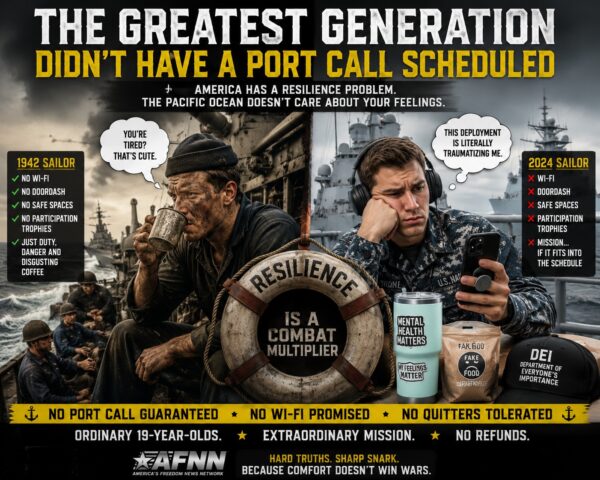
America Has a Resilience Problem—and the Pacific Ocean Doesn’t Care About Your Feelings
Something uncomfortable is happening in the United States military.
And for once, I don’t think we can blame PowerPoint.
Reports of miserable deployments, missed port calls, exhausted crews, mental-health problems, declining morale and sailors reaching their psychological limits have generated the predictable national argument.
One side screams, “TOXIC LEADERSHIP!”
The other screams, “KIDS TODAY ARE SOFT!”
Both sides then retreat to social media to fight the Battle of Facebook Comment Section, where America has remained undefeated since approximately 2009.
But maybe we’re asking the wrong question.
Maybe today’s sailors aren’t the problem.
Maybe we ALL are.
Because America has spent the last eighty years constructing the most magnificent machine for eliminating inconvenience ever devised by mankind.
Cold?
Turn up the thermostat.
Hot?
Turn down the thermostat.
Hungry?
A stranger will bring a cheeseburger to your house.
Bored?
Here is every movie ever made.
Lonely?
Here are 4,700 people you haven’t actually spoken to since high school.
Don’t know something?
You carry essentially the entire accumulated knowledge of human civilization in your pocket.
We have reached the point where a restaurant forgetting the ranch dressing can produce an emotional event requiring a one-star Google review.
Then the United States Navy takes an 18-year-old manufactured by this civilization and says:
“Welcome aboard.”
Suddenly your bedroom has roommates.
Your schedule belongs to somebody else.
Privacy has become a historical concept.
Somebody is opening a hatch while you’re sleeping.
Someone else is grinding metal three decks below you.
The food isn’t what Mom makes.
The internet sucks.
Your girlfriend is 7,000 miles away.
You’re tired.
You’re bored.
You’re working again tomorrow.
And tomorrow.
And tomorrow.
Then the Navy commits the ultimate crime against modern American civilization:
The mission does not care whether you’re comfortable.
Welcome to war.
This isn’t an argument that today’s sailors are weak.
Quite the opposite.
Today’s sailors are operating nuclear reactors, maintaining jet aircraft, launching missiles, conducting combat operations and keeping enormously complicated floating cities functioning thousands of miles from home.
The problem isn’t necessarily the sailor.
The problem may be the civilization that delivered the sailor to the recruiter’s office.
Consider the American who joined the Navy in 1942.
He might have grown up during the Great Depression.
His family might not have owned a telephone.
Air conditioning was something rich people heard rumors about.
Amazon Prime consisted of ordering something from Sears and hoping it arrived before Christmas.
If you wanted to communicate with someone across the country, you wrote words on a piece of paper, put a stamp on it and trusted the United States Postal Service with your emotional well-being.
Then Pearl Harbor happened.
And America looked at millions of teenagers and twenty-somethings and said:
Congratulations. You’re going to war.
No deployment survey.
No scheduled port call.
No FaceTime.
No Wi-Fi.
No “expected return date.”
Here is your rifle.
There is Europe.
There is Japan.
We’ll let you know when Hitler and Hirohito are finished.
Have a pleasant deployment.
And somehow these young Americans climbed aboard ships and went.
Not because they were Marvel superheroes.
They were scared.
They got depressed.
They suffered combat fatigue.
Some broke psychologically.
Some drank too much.
Some carried wounds nobody could see for the rest of their lives.
Some undoubtedly complained about the Navy with vocabulary that would make today’s command climate survey burst into flames.
But collectively they endured something almost unimaginable today.
And here’s the uncomfortable part:
Their culture expected them to.
Hardship wasn’t automatically interpreted as institutional failure.
Sometimes life simply sucked.
Your response was expected to be:
Keep going.
That cultural muscle may have atrophied.
We have become so technologically successful at eliminating discomfort that we’ve started confusing discomfort with injury.
And that is potentially catastrophic for a military preparing for great-power war.
Because China isn’t going to consult the deployment schedule.
The Pacific Ocean doesn’t have an HR department.
The enemy isn’t required to respect your work-life balance.
A Chinese anti-ship missile will not postpone launch because the crew has exceeded its recommended operational tempo.
If the next war becomes the nightmare Pentagon planners worry about, ships may remain at sea because returning to port isn’t merely inconvenient.
The port might not exist anymore.
Supply ships may not arrive.
Parts may not arrive.
Fresh food may not arrive.
The internet may disappear.
Sleep may become something sailors remember fondly from peacetime.
And people around you may die.
Suddenly “resilience” stops being something printed on a command poster next to a photograph of diverse sailors staring heroically toward the horizon.
It becomes ammunition.
That doesn’t excuse bad leadership.
There is a gigantic difference between necessary hardship and unnecessary stupidity (ask any Infantryman).
If sailors are exhausted because somebody can’t write a sensible watch schedule, fix the schedule.
If food is inadequate, fix the food.
If manning is insufficient, fix the manning.
If sailors aren’t getting enough sleep because bureaucracy consumes every waking minute, find the PowerPoint responsible and ceremonially launch it from the catapult.
Preferably without a helmet.
Good commanders eliminate stupid suffering precisely because someday their sailors may need every ounce of resilience they possess for suffering that cannot be eliminated.
But America has a job here too.
We need to rediscover an ancient and apparently controversial concept:
Sometimes things are difficult.
You might be cold.
You might be hot.
You might be tired.
You might be lonely.
Dinner might suck.
Your phone might not work.
Nobody may care that you’re uncomfortable.
And despite this unprecedented humanitarian catastrophe…
you will survive.
This used to be called “life.”
Now apparently it requires a resilience seminar.
Maybe that’s why hunting matters.
Camping matters.
Sports matter.
Competition matters.
Manual labor matters.
Losing matters.
Getting your ass kicked at something and coming back tomorrow matters.
Maybe occasionally allowing a teenager to experience boredom without immediately handing him a glowing rectangle is actually national-defense preparation.
Because sooner or later America may again need ordinary 19-year-olds to accomplish extraordinary things.
And history will not politely ask whether we’ve completed the appropriate resilience training module.
There may be no liberty call.
There may be no replacement crew.
There may be no DoorDash.
There may be no Wi-Fi.
There may simply be a damaged ship, an exhausted crew, a flooding compartment and somebody yelling:
**“KEEP FIGHTING THE SHIP.”**
The Greatest Generation wasn’t genetically superior.
They weren’t born with larger testicles and an internal supply of black coffee.
They were ordinary Americans whose civilization expected hardship—and then history handed them more hardship than anyone could reasonably imagine.
And they discovered something about themselves.
They could take it.
That’s the lesson we should recover.
Not that mental health doesn’t matter.
Not that leadership doesn’t matter.
Not that sailors should silently tolerate stupidity.
But that resilience itself is a military capability.
Because someday America may fight an enemy who doesn’t care about our expectations, our conveniences, our deployment schedules or our feelings.
And when that happens, the Navy isn’t going to need customers.
It’s going to need sailors.
The Greatest Generation didn’t have a port call scheduled.
They had a war to win. And they did it…
_________________________________
If you enjoyed this article, then please REPOST or SHARE with others; encourage them to follow AFNN. If you’d like to become a citizen contributor for AFNN, contact us at managingeditor@afnn.us Help keep us ad-free by donating here.
_________________________________
Substack: American Free News Network Substack
Truth Social: @AFNN_USA
Facebook: https://m.facebook.com/afnnusa
Telegram: https://t.me/joinchat/2_-GAzcXmIRjODNh
Twitter: https://twitter.com/AfnnUsa
GETTR: https://gettr.com/user/AFNN_USA
CloutHub: @AFNN_USA