This is Going to Irritate Some People…
There are certain things you simply do not discuss at deer camp unless you’re prepared for violence.
Politics. Religion. Whether beans belong in chili.
And the 6.5 Creedmoor.
Mention the Creedmoor around a sufficiently seasoned collection of American hunters and somebody wearing a faded blaze-orange hat will immediately explain that his .30-06 has been killing deer since Teddy Roosevelt was charging up San Juan Hill and therefore anything invented after the microwave oven is unnecessary.
Then somebody will invoke Jack O’Connor.
“Well, Jack O’Connor used a .270.”
Yes. He certainly did.
And I have some unfortunate news for the Church of Saint Jack of the .270:
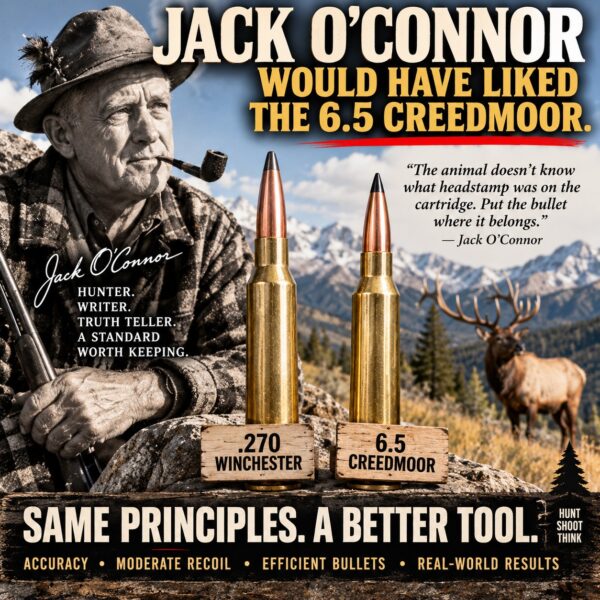
Jack O’Connor probably would have loved the 6.5 Creedmoor.
O’Connor died in 1978, nearly three decades before the Creedmoor arrived, so obviously he never rendered judgment on it. But we don’t have to hold a séance. The man spent decades telling us exactly what he thought made a good hunting cartridge.
O’Connor became Outdoor Life’s gun editor in 1939 and eventually became virtually synonymous with the .270 Winchester. He didn’t merely write about it; he used it around the world on everything from sheep and deer to elk, moose, zebra and other African game.
But here’s the part that gets conveniently forgotten.
Jack didn’t love the .270 because “.270” was magically stamped on the case head.
He loved what it did.
O’Connor praised the .270 for its combination of flat trajectory, velocity, accuracy and manageable recoil. In his famous 1954 defense of the cartridge, he argued that those characteristics made it unusually easy to place bullets correctly at long and uncertain ranges.
Sound familiar?
Accuracy.
Moderate recoil.
Efficient bullets.
Good trajectory.
Enough power to do the job.
And, above everything else, put the damned bullet where it belongs.
Congratulations, Jack. You just designed the 6.5 Creedmoor 50 years early.
The Creedmoor appeared in 2007, which means it is now old enough to vote.
So can we finally stop calling it a “new cartridge”?
At this point, the Creedmoor isn’t the teenage kid crashing deer camp. It’s the guy helping you unload the truck while reminding you that your flip phone doesn’t work anymore.
Move over, Boomer. The Creedmoor has a voter-registration card.
And the great irony is that many of the arguments thrown at the Creedmoor today are strikingly similar to the arguments thrown at O’Connor’s .270 generations ago.
Too small.
Not enough bullet.
Not enough horsepower.
Real hunters use something bigger.
The .270 itself was still being attacked as underpowered decades after its introduction, which prompted O’Connor’s famous defense of it.
Apparently caliber arguments are hereditary.
Perhaps the strongest evidence for how O’Connor might have viewed the Creedmoor isn’t the .270 at all.
It’s the 7×57 Mauser, American’s know it as the .275 Rigby.
O’Connor watched his wife Eleanor use the mild little 7×57 successfully on large African antelope. He later compared its field performance with the .280 Remington and 7mm Remington Magnum and wrote that he couldn’t see the more powerful cartridges killing any better.
Uh-oh.
Somewhere, a magnum enthusiast just spilled his coffee.
O’Connor wasn’t saying velocity and energy were meaningless. He understood ballistics exceptionally well. What he rejected was the idea that recoil, muzzle energy and bore diameter could compensate for lousy shooting.
He once put the principle wonderfully simply: “There simply is no substitute for correct shot placement.”
And that’s where the Creedmoor walks straight into Jack’s hunting camp, takes off its boots and makes itself at home.
A 140-grain .264 bullet has excellent sectional density. Modern 6.5mm hunting bullets can have outstanding ballistic coefficients. Recoil is mild. Accuracy is generally excellent. The cartridge is easy for ordinary humans to shoot well.
Jack would understand the equation immediately.
But the .270 Isn’t Going Anywhere
Before the Creedmoor congregation begins speaking in tongues, however, Jack probably wouldn’t throw his .270 into the Snake River.
The .270 has something the Creedmoor cannot manufacture through internet enthusiasm:
Velocity.
O’Connor’s famous .270 load pushed a 130-grain bullet at roughly 3,150 fps from his 22-inch Model 70. He specifically valued that flatter trajectory because he was hunting in an era when “rangefinder” meant Jack O’Connor looked across a canyon and said, “Looks like about 300 yards.”
No Leica.
No Kestrel.
No Bluetooth ballistic computer.
No phone telling him to dial 1.7 mils.
Just Jack, a 4X scope, a sling and several thousand animals’ worth of experience.
Under those conditions, velocity bought forgiveness.
For a one-rifle battery covering deer, sheep, antelope, caribou and elk in open country, I suspect Jack would still reach for his .270.
But give him a lightweight modern rifle chambered in 6.5 Creedmoor, excellent glass, a 130- or 140-grain premium hunting bullet and a laser rangefinder?
I suspect things would get interesting very quickly.
Because Jack O’Connor wasn’t actually a .270 fanatic.
He was a results fanatic.
Outdoor Life’s own retrospective on this question reaches much the same conclusion: O’Connor was a cartridge enthusiast who appreciated lower-recoiling medium bores and routinely evaluated ballistic coefficient, sectional density, velocity and trajectory—the very characteristics at the heart of the Creedmoor’s design philosophy.
The .270 Winchester is still magnificent.
The 6.5 Creedmoor is magnificent too.
And despite approximately seventeen billion pages of internet arguments, both facts can simultaneously be true.
If Jack O’Connor were sitting at the loading bench today, I suspect he’d shoot the Creedmoor, chronograph it, measure a few groups, study the trajectory, take it hunting and wonder why everyone was screaming at each other.
Then he’d probably remind us of something American riflemen apparently need to relearn every generation:
Animals don’t read ballistic charts.
They don’t know whether your case holds 52 grains of powder or 42.
They don’t know whether your cartridge was introduced in 1925 or 2007.
And that buck certainly doesn’t know what the headstamp says.
He only knows where the bullet landed.
The 6.5 Creedmoor isn’t revolutionary because it repealed the laws of physics.
It’s successful because it follows principles Jack O’Connor spent a career teaching: accuracy, manageable recoil, efficient bullets, adequate power and precise shot placement.
So the next time somebody at deer camp announces that the Creedmoor is an overhyped newfangled popgun and that Jack O’Connor would never have tolerated such nonsense, smile politely.
Then explain the uncomfortable truth:
The 6.5 Creedmoor may be one of the most Jack O’Connor cartridges Jack O’Connor never got to shoot.
And it’s old enough to vote.
Now get off its lawn, boomer!
_________________________________
If you enjoyed this article, then please REPOST or SHARE with others; encourage them to follow AFNN. If you’d like to become a citizen contributor for AFNN, contact us at managingeditor@afnn.us Help keep us ad-free by donating here.
_________________________________
Substack: American Free News Network Substack
Truth Social: @AFNN_USA
Facebook: https://m.facebook.com/afnnusa
Telegram: https://t.me/joinchat/2_-GAzcXmIRjODNh
Twitter: https://twitter.com/AfnnUsa
GETTR: https://gettr.com/user/AFNN_USA
CloutHub: @AFNN_USA