The Long Road
But in the end, the Camino de Santiago is just a road. That’s all it can ever be. The difference is, of course, when you’re on this road, you’re actually THERE.
Citizen Writers Fighting Censorship by Helping Americans Understand Issues Affecting the Republic.
But in the end, the Camino de Santiago is just a road. That’s all it can ever be. The difference is, of course, when you’re on this road, you’re actually THERE.
Seated beside me was an elderly pilgrim who seemingly had energy to converse. His beard was white. His skin was shoe leather. His odor was ripe. He looked like a cross between Moses and a Hobbit.
If my brain were a school bus, all the nerdy thoughts would be sitting up front. These are the responsible, grown-up thoughts, wearing horn-rimmed glasses and neckties, performing important tasks on calculators, computing existentially vital equations such as, “Do BLTs actually need the L?”
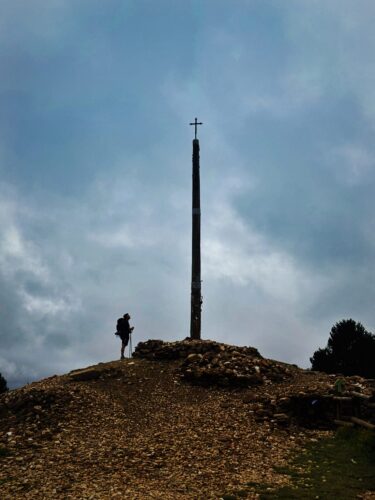
It was raining when we saw the big cross. In the distance. We’d been told about the cross. We knew it was near. Everyone on the trail had been talking about it.
The voice is telling you to spend more time playing; less time working. More time praying, less time worrying. More time being silly; less time being a grown-up. “Have fun with your life,” the voice keeps saying, “while you still can.”
The first big difference I noticed in America was that we move very fast. Everything we do is fast. We want our food fast. We want our news fast. We drive fast. We pump gas fast. We stand before a microwave and shout, “HURRY UP!!!!”
We entered Santiago de Compostela at 2:11 p.m. On foot. We’d been hiking since sunup. Our pace was slow. Our clothes, threadbare. I was muttering the 23rd Psalm—a kind of private meditation on the trail.
Sean and his Bride have completed their epic trek. Stay tuned for more commentary after his legs get a rest.
Some of the most powerful lessons we pilgrims have learned on this proverbial Chisholm Trail have not been about life, or the nature of the universe. Our lessons have been in relation to each other.
Here are a few random things I have written in my journal throughout my time walking the Camino de Santiago.
Sean is back on the Camino! Here is a short video from him. Please pray for him and his wife.
I am standing at a bus stop in the unrelenting rain. Although to call this a “bus stop” is being generous. It’s just a highway guardrail. I am alone on this empty highway, waiting to catch a ride out of O Cebreiro.
Somewhere in the distant mountains, my wife is hiking the Camino. I should be with her, but I am here with shin-splinted legs and swollen calves.
My taxi arrived at Ponferrada after a long, twisty, pleasant ride through the mountains. And by “pleasant” I mean that only one of three taxi passengers actually vomited. I paid our driver, then found a nearby bush where I could double over.
My wife and I parted in the lobby of the albergue. She was crying. It was a little-girl cry. The kind of crying you do when you don’t care who is watching you. She has never been self-conscious about her own emotions. Thank God nobody ever told this beautiful woman that it’s not dignified to cry in public.
My eyes first caught the sight of a rosary, lying on my nightstand. The rosary was given to me by a nun, a few villages back. The rosary bears a hieroglyphic-like symbol on it. I have no idea what this symbol means.
We limped into Rabanal Del Camino on three legs. I was holding Jamie for support as we ascended the inclined street into an isolated Spanish village with a population of 60 residents.
Dear God, thank you for letting me happen upon this small church, so I might rest my anguished feet. This little church, alongside the Camino, somewhere in the far flung regions of rural Spain. A place where I can kneel and pray in solitude.
Leòn Cathedral is among the greatest of human works in Gothic style. The church features one of the world’s largest collections of medieval stained glass windows.
In today’s dispatch, Sean answers reader questions about his trek across Spain.