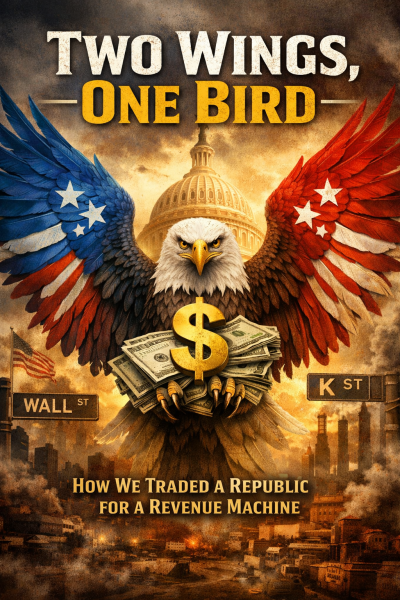
We like to pretend we live in a fierce two-party system. Red vs. blue. Left vs. right. Cable news gladiators screaming like it’s the Super Bowl of righteousness. But step back far enough and the illusion fades. What you actually see is one bird with two wings—and that bird doesn’t care about your values, your vote, or your virtue. It worships one thing: money.
Call it capitalism if you want. That’s the polite term. A more accurate description might be corporatism with a lobbying budget. Because the modern political ecosystem doesn’t run on ideology—it runs on incentives. And both parties, for all their theatrical differences, operate inside the same incentive structure. Fundraising. Power retention. Donor satisfaction. Rinse, repeat.
That’s why the outcomes start to look eerily similar, no matter who’s “in charge.”
Now, let’s be clear. Every system of government has flaws. There is no utopia, no perfect structure where humans suddenly stop being human. Monarchies decay. Democracies mob. Dictatorships rot from the inside out. The Founders knew this. They weren’t naive—they were brutally realistic about human nature.
So they built something different: a representative constitutional republic. Not fast. Not efficient. Not “responsive” in the modern, dopamine-hit sense. It was intentionally slow, friction-heavy, and occasionally frustrating. That wasn’t a bug—it was the feature.
Power was divided. Authority was checked. Change required effort, consensus, and time. The system was designed like a series of locked gates, not an open highway. Because history had already proven that when power moves quickly, liberty tends to get run over in the process.
And for a long time, it worked. Not perfectly, but better than most alternatives. The rules were clear. If you wanted to fundamentally change the system, you had to amend it—publicly, lawfully, and with broad agreement. No shortcuts. No back doors.
That’s where things went sideways.
Because we didn’t wake up one morning and vote to abandon that system. There was no dramatic overthrow, no tanks in the streets, no declaration that “the republic is over.” What happened instead was far more subtle—and far more dangerous.
We just… stopped following the rules.
Instead of amending the Constitution, we began “interpreting” it. Then expanding those interpretations. Then stacking precedent on top of precedent until the original meaning was buried under a mountain of legal jargon and bureaucratic convenience. Agencies grew. Powers shifted. Lines blurred.
And nobody really voted on any of it.
This is how you end up with a hybrid system—a political mutt. Part republic, part administrative state, part corporate influence machine. Something that still uses the language of the Founders but operates on a completely different playbook.
You still get elections, sure. But choices are often pre-filtered by money, media, and machinery. You still get laws, but many of the real rules come from unelected bodies issuing regulations with the force of law. You still get representation, but it increasingly feels like representation of interests—not citizens.
And through it all, both “wings” of the bird keep flapping.
They argue loudly about social issues, cultural flashpoints, and symbolic battles that keep voters emotionally invested. But when it comes to the structural incentives—spending, debt, centralized power, and the influence of money—there’s a lot less daylight between them than either side would like to admit.
Because those incentives benefit both wings.
This isn’t a conspiracy theory. It’s just systems analysis. If you build a machine that rewards certain behaviors, you shouldn’t be surprised when everyone inside that machine starts behaving the same way.
The real tragedy isn’t that the original system was flawed—it’s that it was bypassed. The amendment process still exists. The constitutional framework is still there. But instead of using it, we allowed a culture of convenience to take over. It’s easier to reinterpret than to amend. Easier to expand power than to restrain it. Easier to win short-term than to preserve long-term.
And here we are.
Still calling it a republic. Still waving the same documents. Still arguing like the old lines matter the way they used to.
But deep down, most people can feel it: something has shifted.
The question isn’t whether the system was perfect—it never was. The question is whether we still have the discipline to operate within its rules, or whether we’ve permanently traded structure for speed, and principle for profit.
Because once a system stops following its own rules, it doesn’t matter what you call it anymore.
It’s just a different bird.
If you enjoyed this article, then please REPOST or SHARE with others; encourage them to follow AFNN. If you’d like to become a citizen contributor for AFNN, contact us at managingeditor@afnn.us Help keep us ad-free by donating here.
Substack: American Free News Network Substack
Truth Social: @AFNN_USA
Facebook: https://m.facebook.com/afnnusa
Telegram: https://t.me/joinchat/2_-GAzcXmIRjODNh
Twitter: https://twitter.com/AfnnUsa
GETTR: https://gettr.com/user/AFNN_USA
CloutHub: @AFNN_USA