Before Olympic medals, before social media, before electronic targets and laser rangefinders, there was a simple question that haunted the U.S. Army:
“Can Americans actually shoot?”
The answer, after the Spanish-American War in 1898, was uncomfortable. American soldiers had courage in abundance, but marksmanship varied wildly. The nation needed a way to develop skilled riflemen before the next war—not after it had already begun.
So in 1903, Congress acted.
It created the National Board for the Promotion of Rifle Practice and established a partnership between the Army and the American people. The mission wasn’t to create champions. It was to create capable citizens. Rifle clubs were encouraged. The National Matches were born. And ordinary Americans were invited to learn from the nation’s best military marksmen.
That mission has never truly changed.
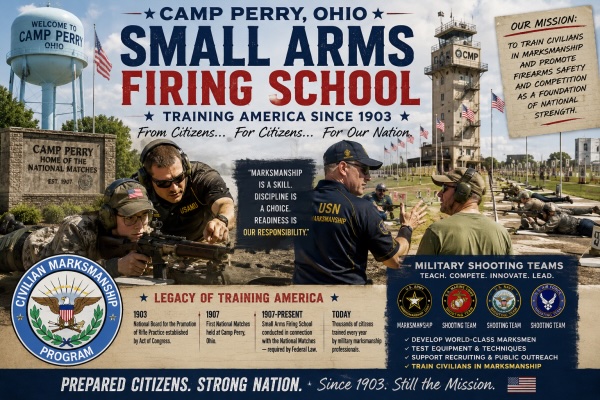
Every summer at Camp Perry, Ohio, thousands of civilians attend the Small Arms Firing School (SAFS). Most think they’re signing up for a shooting clinic.
They’re actually participating in one of America’s oldest continuously operating national defense programs.
In fact, Congress still requires it.
More than 120 years after it began, federal law still mandates that a Small Arms Firing School be conducted in conjunction with the National Matches. That isn’t a historical footnote. It’s current law. Congress has repeatedly affirmed that teaching civilians safe, accurate marksmanship remains a legitimate national interest.
I’ve had the privilege of serving as a SAFS instructor for several summers.
From behind the firing line, you quickly realize this isn’t about punching holes in paper.
It’s about passing knowledge from one generation to the next.
Military instructors teach safe firearms handling. They teach sight alignment, trigger control, breathing, natural point of aim, sling use, wind reading and discipline. Thousands of new shooters—many of whom have never fired a service rifle—leave Camp Perry safer, more confident and more capable than when they arrived.
That knowledge doesn’t stay at Camp Perry.
It goes home to hunting camps, local rifle clubs, junior shooting teams, law enforcement agencies and families who value responsible firearms ownership.
This is where the military shooting teams enter the story.
Many people see the Army Marksmanship Unit, the Marine Corps Shooting Team, Navy shooters or Air Force competitors and assume their job is to collect trophies.
The trophies are simply evidence they’re doing their real job well.
Military shooting teams exist because excellence attracts excellence.
The Army established the U.S. Army Marksmanship Unit in 1956 during the Cold War. Soviet shooters were dominating international competition, and every Olympic medal became another propaganda victory for Moscow. Demonstrating American excellence on the world stage mattered. It still does.
But competition was never the entire mission.
Military shooters develop better training methods.
They evaluate new equipment.
They refine shooting techniques.
They mentor soldiers.
They coach civilians.
And they carry everything they learn back into the operational force.
One of the greatest examples was Lones Wigger.
Most Americans know him as one of the greatest competitive rifle shooters in history, winning Olympic gold medals and dozens of world championships.
Soldiers remember another chapter.
During the Vietnam era, Wigger served as commander of the 23rd Infantry Division Sniper School, training combat snipers before returning to dominate international competition. The flow of knowledge worked in both directions. Combat experience improved competition. Competition improved military training.
That’s exactly what Congress envisioned over a century ago.
The Small Arms Firing School is not separate from the military shooting teams.
It is one of the reasons they exist.
Every Army, Marine, Navy and Air Force instructor on the firing line represents decades of accumulated experience being passed directly to American citizens.
That mission is arguably more important today than it has been in decades.
America is once again in an era of great-power competition. Russia continues its aggression in Europe. China is rapidly modernizing its military while investing heavily in international sports as a demonstration of national prestige and discipline.
Winning alone doesn’t deter adversaries.
But excellence does.
When American military shooters stand on international podiums, they demonstrate professionalism, discipline and technical mastery. When they return home to Camp Perry, they share those same skills with thousands of Americans.
That is a remarkable return on investment.
Where else can an Olympic-caliber instructor spend a week teaching an accountant from Ohio, a farmer from Iowa, a college student from Texas and a retired Marine from Michigan how to shoot more safely and accurately?
That’s uniquely American.
Some ask why the military still fields competitive shooting teams.
The better question is: why wouldn’t it?
We don’t question the Navy’s Blue Angels because they inspire recruiting, showcase professionalism and sharpen aviation excellence.
We don’t question Army Rangers competing in international military competitions.
We don’t question military bands representing America overseas.
Military shooting teams serve the same purpose.
They represent the nation.
They sharpen military skills.
They test equipment and doctrine.
They recruit future soldiers.
And they fulfill a mission Congress first recognized in 1903: helping train the American people in responsible marksmanship.
Every summer, while the headlines focus on scores and medals, something much bigger is happening on the firing line at Camp Perry.
An Army sergeant adjusts a student’s sling.
A Marine coach explains natural point of aim.
A Navy competitor demonstrates breathing control.
An Air Force marksman helps a first-time shooter call the wind.
Knowledge passes from uniformed professionals to ordinary citizens, just as it has for more than a century.
That isn’t an accident.
It’s America’s oldest marksmanship tradition still doing exactly what Congress intended.
The medals are impressive.
The mission is enduring.
And as long as free Americans continue learning from the nation’s finest military marksmen, the Small Arms Firing School will remain one of the quiet success stories of American preparedness.
If you enjoyed this article, then please REPOST or SHARE with others; encourage them to follow AFNN. If you’d like to become a citizen contributor for AFNN, contact us at managingeditor@afnn.us Help keep us ad-free by donating here.
Substack: American Free News Network Substack
Truth Social: @AFNN_USA
Facebook: https://m.facebook.com/afnnusa
Telegram: https://t.me/joinchat/2_-GAzcXmIRjODNh
Twitter: https://twitter.com/AfnnUsa
GETTR: https://gettr.com/user/AFNN_USA
CloutHub: @AFNN_USA