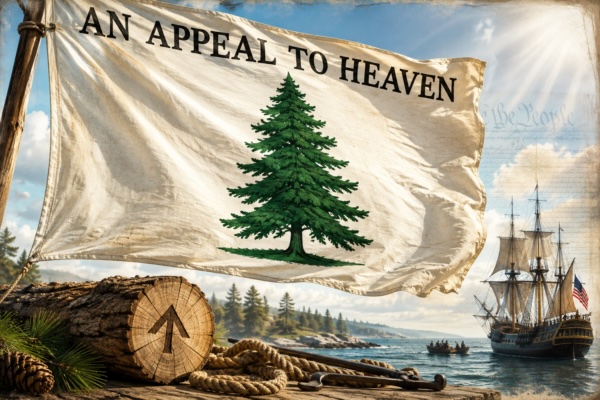
Long before Americans started arguing about flags on social media, our ancestors managed to make a tree politically dangerous.
Not an eagle. Not a cannon. Not a rattlesnake.
A pine tree.
The evergreen that appeared on early American flags—and most famously on the banner carrying the words “AN APPEAL TO HEAVEN”—was not chosen because somebody in 1775 thought the Navy needed better landscaping. It carried a message that made perfect sense to people living in colonial New England.
And that message was essentially this:
This is our land. These are our trees. And at some point, gentlemen, you have pushed your luck far enough.
The story begins with something called the King’s Broad Arrow.
Britain possessed the greatest naval power on earth, and wooden warships required enormous quantities of high-quality timber. Especially valuable were the towering white pines of New England. Their long, straight trunks made excellent masts for the Royal Navy.
The Crown therefore claimed certain large white pines for its own use. Surveyors marked reserved trees with the “Broad Arrow,” identifying timber that colonists were prohibited from simply cutting and using as they pleased.
Think about the psychology of that for a moment.
You clear the land. You build the house. You survive the winter. You raise your family there. There is a magnificent pine tree standing on what you consider your property.
Then somebody representing a king thousands of miles away effectively says:
Nice tree.
Mine.
Taxation without representation gets all the historical publicity, but colonial resentment involved something deeper: the question of who ultimately controlled the land, resources and lives of the people living here.
The pine became wrapped up in that argument.
In 1772, the issue exploded in New Hampshire in what became known as the Pine Tree Riot. Authorities attempted to enforce timber laws against mill owners accused of possessing logs reserved for the Crown. The confrontation turned physical, and the incident became another small but revealing step toward revolution.
Three years later, Americans were shooting at British troops.
By 1775, General George Washington commissioned a small fleet of armed vessels to interfere with British shipping and supply operations. One of the flags associated with those early American naval forces featured an evergreen tree above the words:
AN APPEAL TO HEAVEN.
That phrase came from political philosopher John Locke.
Locke argued that when ordinary legal remedies had been exhausted—when there was no earthly authority capable of fairly resolving a dispute between rulers and the people—the final appeal was to heaven.
That is much heavier than “Don’t Tread on Me.”
It essentially says:
We tried the normal channels.
They failed.
God can judge what happens next.
The tree therefore represented more than timber. It represented the natural rights of a people who increasingly believed government existed to protect their liberty rather than dispense it.
And there is another piece of the symbolism worth remembering.
America’s defense did not begin with a gigantic standing military establishment.
It began with citizens.
Farmers, craftsmen, merchants, sailors and tradesmen lived ordinary lives while retaining the expectation that, if circumstances demanded it, they might also have to defend their communities and country.
That idea eventually became deeply embedded in the American military tradition.
The modern United States possesses an extraordinarily small professional active-duty military, but the older concept never completely disappeared. You can still see its descendants in the National Guard, the Reserve components, civilian marksmanship traditions and generations of Americans who believed citizenship came with responsibilities as well as rights.
That doesn’t require romanticizing every self-appointed “militia” wandering around the Internet wearing camouflage and carrying seventeen pounds of tacti-kool accessories to a meeting at Denny’s.
History is considerably more interesting than childish cosplay.
The important idea was “prepared citizenship.”
The early republic understood that a free country ultimately depended upon citizens possessing the competence, character and willingness to defend it. George Washington did not cross the Delaware with a focus group. The Revolution was fought by an evolving mixture of Continental soldiers, sailors, state forces and ordinary citizens who stepped forward when required.
That makes the evergreen a surprisingly appropriate symbol today.
An evergreen stays green through winter.
It endures.
It doesn’t need fifteen stars, three slogans, a Punisher skull and a distressed American flag background to explain itself.
It is simply there.
Rooted.
Alive.
Persistent.
And perhaps that is why the old Pine Tree Flag remains so fascinating nearly 250 years later.
Strip away modern political baggage and Internet arguments and you find something uniquely American underneath: ownership, independence, natural rights, responsibility and the stubborn conviction that free people are not merely spectators in the defense of their country.
The colonists looked at those enormous New England pines and saw something the Crown apparently did not.
They weren’t merely ship masts.
They were symbols of a country beginning to realize it belonged to the people living in it.
Maybe that is why the simplest version of the symbol is still the best.
No words.
No political party.
No explanation.
Just an evergreen tree.
Those who know the history will understand. IYKYK.
If you enjoyed this article, then please REPOST or SHARE with others; encourage them to follow AFNN. If you’d like to become a citizen contributor for AFNN, contact us at managingeditor@afnn.us Help keep us ad-free by donating here.
Substack: American Free News Network Substack
Truth Social: @AFNN_USA
Facebook: https://m.facebook.com/afnnusa
Telegram: https://t.me/joinchat/2_-GAzcXmIRjODNh
Twitter: https://twitter.com/AfnnUsa
GETTR: https://gettr.com/user/AFNN_USA
CloutHub: @AFNN_USA