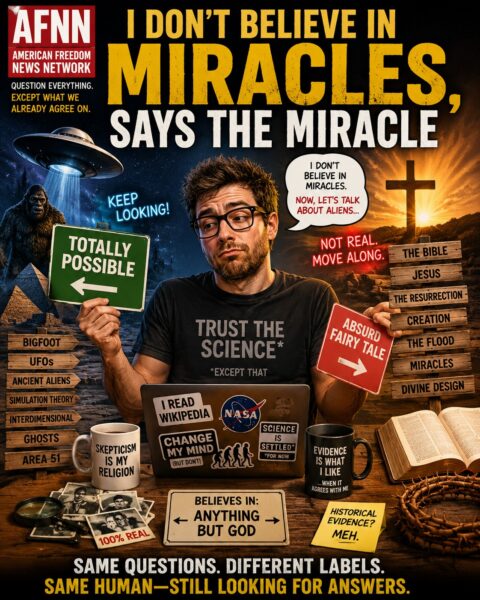
There is a particular sentence modern intellectuals love because it sounds devastatingly sophisticated:
“I’ll talk religion with you right up until you mention the first miracle.”
Boom.
Checkmate, Christians.
Pack up the manger. Cancel Easter. Somebody tell Moses the sea is closed for maintenance. Science has arrived, and apparently miracles are no longer permitted.
There is just one minor problem.
You’re standing here, aren’t you?
You are a self-aware collection of atoms living on a wet rock orbiting a nuclear furnace in an incomprehensibly enormous universe, contemplating your own existence with a three-pound lump of electrically active biological material that somehow produces memories, love, mathematics, music, grief, morality, humor and the ability to argue with strangers on Facebook.
But miracles?
Don’t be ridiculous.
We’re educated people.
And this is where modern man’s supposed intellectual superiority starts getting wonderfully entertaining.
Tell someone that an intelligent Creator might have been involved with humanity and he may roll his eyes.
Tell him technologically advanced extraterrestrials genetically engineered ancient humans and suddenly we’re ordering another season on the History Channel.
God creating mankind?
Primitive superstition.
Aliens creating mankind?
Hold my beer. I need to hear more about this.
Ancient people wrote that beings descended from the heavens?
Obviously they couldn’t possibly have meant anything religious. Those were aliens.
Ancient people described angels?
Extraterrestrials.
Demons?
Interdimensional entities.
Heaven?
Another dimension.
Creation?
Simulation theory.
Apparently modern humanity didn’t stop believing in extraordinary things.
We just changed the vocabulary so we wouldn’t have to call any of it religion.
That’s the great joke.
We congratulate ourselves for having escaped superstition while spending Saturday night watching a television program explaining that extraterrestrials helped Egyptians stack rocks.
And somehow Grandma believing Matthew, Mark, Luke and John is the intellectually embarrassing one.
That doesn’t mean ancient-alien theories are impossible. It means our standards of skepticism have become hilariously selective.
The same thing happens with the universe itself.
People casually say, “The Big Bang explains where everything came from.”
Not exactly.
Modern cosmology does an extraordinary job describing the evolution of the early universe from an extremely hot, dense state. What it does not hand us on a laminated card is the final answer to the oldest question humanity has ever asked:
Why is there something instead of nothing?
Where did existence come from?
Why are there physical laws?
Why does mathematics describe those laws?
Why is there anything here capable of obeying them?
Call that a miracle or don’t. That’s partly semantics.
But don’t stand inside the greatest mystery imaginable and announce that mysteries are for stupid people.
Then there is consciousness.
Science can watch the brain work. We can measure electrical activity, identify neural structures, alter brain chemistry, anesthetize consciousness and correlate injuries with changes in personality.
Fantastic.
Now tell me why any of that produces you.
Not your heartbeat.
Not reflexes.
Not information processing.
You.
Why is there somebody inside experiencing the experience?
Why does matter know that it exists?
Congratulations. You’ve just wandered into one of the nastiest unresolved problems in philosophy and neuroscience.
But miracles are silly.
Got it.
Then there’s morality.
We can construct excellent evolutionary explanations for cooperation, empathy and social behavior. Humans who cooperate survive. Families protect children. Groups punish freeloaders. Wonderful.
But that still leaves another uncomfortable question.
Is anything actually wrong?
Not socially unpopular.
Not evolutionarily disadvantageous.
Wrong.
If murdering an innocent child for entertainment would remain wrong even if every government, university, court and human being on Earth voted that it was acceptable, then you’ve asserted the existence of a moral truth that exists independently of human opinion.
Where exactly is that stored?
Can we weigh it?
Photograph it?
Put it underneath a microscope?
No?
Interesting.
And none of this proves Christianity.
That’s important.
Pointing at consciousness doesn’t prove the Resurrection. Cosmology doesn’t establish Genesis. Objective morality doesn’t scientifically demonstrate God.
But neither does saying “I don’t believe in miracles” settle any of those questions.
That’s not science.
That’s philosophy wearing a lab coat.
And Christians can make exactly the opposite mistake.
Finding evidence of an ancient catastrophic flood doesn’t automatically prove Noah’s Flood exactly as one particular interpretation understands it. Finding something science hasn’t explained doesn’t mean we get to write “GOD DID IT” across the blank space and go home early.
Both tribes need some humility.
Because the recurring problem isn’t science.
It isn’t religion.
It isn’t UFOs.
It isn’t Bigfoot.
It’s us.
Humans are spectacularly talented at confusing what we currently believe with what reality is required to be.
We’ve done it in churches.
We’ve done it in universities.
We’ve done it in governments.
We’ve done it in scientific institutions.
And Lord knows we’ve done it on Facebook.
The irony is that Christianity and science, properly understood, should both contain mechanisms for humility.
Science says evidence outranks your favorite hypothesis.
Christianity says God outranks your understanding of God.
Human beings somehow manage to screw up both.
We build a model, move into it, hang pictures on the walls, declare it permanent housing and become furious when somebody knocks on the door carrying inconvenient evidence.
Which brings us back to Jesus.
You don’t have to believe Jesus Christ is God.
You don’t have to believe in the Resurrection.
Those are claims a person has to wrestle with personally.
But dismissing Jesus as though Christianity begins with some completely unhistorical imaginary character isn’t serious scholarship. Jesus of Nazareth is treated by mainstream historians as a genuine first-century historical person. The argument is over who he was and what happened—not generally whether somebody invented the guy centuries later.
And that’s what makes our modern hierarchy of acceptable mysteries so damn funny.
Jesus?
“Show me the evidence.”
Bigfoot?
“My cousin heard something behind his deer blind in 1997.”
Jesus?
“Extraordinary claims require extraordinary evidence.”
UFOs?
“Did you SEE that blurry dot?”
Jesus?
“Ancient people were gullible.”
Ancient aliens?
“Eleven seasons. There has to be something to this.”
Maybe.
I’m willing to entertain strange possibilities.
That’s the point.
Maybe we should stop using “I don’t believe that” as though it means “that cannot possibly be true.”
Those are very different sentences.
Science has taught humanity extraordinary things precisely because occasionally somebody was willing to look at the accepted explanation and say:
What if we’re wrong?
Faith should be humble enough to ask the same question about human interpretation.
And skepticism should be humble enough to admit that skepticism isn’t omniscience.
Because when someone announces with supreme confidence that miracles are impossible, I can’t help noticing the absurdity of the scene.
A conscious organism made from elements forged inside ancient stars, living on a planet carrying billions of other living organisms, orbiting one star among hundreds of billions in one galaxy among perhaps hundreds of billions or trillions of galaxies, possessing the inexplicable subjective experience necessary to contemplate existence itself, has examined the situation and reached a conclusion:
“Miracles are ridiculous.”
Okay.
Maybe they are.
But before we close the investigation, answer four little questions.
Why is there something instead of nothing?
Why is matter capable of becoming conscious?
Why should anything be objectively right or wrong?
And why, in this incomprehensibly enormous universe, are you standing here capable of asking?
Take your time.
Humanity has been working on those for a while.
Until then, perhaps we could retire one of modern man’s most egotistical declarations:
“I don’t believe in miracles.”
Because whether you recognize one or not—
you’re standing here, aren’t you?
_________________________________
If you enjoyed this article, then please REPOST or SHARE with others; encourage them to follow AFNN. If you’d like to become a citizen contributor for AFNN, contact us at managingeditor@afnn.us Help keep us ad-free by donating here.
_________________________________
Substack: American Free News Network Substack
Truth Social: @AFNN_USA
Facebook: https://m.facebook.com/afnnusa
Telegram: https://t.me/joinchat/2_-GAzcXmIRjODNh
Twitter: https://twitter.com/AfnnUsa
GETTR: https://gettr.com/user/AFNN_USA
CloutHub: @AFNN_USA