Foolish Disputes and Arguments
In the first century, after Jesus’ life, death and resurrection, His followers were known as “The Way,” before eventually being referred to as “Christians.”
Citizen Writers Fighting Censorship by Helping Americans Understand Issues Affecting the Republic.
In the first century, after Jesus’ life, death and resurrection, His followers were known as “The Way,” before eventually being referred to as “Christians.”
If you strip away politics, slogans, and culture-war noise, the Bible gives a simple answer to why Pride—specifically the ideology of self-defined identity—is against God’s will.
When rights come from God, the state is limited. When rights come from government, the state becomes god. That’s the quiet theological dispute beneath all the noise.
Our country — and the world — has become something I never thought I’d live to see. I suppose every generation experiences some of that as they reminisce about the “good old days.” And in retrospect those “good old days” were not as good as we probably remember them
George Washington cautioned in his Farewell Address that “reason and experience both forbid us to expect that national morality can prevail in exclusion of religious principle.”
Every few years, somebody dusts off that 2007 YouTube-special “documentary” Zeitgeist like it’s forbidden knowledge smuggled out of the Vatican basement.
Every December, right on schedule, someone announces with great confidence that writing “Xmas” is a sinister attempt to erase Christ. Cue the outrage, the memes, and the self-appointed guardians of seasonal orthodoxy. And every year, history calmly clears its throat, raises one eyebrow, and says: “Actually… no.”
A Dallas area church is lying to its parishioners, and destroying the trust the Christian church needs to tend a flock.
I’m about to share some heartbreaking news — and we should all be in prayer about this, because it seems people in our country have become unbelievably cruel and unthinkably evil — to their own children.
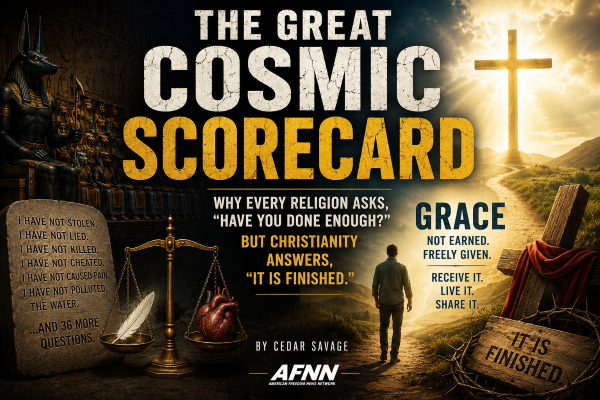
If you’ve tried everything else, try the one thing that isn’t just another version of you trying harder. Try grace. Try the One who actually knows you.
Someone once said life is short, but that’s not quite right. Life isn’t just short — it’s strategic. It’s the brief stage where humans decide whether they want to be restored imagers of God under Christ, or remain in rebellion with the powers who oppose Him.
Every year, right on schedule, someone announces that Christmas is “really pagan,” that Christians stole December 25, and therefore the celebration is tainted. This is what happens when people learn one fact, ignore ten others, and then build a personality around it.
Obviously, the Christian message about the Creator and Sovereign of the Universe sending part of himself to be human and experience his own creation is the hallmark of December.
Christians don’t need gimmicks to believe the Bible—but we do need to stop reading it like modern people who assume the universe is silent. The biblical authors didn’t.
“The people walking in darkness have seen a great light; on those living in the land of deep darkness a light has dawned.” (Isaiah 9:2)
Because we’re so zealous for righteousness, truth, and the truth of God’s Word, we can sometimes become somewhat smug, under the banner of the old adage, “Truth sounds like hate to those who hate the truth.”
My wife and I read aloud from our little Episcopal book, standing before our Advent candles, using solemn voices. The dogs were seated around our feet, trying to interpret our human words, listening closely for words like: “Ham.”
It was not a quiet holiday stroll, but a grueling, exhausting, emotionally heavy undertaking. And yet—they went. Not because it was convenient. Not because they understood everything. But because they trusted God more than their circumstances.
As a Christian, do you feel it’s important for us to reach the lost and perishing with God’s Word and truth? Should we be working to put forth truth, rather than letting deception run rampant in the hearts of our nation’s people — young and old?
Michael Heiser wrote What Does God Want? to bulldoze the religious clutter modern Christianity has wrapped around the gospel. Pastors padded it. Denominations complicated it. Church culture buried it.