In Their Own Words

JOHN—My angel story takes place when my wife was dying, and I watched everything go downhill in a matter of months. And every night, I would hear a voice tell me “You can get through this, John.”
Citizen Writers Fighting Censorship by Helping Americans Understand Issues Affecting the Republic.
JOHN—My angel story takes place when my wife was dying, and I watched everything go downhill in a matter of months. And every night, I would hear a voice tell me “You can get through this, John.”

It would appear that Virginia’s new Progressive governor, comrade Abigail Spanberger, want’s to turn her state into a clone of Minnesota, politically, culturally (return DEI policies) and, as an anti-American resource nearest to the seat of Americas power, Wash. DC.
TMZ founder Harvey Levin discusses the latest in the two week search for Nancy Guthrie on ‘Hannity.’
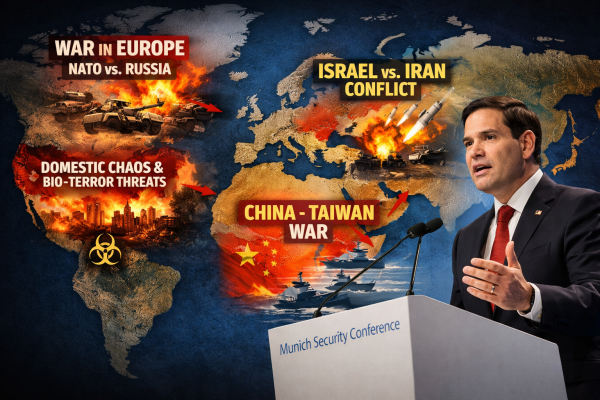
At the Munich Security Conference, Secretary of State Marco Rubio did something unusual in modern diplomacy: he told the truth politely. He reaffirmed America’s commitment to Europe, praised NATO, spoke warmly about shared history and civilization—and then, in effect, slid a note across the table that read: You’re going to have to handle more of your own business.

My Twitter — I refuse to call it 𝕏 — feed on Monday had been filled with complaints because His Holiness Pope Leo XIV held Mass yesterday at a diocesan church in Rome with, Heaven forfend! altar girls as well as altar boys. Some of the complaints were trivial, that the altar server on the …

Former federal prosecutor Andrew Cherkasky discusses Meta CEO Mark Zuckerberg’s landmark social media addiction trial on ‘Varney & Co.’

Weaponized immigration, or migration, as defined, is a term to describe a “hostile government organizing a sudden influx of refugees into a country with the intent of causing political disturbances.”

Yesterday we celebrated George Washington’s Birthday in honor of the first president. In 1879, it became an official holiday. Confused people illiterate about American history call it Presidents Day.

Samuel Huntington’s “Clash of Civilizations” is meeting Orwells’ “1984’ in the UK. Right now. Rupert Lowe’s brand new political party, Restore Britain, promises massive deportations. This is a time of choosing for the UK, the US, and Western Civilization.

‘The Big Money Show’ panel discusses Congress’s plan to tackle the nation’s housing crisis.

York City needs more affordable housing for its residents. Pushing private owners out will only make matters worse

Yeah, I believe in angels. I haven’t always. And sometimes I wish I didn’t believe. It would be easier not to.

This multi-part series has been examining the premise that the Democrat Party is a criminal enterprise.

TMZ founder Harvey Levin reveals new information into the latest letter the outlet has received from an individual claiming to know where Nancy Guthrie is, on ‘Hannity.’

That’s the part modern commentators miss when they wave away Balkan violence as “ancient hatreds.” These weren’t abstract grudges. They were lived systems. For centuries, the region was ruled by empires that never integrated their subjects into a shared civic identity. Catholic Croats looked west to Rome and Vienna. Orthodox Serbs looked east to Constantinople and Moscow. Muslim communities were tied to Ottoman structures. Religion wasn’t just belief; it was citizenship, law, and survival. Identity was not optional. It was inherited like debt.

Unleash Prosperity co-founder Stephen Moore assesses the state of the U.S. economy, new leadership at the Federal Reserve and more on ‘Maria Bartiromo’s Wall Street.’

Soon, the Supreme Court is expected to rule on President Trump’s use of IEEPA provisions in the creation of “reciprocal tariffs.” How they rule is at least in part based on a single question: Does the current state of the American economy constitute an “emergency?”

I will never understand the stupidity of voters who knowingly vote for a Socialist/Communist who increasingly populate the Democrat Party.

The wars of the future—and increasingly, the wars of the present—will not announce themselves with bombs and bullets. They will arrive as confusion, contradiction, outrage, and exhaustion. You won’t know when they start. You won’t know who started them. You won’t even agree with your neighbors on whether they’re happening at all.

Sen. John Hoeven, R-N.D., says the recent uptick in U.S. naval assets in the Middle East sends a ‘serious’ message to Iran’s Ayatollah Khamenei on ‘Fox Report.’