The Cost of Betrayal: When a Nation Turns on Its Volunteers

The trust between a nation and those who swear to defend it was fractured when the U.S. military separated 8,200 service members for refusing to comply with COVID-19 mandates
Citizen Writers Fighting Censorship by Helping Americans Understand Issues Affecting the Republic.
 David T. Cloft
The trust between a nation and those who swear to defend it was fractured when the U.S. military separated 8,200 service members for refusing to comply with COVID-19 mandates

In the timeless tale of Adam and Eve in the Garden of Eden, the pursuit of knowledge led to dire consequences. Driven by the desire to understand good and evil, they reached for the forbidden fruit.

For over 100 years, fly fishing has served not only as a sport but as a quiet, powerful form of therapy for veterans returning from war.

Putin’s positioning of Russia as a counterforce to Western liberal ideologies, as espoused by Dugin, reflects a broader geopolitical narrative of ideological competition and conflict.

Alexander the Great, born in 356 BC in Macedon, was one of the most successful military commanders in history.

Fellow Americans, we stand at the precipice of moral and spiritual decay, a fate worse than any foreign tyrant or invading army.

For decades, Americans have been told to change their oil every 3,000 to 5,000 miles. It’s been drilled into us by quick-lube shops, service stations, and manufacturers.

In a world where convenience and comfort are often just a tap away, it’s easy to forget the unimaginable hardships that shaped the lives of our ancestors. They lived through times when sacrifice wasn’t optional—it was expected.

In 1999, while most of the world moved on from the headlines about the Balkans, soldiers and peacekeepers stepped into a devastated land where the horrors of ethnic cleansing still hung in the air like smoke.

Evil, in its most harrowing form, emerges not as an external force but as a seed within humanity, capable of growing under the right conditions.

It doesn’t take much for civilization’s glossy veneer to crack. We like to think of ourselves as evolved, enlightened beings, but beneath the surface lies the same brutish, selfish creature we’ve been since Adam and Eve reached for the forbidden fruit.
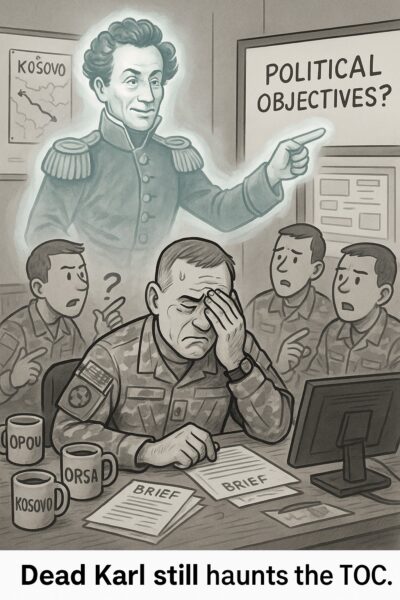
You can’t swing a laminated mission statement at CGSC without hitting a Clausewitz quote. And for good reason: the guy nailed it centuries ago. War isn’t just blowing stuff up—it’s blowing stuff up on purpose

When the Korean War ended in 1953, the world saw more than a ceasefire. It witnessed the opening shot in a new kind of war—one not fought with bullets and bombs, but with ideas, fear, confusion, and persuasion.

Hidden away in the remote wilderness of Gakona, Alaska, sits one of the most controversial research facilities in the world: the High-Frequency Active Auroral Research Program, better known as HAARP.

In our postmodern culture, where individuality and self-expression reign supreme, history has become a neglected casualty. Take, for instance, the skyrocketing popularity of tattoos and piercings.

War has always been defined by paradox: it is at once simple and impossibly hard. The fundamentals—move, shoot, communicate, sustain—are straightforward on paper.

The universe is not random but encoded with sacred geometry and mathematical laws that reflect the very nature of God.

In the year 2050, in the glorious gray sprawl of the United Socialist States of America, meat was illegal, cows were extinct (except for the one in the Smithsonian), and the only thing anyone had ever eaten was Bugpaste™

Rocks. In. My. Garden. Those demon-possessed geological freeloaders are multiplying faster than a college feminist studies major’s pronouns.

No one starts a war—or rather, no one in his senses ought to do so—without first being clear in his mind what he intends to achieve by that war and how he intends to conduct it.”
~Carl von Clausewitz