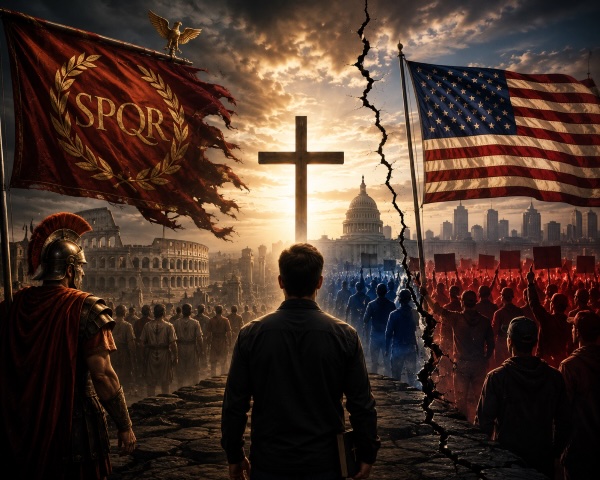
The Last Walk to Jerusalem
Did Jesus know where His journey to Jerusalem would lead? Yes! And He did it for you and me and for our “everlasting life!”
Citizen Writers Fighting Censorship by Helping Americans Understand Issues Affecting the Republic.
Did Jesus know where His journey to Jerusalem would lead? Yes! And He did it for you and me and for our “everlasting life!”
If you get 50% on a test, you fail. In marriage, 50% also equals failure, and not just the failure of one, but the failure of both partners, and then the failure of the marriage itself.
Cancel culture seeks justice through exclusion, but the gospel calls Christians to a better way.
Below the marble statues and museum mythology, the Greek and Roman “lesser gods” look suspiciously like something the Bible already warned us about: rebellious spiritual beings posing as divine authorities, corrupting humanity, and manufacturing a counterfeit religion of power, lust, blood, and “enlightenment.”
The Holy Spirit is like a child waiting for snow—unpredictable, quietly exciting, and full of promise that something ordinary is about to be changed by God.
I believe most people today are so caught up in the “material world,” the world we live in, see and experience, that we forget there’s a whole other realm out there — just as real as the material world, but one we, as human beings, are unable to see with our eyes. I’m talking about the spiritual realm.
The old preacher sipped his thermos of coffee, holding a fishing rod in the other hand. He asked what I wanted most in this life. I stared at the lake surface and told him I wanted peace. I was young, I came from a broken home. Peace was all I wanted.
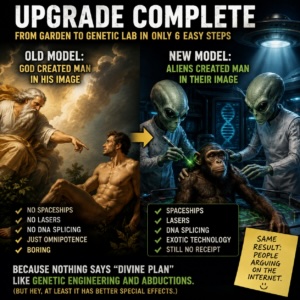
Words matter. UFO became UAP. Sightings became sensor data. Rumors became congressional hearings. And then came the most carefully engineered phrase yet: “non-human biologics.” That term didn’t exist to inform you—it exists to prepare you. It introduces a category without evidence, certainty without clarity, and authority without accountability. It tells your brain, “Accept the possibility first; we’ll define it later.” That’s not science. That’s narrative conditioning.
Winter cleaning, whether of our homes or our hearts, invites us to slow down, reflect honestly, and allow God to renew our hearts with grace.
One of the quiet tragedies of church history is not that Christians rejected the Bible, but that—at a critical moment—they reinterpreted it to survive cultural pressure. Instead of allowing Scripture to challenge the assumptions of the age, parts of the Church chose to soften the Bible’s worldview so it would sound reasonable to the world it was trying to convert. Over time, that accommodation didn’t just adjust emphasis; it changed how entire passages were understood.
Before the World Was Soft Civilization did not create the warrior brain. Civilization survived because of it. Long before laws, courts, or polite abstractions about peace, human beings existed in a world where violence was not exceptional—it was routine. Hunger, predators, rival tribes, and scarcity were constant pressures. The human nervous system evolved not to be calm, but to be ready.
The cited article below comes from The Irish Times, published in Dublin, and what passes for the only newspaper of record in that heavily Catholic country. Of course, that heavily Catholic country has also legalized homosexual marriage and prenatal infanticide, so . . . . Sunday, January 11, 2026, is in the calendar of …
January may feel like a long, cold stretch of waiting, but God uses these ordinary, in-between times to shape our faith, deepen our trust, and remind us that He is just as present in the January gloom as He was in the December joy.
Help us to love one another. Help us to find beauty in each fellow human being. Beauty within each soul who crosses our path today. Teach us to find beauty in our enemies.
For most of human history, speech was a permission, not a right. Kings, emperors, churches, and councils decided what could be said, written, or taught—and dissent was treated as disorder. The idea that ordinary people could openly criticize power was not just discouraged; it was dangerous.
Epiphany celebrates Christ’s revelation to all people through the worship of the magi, reminding us that Jesus is revealed beyond tradition and history and still calls us today to seek Him, recognize His presence, and be transformed by worship.
The week between Christmas and the New Year invites us to use these quiet days between to slow down, reflect, and rest in the presence of the Lord through stillness, scripture, and trust in His guidance.
Most people think war looks like explosions, uniforms, and some guy yelling into a radio while things burn. That’s Hollywood.
Real wars—the ones that stick—are usually won before anyone pulls a trigger.
Every few years, somebody dusts off that 2007 YouTube-special “documentary” Zeitgeist like it’s forbidden knowledge smuggled out of the Vatican basement.
The story of Christmas is, at its heart, the story of God’s love. It is the story of a Creator who loved His people so deeply that He could not leave us lost and separated from Him.