The Dollar Isn’t Backed by Gold — It’s Backed by DIME and a Carrier Strike Group

Let’s retire the fairy tales.

The U.S. dollar is not backed by gold. It’s not backed by “faith.” It’s not backed by vibes. It’s backed by power — specifically the kind of power that sails in carrier strike groups, negotiates trade deals, controls sea lanes, writes sanctions law, insures shipping, and can ruin your economy before your stock market even opens.

Using the Veil of Religion to Advance Tyranny

We are in a war in which our enemies use the veil of religion to seize power. Few understand this war in which past losses resulted in hundreds of millions of innocents being murdered, tortured, imprisoned or living for decades to centuries under tyranny. The use of religion to seize power is ancient in concept – and often uses one of two approaches. One is to attack or vilify a religion to advance tyranny. The other, to use the veil of religion to hide insidious efforts to advance tyranny. The genius (and danger) in using religion, in this perpetual cognitive war, is its subtlety. There are no tanks in the streets. Rather, memes, sermons, rhetoric, and false narratives and manufactured victims are employed using our cognitive biases (e.g., emotion, moral outrage) that erode shared reality over time.

Verdun with Drones: How the Future of War Looks Suspiciously Like 1916

We were promised glide paths into a frictionless era of war. Precision would replace mass. Networks would replace mud. Information dominance would compress decision cycles so tightly that victory would arrive before the coffee cooled. Instead, the war in Ukraine settled into trenches, minefields, artillery duels, and casualty math that feels uncomfortably familiar to anyone who’s ever read about 1916. The aesthetic is pure World War I, except now every trench has a charging cable.

World War III Watch: Maybe This Wasn’t the Best Idea

No, I don’t think this will result in World War III, despite my headline and stock illustration, but wars do not always turn out quite the way you expect. Der Führer certainly didn’t expect Germany to have been virtually destroyed, Hideki Tojo did not expect Japan to be utterly defeated and bombed to smoking ruins, …

Read more

Why Christians Feel Obligated to Defend Israel—and Why the Bible Never Commands It

There is a quiet anxiety baked into much of modern American Christianity: if you don’t support Israel—always, loudly, and without qualification—God might notice. Entire churches treat Israeli foreign policy as a third sacrament. Question a settlement policy or a military response and someone will reach for Genesis 12 like it’s a theological panic button. This fear wears the costume of faith, but it isn’t biblical. It’s superstition with a study Bible.

“The 51st Star We Never Voted On: How Israel Became America’s Problem Child”

Let’s dispense with the polite fiction. The United States has 50 states on paper and one premium subscription state overseas that gets all the benefits with none of the awkward obligations like paying federal taxes or pretending to listen to Washington. Welcome to Israel, America’s unofficial 51st state — the only one close enough to lecture Congress but far enough away that we pretend it’s “just an ally.”

From Garand to AR-15: When Service Rifles Stopped Belonging to the Nation and Started Belonging to Lawyers

When the M1 went ashore in Normandy, no one wondered who owned the blueprints. When the M16 went to Vietnam, arguments over chrome lining, ammunition specifications, and intellectual property simmered behind the scenes. The rifle itself became entangled in acquisition disputes and contract language. Even improvements—like later A2 modifications—unfolded within a world shaped by lawyers as much as logisticians.

Since 1942, the United States Has Been Going to War Illegally — and Everyone Pretends That’s Fine

Enter the War Powers Resolution — Congress’s attempt to look relevant after Vietnam without actually reclaiming its authority. The War Powers Resolution is often defended as a guardrail. In reality, it’s a constitutional fig leaf stapled to a surrender note.

Acorns, Aggression, and Melanin: Why the Black Squirrels Run Northern Michigan

If NATO ever needs a real-world case study in territorial conflict, dominance hierarchies, and cold-weather logistics, they can skip the war colleges and simply hang a bird feeder in northeastern Michigan. Within hours, it becomes a contested supply hub. Within days, a full-blown squirrel conflict emerges—predictable, ruthless, and strangely educational.

The Battlefield Moved, Humans Didn’t: Why a 1930s Historian Still Understands Modern War Better Than We Do

Nearly a hundred years ago, Sir Herbert Butterfield sat down and committed the unforgivable sin of telling historians, strategists, and polite academics something they still hate hearing today: war is not a clean system. It is not a spreadsheet problem. It is not solved by better charts, prettier maps, or a PowerPoint deck with the right color palette. War—every war—boils down to frightened human beings trying to reconcile self-preservation, honor, faith, and meaning while other frightened human beings try to kill them.

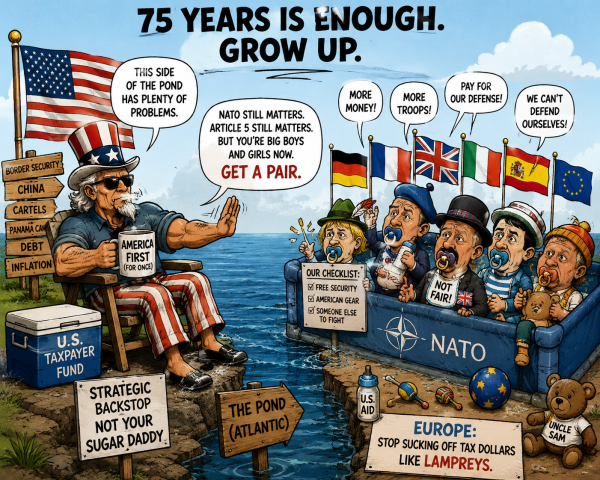
Four Fires, One Ally With a Hose: Why NATO Has to Grow Up So America Can Survive

At the Munich Security Conference, Secretary of State Marco Rubio did something unusual in modern diplomacy: he told the truth politely. He reaffirmed America’s commitment to Europe, praised NATO, spoke warmly about shared history and civilization—and then, in effect, slid a note across the table that read: You’re going to have to handle more of your own business.

The Academy That Wanted to Be Ivy League: West Point, Rankings, and the Cost of Forgetting War

West Point does not need to be Harvard. America already has Harvard. What it needs—what it has always needed—is an academy singularly focused on producing officers whose primary purpose is to close with and destroy the enemy.

From Scorched Earth to Empty Shelves: How Some Wars Are Fought Without Firing a Shot

Future wars won’t thunder across borders on tanks or scream overhead in fighter jets. That’s old-fashioned, noisy, and—worst of all—obvious. The next wars will arrive quietly, wearing lab coats, carrying clipboards, and insisting it’s “just a naturally occurring disruption.” No explosions. No declarations. Just empty shelves, euthanized livestock, and a government spokesperson calmly reminding you that there is no evidence of foul play at this time.

Educated to Destroy: The Rise of the College-Trained Wrecking Class

For decades, political science was the academic punchline—the major you picked when calculus broke you, engineering filtered you out, and chemistry made you cry. Everyone knew the line: If you can’t do anything else, go poli-sci. Parents nodded approvingly because “college is good for you,” administrators cashed tuition checks, and students emerged four years later fluent in theory, jargon, and grievance—but functionally incapable of building, fixing, or running anything in the real world. What no one admitted at the time was that political science didn’t just produce underemployed graduates; it quietly trained a generation in how to dismantle systems they never understood and could never rebuild.

Color Revolution Phase 2: Barking in the Streets for a Hunter You’ll Never See

Phase 2 of a color revolution is the “streets on fire” phase. It looks organic. It feels spontaneous. It’s loud, chaotic, righteous, and emotionally intoxicating. This is where the dogs flood the streets. Students, activists, professional grievance collectors, and social-media revolutionaries with ring lights and Venmo links all sprint after the same thing: meaning.

Civil War 2; The Gathering Storm

Resorting to familiar attacks against President Trump, Tim Walz repeatedly declares Minnesota is at “war against the federal government.” Other posts diagnose Walz as, “This lunatic is SICK and DANGEROUS!” I have a question for the bellicose, belligerent spewer of anti-American words and defender of criminals, “Exactly who was criminally liable for being at war …

Read more

Concrete Mushrooms, Mandatory Fitness, and Manufactured Fear: Albania’s Paranoid Inheritance

Concrete mushrooms were everywhere.

They sat in fields, along roads, on hillsides, near villages, even edging farmland—small, dome-shaped bunkers of reinforced concrete, half-buried and impossible to ignore. At first, they looked defensive. After a while, they felt like something else entirely: fear made permanent.